

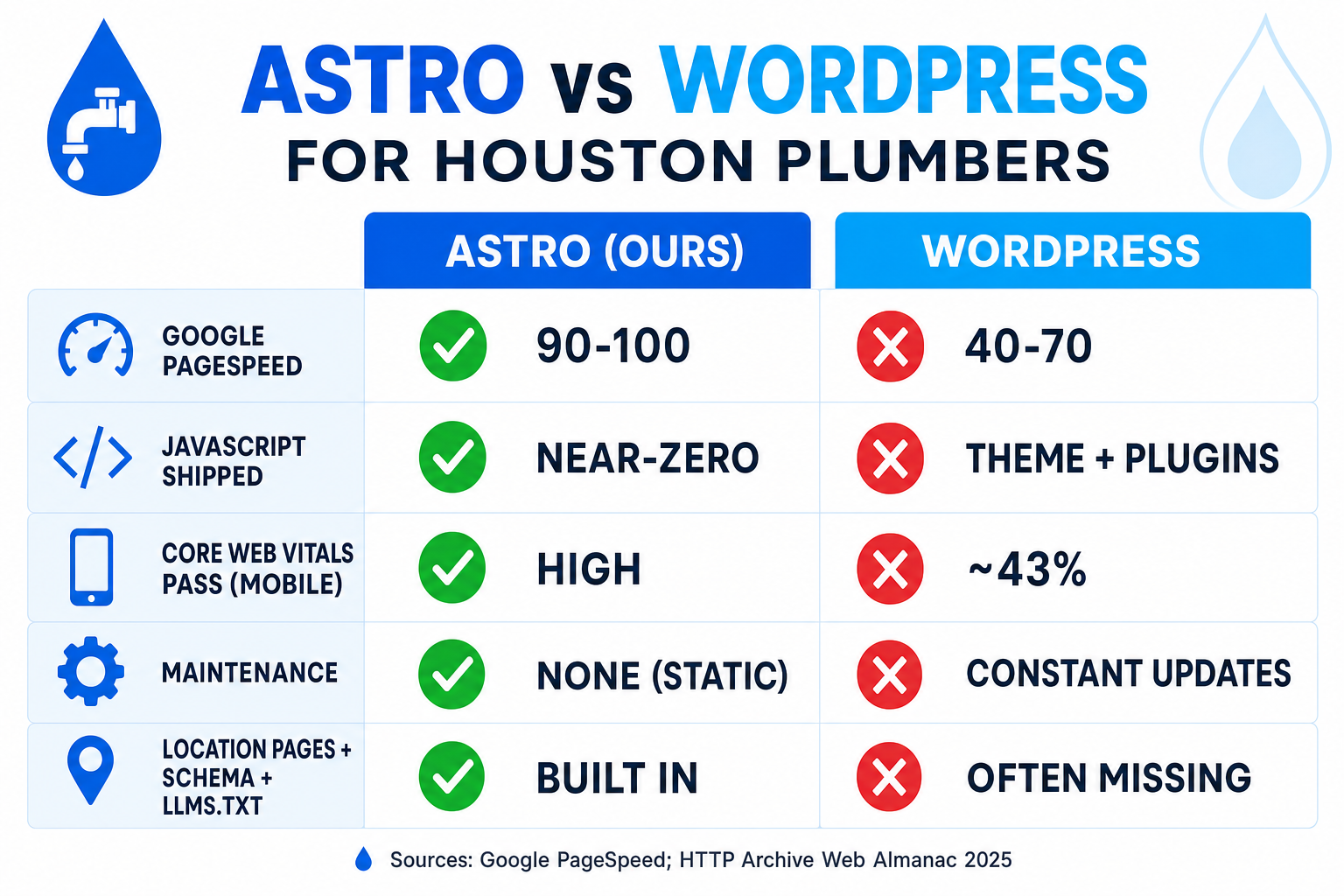
For a Houston plumbing contractor, an Astro-built website beats a typical WordPress site on the one metric that actually books jobs — speed. Astro ships static-first HTML with almost no JavaScript, so it hits a 90+ Google PageSpeed score by default; a plumbing site built on WordPress usually lands at 40–70 because page builders and stacked plugins bloat every page. That gap matters because 53% of mobile visitors abandon a page that takes longer than three seconds to load (Google) — and a Houston homeowner staring at a burst supply line at 2 a.m. is on a phone, in a hurry, and one tap from the next plumber on the map. This is the head-to-head: where each platform wins, why speed decides the emergency call, and what the difference is worth in booked work.
In this guide
- The short answer: Astro or WordPress for a Houston plumber?
- Why website speed decides who gets the Houston emergency call
- Astro vs WordPress: the head-to-head
- Where WordPress slows a plumbing site down
- What Astro does differently
- Speed is money: what a faster Houston site is worth
- “Can’t I just add a caching plugin to WordPress?”
- Does speed actually help you rank in Houston?
- The done-for-you path: an Astro plumbing site
- Frequently asked questions
- About the author
- Related reading
The short answer: Astro or WordPress for a Houston plumber?
If your website’s job is to turn a “plumber near me” search into a ringing phone, Astro is the better foundation for a Houston plumbing shop, and speed is why. WordPress is a powerful, flexible CMS — it runs more than 40% of all websites (W3Techs) — but that flexibility comes from themes, page builders, and plugins that each add weight to every page a homeowner loads. Astro takes the opposite approach: it renders your pages to plain static HTML at build time and ships almost no JavaScript, so the page paints fast on a phone the instant it’s requested.
The distinction isn’t academic for a service trade. Your buyers rarely browse — they search in a moment of need (a slab leak, no hot water, a backed-up main), tap the top local result, and decide in seconds whether to call or hit “back.” On that decision, milliseconds are money. WordPress can be tuned to load fast, but it rarely arrives that way and rarely stays that way as plugins pile up. Astro is fast because of how it’s built, not because someone remembered to optimize it. For a plumbing operator who wants a site that ranks and converts without babysitting, that default matters more than any feature checkbox.
Homeowners don’t grade your website — they abandon it. A Houston plumber doesn’t need a prettier site than the shop across town; they need the one that loads before the panicked customer taps away. That’s a speed problem, and speed is an architecture decision you make once.
Why website speed decides who gets the Houston emergency call
Houston is a big, humid, older-housing market where plumbing emergencies are a nightly occurrence — foundation shifts crack supply lines, summer storms overwhelm drains, and aging water heaters give out. When one hits, the homeowner does the same thing everyone does now: pulls out a phone and searches. 76% of people who search for something nearby on a smartphone visit a related business within a day, and 28% of those local searches end in a purchase (Think with Google). The intent is there. The only question is whether your page loads before their patience runs out.
The data on that patience is brutal and consistent. Google found that 53% of mobile site visits are abandoned if a page takes longer than three seconds to load (Google). And it’s not a cliff at three seconds — it’s a slope the whole way down. Google’s machine-learning analysis of real mobile data showed the probability that a visitor bounces climbs steadily as pages slow:
Increase in the probability a mobile visitor bounces as page load time grows. Source: Think with Google / SOASTA — Mobile page speed benchmarks.
Read that against a plumbing emergency. A WordPress site that limps in at 5–6 seconds on a mid-tier phone on a Houston cell network has roughly double the bounce risk of a 1-second Astro page. Every one of those bounces is a homeowner who dialed the next result — and in the emergency segment, that lost click was a same-day water-heater swap, a repipe, or a sewer job. This is the exact leak the rest of the Plumbing Snapshot system is built to close after the call comes in; a fast website makes sure the call comes in at all.
Astro vs WordPress: the head-to-head
Here is the practical comparison for a plumbing website — not a developer’s feature war, but the things that decide whether you get the Houston call and rank for it.
| What matters for a plumbing site | Astro (static-first) | WordPress (typical build) |
|---|---|---|
| Google PageSpeed (mobile) | 90–100 by default | Commonly 40–70 |
| How pages are served | Pre-built static HTML from the edge | PHP renders on each request + plugins |
| JavaScript shipped | Near-zero; interactive bits only | Theme + builder + plugin JS on every page |
| Core Web Vitals pass rate | High (static, light pages) | ~43% of sites pass on mobile |
| Ongoing maintenance | No plugins to update or break | Constant plugin/theme/security updates |
| Security surface | Static files — little to attack | Plugins are the #1 attack vector |
| Location/city pages, schema, llms.txt | Built in, structured for AEO/GEO | Add-ons, often missing or misconfigured |
| Hosting | Global CDN edge (e.g. Cloudflare) | Shared/managed PHP host |
The pattern is consistent: Astro’s defaults are the outcomes a plumbing marketer wants, while WordPress’s defaults are the things that slow a site and cost you calls. The clearest single number comes from real-world field data. The HTTP Archive Web Almanac 2025, which measures actual Core Web Vitals across millions of live sites, found WordPress passes all Core Web Vitals on only about 43% of mobile sites — near the bottom of the major platforms — while the fastest modern platforms pass at nearly double that rate.
Share of mobile sites passing all three Core Web Vitals, by platform. Source: HTTP Archive — Web Almanac 2025, Performance (real-user CrUX data).
Where WordPress slows a plumbing site down
WordPress isn’t slow because it’s badly made — it’s slow because of how most plumbing sites end up built on it. Three things compound:
- Page builders. Elementor, Divi, WPBakery and friends make editing easy for non-developers, but they inject heavy CSS and JavaScript into every page. A simple “Water Heater Repair in Houston” page can ship hundreds of kilobytes of builder overhead the homeowner’s phone has to download and parse before your phone number even appears.
- Plugin stacking. Need a contact form, a review widget, a booking calendar, SEO tools, a chat box, and a slider? That’s six plugins, each with its own scripts and styles loading site-wide — plus six things to keep updated and secure. Plugins are also the leading source of WordPress vulnerabilities, so the bloat is a security bill too.
- Server-rendered PHP + shared hosting. Every WordPress page is assembled on the fly by PHP hitting a database, then cached (if configured well) and served from a single origin server. On the budget hosting most local shops use, that first render is where the seconds pile up — especially on mobile connections across a metro as large as Houston.
None of these are unfixable, but fixing them is a permanent job. You’re forever chasing a caching config, pruning plugins, and re-testing PageSpeed after every update. For a shop whose owner should be running trucks — not tuning a CMS — that’s the wrong place to spend attention.
What Astro does differently
Astro is a modern web framework built around one idea that happens to be perfect for a plumbing site: ship the least possible to the browser. At build time, Astro renders every page — home, each service, each Houston-area location page — into plain, finished HTML. There’s no page builder to run in the visitor’s browser and, by default, no JavaScript framework loading on pages that don’t need it. Interactive pieces (a chat widget, a booking form) are added as small, isolated “islands” that load only where used, instead of dragging a heavy runtime onto every page.
That architecture is why a well-built Astro site earns a 90+ PageSpeed score as its normal state, often a perfect 100, on both mobile and desktop. Serve those static files from a global edge network like Cloudflare and the page starts painting in a few hundred milliseconds no matter where in greater Houston the homeowner is standing. Structured data, clean meta, a correct sitemap, robots.txt, and an llms.txt file for AI answer engines are baked in — the AEO/GEO groundwork that helps you show up both in Google’s map pack and in an AI Overview when someone asks “who fixes a burst pipe near me?” That’s exactly how our done-for-you plumbing website is built.
The best part of a static Astro site is what it doesn’t do. No plugin updates at midnight, no builder bloat, no PHP timeout when three Houston storms drive traffic at once. It’s a fast page that stays fast — which is the only kind of page that reliably converts an emergency search.
Speed is money: what a faster Houston site is worth
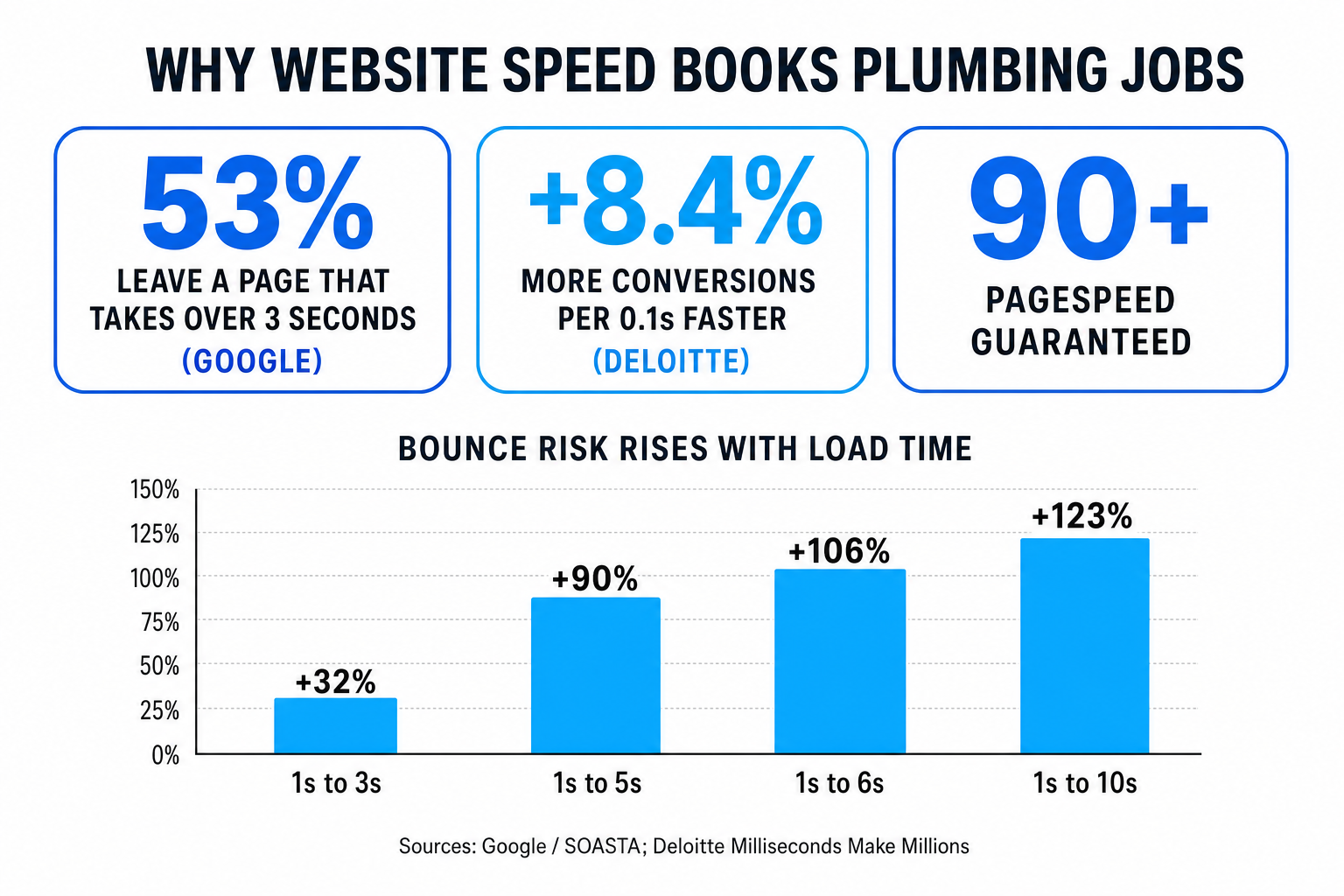
The speed argument only matters if it shows up in booked jobs — and it does. The most cited study here is Deloitte’s Milliseconds Make Millions, which analyzed 30 million-plus user sessions and found that a mere 0.1-second improvement in mobile site speed lifted retail conversion rates by 8.4% and average order value by 9.2%; for lead-generation sites specifically, the same speed bump cut bounce rates (Deloitte / web.dev). A plumbing website is a lead-gen site — its conversion is a booked call.
Portent’s analysis of 100 million-plus page views put a slope on it: conversion rate drops an average of 4.42% with every additional second of load time between seconds 0 and 5, and a site that loads in one second converts far better than one that loads in five (Portent). Now put Houston numbers on it. Say your fast site gets 400 mobile visitors a month from local search. If shaving your load time from a WordPress-typical 5 seconds to an Astro-typical 1 second recovers even a handful of the visitors who would have bounced, and one of them books a $2,000 water-heater install or a $7,000 repipe, the site has paid for a year of itself in a single job. Speed isn’t a vanity score — it’s the difference between a visitor who calls and a visitor who’s already dialing your competitor.
“Can’t I just add a caching plugin to WordPress?”
You can, and you should if you’re staying on WordPress — but understand what a caching plugin does and doesn’t fix. Caching helps the server return a page faster by storing a pre-built copy. It does not remove the JavaScript and CSS that a page builder and a dozen plugins force the visitor’s phone to download, parse, and execute. That client-side work is a big part of what tanks mobile Core Web Vitals, and it’s exactly what Astro avoids by not shipping the bloat in the first place.
In practice, taking a plugin-heavy WordPress plumbing site from a 45 to a genuine 90+ mobile PageSpeed is real, ongoing engineering: auditing plugins, deferring scripts, optimizing images, configuring caching and a CDN, and re-testing after every WordPress or plugin update forever. It’s doable for a specialist. It is not a checkbox, and it’s not free. With Astro, 90+ is where you start — and it stays there because there’s no plugin stack to regress it. For most plumbing shops, the honest math favors starting on the fast platform instead of perpetually rescuing a slow one.
Does speed actually help you rank in Houston?
Yes — with an honest caveat. Google confirms that page experience, which includes Core Web Vitals (LCP, INP, CLS), is used by its ranking systems (Google Search Central). It’s a real signal, but a light one: Google is clear that “a great page experience doesn’t override having great, relevant content,” and speed mostly acts as a tie-breaker between pages of otherwise similar relevance (Google — Core Web Vitals & Search).
For a Houston plumber, that tie-breaker is worth a lot. Local search is crowded — dozens of shops chase the same “emergency plumber Houston” and “water heater repair near me” queries. When your content, reviews, and local SEO are competitive with the shop ranked next to you, a faster site can be the nudge that puts you above them. And ranking is only half the win: even if two sites rank side by side, the faster one converts more of the clicks it earns. Speed compounds — it helps you show up, and it helps you close. That’s the whole reason a fast foundation beats a slow one you’re perpetually patching.
The done-for-you path: an Astro plumbing site
If you’re a Houston plumbing operator weighing this, the takeaway is simple: you don’t need to become a web developer to get a fast site — you need a fast site built for you. That’s exactly what our Get a Website service delivers. We build blazing-fast plumbing sites on the Astro framework with a guaranteed 90+ Google PageSpeed (often a perfect 100), up to 60 pages including individually optimized Houston-area location pages, schema plus AEO/GEO structure, a clean sitemap/robots/llms.txt, an AI chat widget, review automation, and managed Cloudflare hosting — for $497 one-time + $97/month, live in about 10 working days. The monthly covers hosting, your domain, SSL, and up to 10 change tickets, so you’re never billed by the hour for a one-line edit again.
Frequently asked questions
Is Astro better than WordPress for a plumbing website?
For most plumbing shops, yes — because a plumbing site's job is to load fast on a phone and convert an emergency search into a call. Astro renders static HTML with almost no JavaScript and hits a 90+ Google PageSpeed score by default, while a typical WordPress plumbing site (theme + page builder + plugins) commonly scores 40–70 and passes Core Web Vitals on only about 43% of mobile sites. WordPress is more flexible and has a bigger plugin ecosystem, but for speed, low maintenance, and local-SEO structure, Astro is the stronger foundation.
How much faster is an Astro site than WordPress?
It depends on the specific build, but the practical gap is large. Astro ships pre-built static pages from a CDN edge with near-zero client-side JavaScript, so it routinely earns 90–100 PageSpeed on mobile. Plugin-heavy WordPress sites commonly land at 40–70 because builders and plugins force the visitor's phone to download and run a lot of code. In real-world field data, WordPress passes all Core Web Vitals on only ~43% of mobile sites versus nearly double that for the fastest modern platforms.
Why does website speed matter so much for a Houston plumber?
Because your customers search mid-emergency on a phone and decide in seconds. Google found 53% of mobile visits are abandoned if a page takes over 3 seconds to load, and the odds of a bounce rise about 90% as load time goes from 1 to 5 seconds. In a competitive market like Houston, a slow page means the panicked homeowner taps back and calls the next plumber — a lost same-day water heater, drain, or repipe job.
Can't I just make my WordPress site fast with a caching plugin?
Caching helps the server return pages faster, but it doesn't remove the JavaScript and CSS that page builders and plugins force onto the visitor's browser — and that client-side bloat is what tanks mobile Core Web Vitals. Getting a plugin-heavy WordPress site to a genuine 90+ mobile PageSpeed is real, ongoing engineering that regresses every time you add or update a plugin. With Astro, 90+ is the starting point and it stays there because there's no plugin stack to slow it down.
Does a faster website actually help me rank on Google?
Yes, but it's a light signal. Google confirms Core Web Vitals feed its page-experience ranking systems, acting mainly as a tie-breaker between pages of similar relevance — it won't outrank genuinely better content on its own. For a crowded market like Houston, that tie-breaker is valuable: when your content and reviews are competitive, a faster site can nudge you above a rival, and it converts more of the clicks you already earn.
What does a done-for-you Astro plumbing website cost?
Our Get a Website service is $497 one-time plus $97/month. The one-time build covers up to 60 pages including Houston-area location pages, schema/AEO/GEO, sitemap/robots/llms.txt, an AI chat widget, and review automation, all on the Astro framework with a guaranteed 90+ PageSpeed. The $97/month covers managed Cloudflare hosting, your domain, SSL, and up to 10 change tickets — no per-edit agency fees. Most sites go live in about 10 working days.
About the author
Tyler Brennan is the Compliance & Conversion Editor for Plumbing Snapshot for GHL, based in Columbus, OH. He started in field-service marketing writing Google Ads for drain and sewer specialists, then moved into the unglamorous, essential side of the funnel: making landing pages and SMS flows both convert and stay compliant. He pressure-tests every page and message against the homeowner’s patience and the law, and he writes conversion and technical guidance as checklists a busy plumbing operator can actually follow.
Related reading
- Local SEO for Plumbers: Rank in the Google Map Pack — the location-page and Map Pack playbook a fast site amplifies.
- How to Get More Plumbing Leads — the channels that feed your fast new website.
- Missed-Call Text-Back for Plumbers — catch the callers a fast site sends you when you can’t pick up.
- GoHighLevel for Plumbers — the full automation system behind the site.
- Get a Website — a done-for-you Astro plumbing site, 90+ PageSpeed guaranteed.