

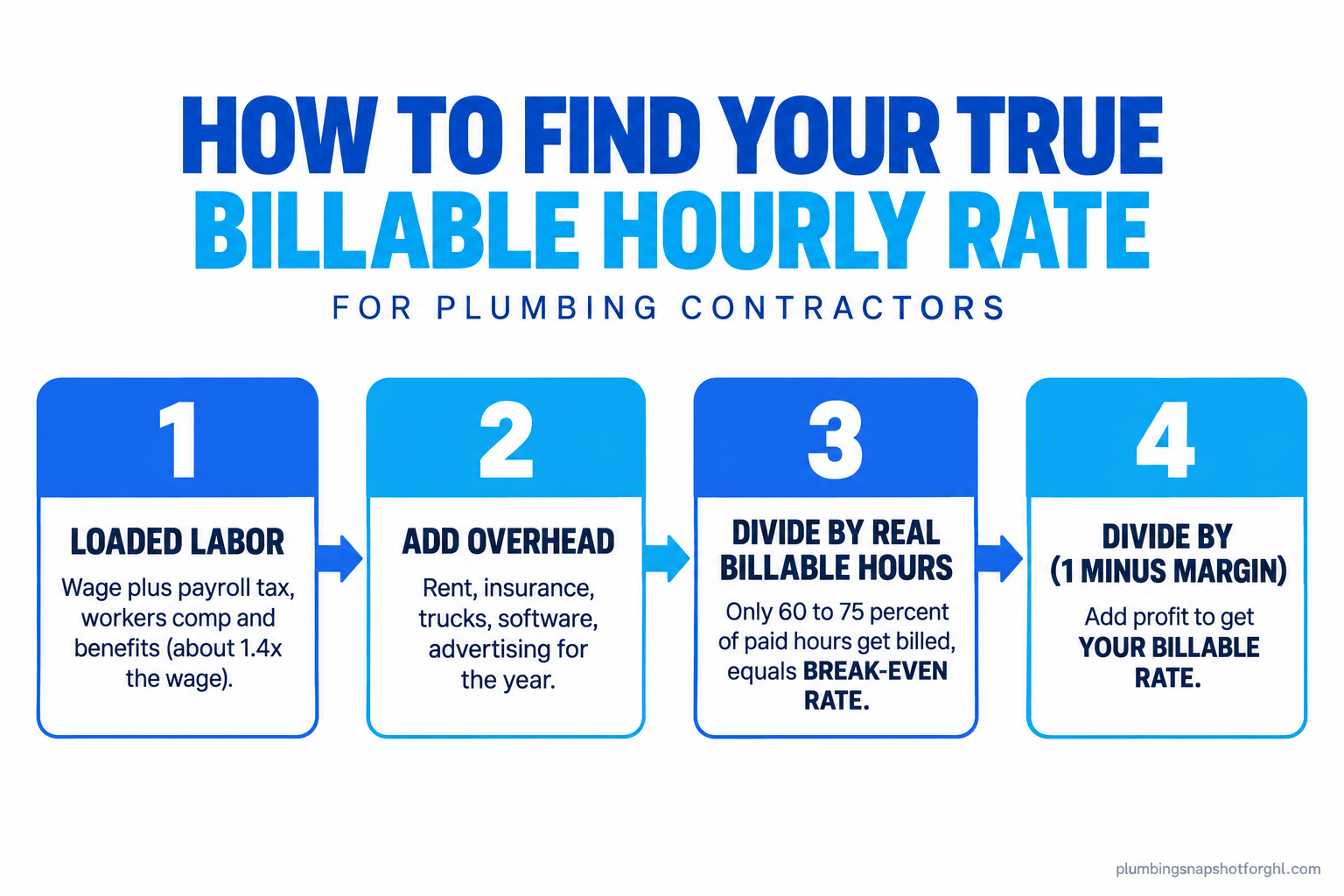
It’s a Tuesday and a customer asks the question every plumber hears: “What’s your hourly rate?” You say a number. Maybe $125. Maybe $150 because the last guy who quit said that’s what the shop across town charges. Here’s the uncomfortable part: most owners have no idea whether that number covers their costs, let alone leaves a profit. Your hourly rate is not a market guess. It is a math problem with one right answer for your shop, built from four of your own numbers: loaded labor cost, overhead, real billable hours, and the profit you want to keep.
In this guide
- The number almost every plumber gets wrong
- Billable rate vs flat rate: what you are actually solving
- Step 1: Add up your true loaded labor cost
- Step 2: Count your overhead honestly
- Step 3: Find your real billable hours
- Step 4: Calculate your break-even rate
- Step 5: Add profit without the markup trap
- Step 6: Pressure-test against the market
- Solo, 5-truck, and 12-truck: three worked answers
- Steal this: the one-page rate worksheet
- Keep it legal and transparent
- Objections, answered straight
- Frequently asked questions
The number almost every plumber gets wrong
Labor is your biggest lever and your biggest cost. The median plumber wage is $62,970 a year, about $30.27 an hour (U.S. Bureau of Labor Statistics, May 2024), and the trade is still growing, projected up 4 percent from 2024 to 2034. That wage is what a tech takes home. It is not what the tech costs you, and it is nowhere near what an hour of that time has to sell for.
When your rate is a guess, the damage never shows up as a lost job. It shows up as a booked job that earned a few hundred dollars less than it should have, over and over, all year. A shop running 1,200 billable hours underpriced by $20 an hour hands back $24,000 and calls it busy.
And the work is not small-ticket. Water damage and freezing claims average $13,954 and account for 27.6 percent of all homeowners insurance claims, with roughly one in 60 insured homes filing one each year (Insurance Information Institute, 2018 to 2022 data). A homeowner standing over a failing water heater wants a plumber who sounds like they know their own number. A confident, correct rate wins that call. A number pulled out of thin air loses it twice: once at the quote, and again on your P&L.
Billable rate vs flat rate: what you are actually solving
Quick clarification, because these get mixed up. Your billable hourly rate is the internal number an hour of sold labor must earn to cover costs and profit. Your customers may never see it. Flat-rate pricing is how you present jobs, one fixed price per task, built on top of that hourly number.
You need the hourly rate first. It is the engine. Once you have it, you turn it into per-job prices, a separate build covered in our guide to building a flat-rate price book. This article gets the engine right, in six steps, each with the place it quietly breaks.
Step 1: Add up your true loaded labor cost
Start with what a tech actually costs per hour, not what they take home. On top of the wage you pay the employer side of Social Security and Medicare, federal and state unemployment, workers’ compensation (steep in the trades), plus any health, retirement, and paid time off.
Rule of thumb: loaded labor runs 1.25 to 1.4 times the base wage. A tech at $30 an hour usually costs around $42 all-in. Don’t estimate the burden if you can pull it: your payroll provider reports the real employer-paid total per employee.
Step 2: Count your overhead honestly
Overhead is everything that keeps the lights on whether or not a truck rolls: rent, office and dispatch pay, business insurance, software, phones, advertising, accounting, truck payments, fuel, and tools. It does not include the billable techs’ wages (that was Step 1) or the parts you resell on a job.
Pull last year’s profit-and-loss statement and total these lines for the whole year. One number. No clean P&L yet? Add up twelve months of bank statements by category. Use real spending, not a guess, because overhead is usually bigger than owners think once fuel, software, and insurance are all on one page.
Step 3: Find your real billable hours
This is the step that wrecks the most shops, and the one nobody wants to do. A full-time tech is paid for about 2,080 hours a year. They do not bill 2,080. Between drive time, restocking, warranty callbacks, meetings, training, and the gaps between calls, a lot of paid time never lands on an invoice.
Well-run plumbing shops bill roughly 60 to 75 percent of paid hours (Fieldproxy), and time-tracking data puts the service-business average closer to 55 to 60 percent (Harvest). So a tech paid for 2,080 hours realistically bills 1,150 to 1,550. A solo owner who also runs the office can drop closer to 1,000.
Here is why it matters. Take a fixed cost base of $115,000 (one owner-operator plus overhead) and watch the break-even rate climb as billable hours fall:
Break-even hourly rate on a fixed $115,000 cost base, as annual billable hours fall. Illustrative calculation using the break-even formula below.
Same costs. Nothing changed except how many hours you actually bill, and the rate you need nearly doubled. This is why two shops with identical trucks and wages can need wildly different rates, and why “charge what they charge” is a good way to go broke.
Step 4: Calculate your break-even rate
Now you have all three inputs. The break-even rate is the hourly number that covers every dollar you spend, with zero profit on top (ServiceTitan):
Break-even rate = (loaded labor + overhead) / total billable hours
Say you run three techs. Loaded labor across the three is $264,000, overhead is $186,000, and they bill 1,250 hours each, so 3,750 billable hours total. That is ($264,000 + $186,000) / 3,750 = $120 an hour. At $120 you pay every bill and keep nothing. Charge a dollar less and you are funding your customers’ plumbing out of pocket.
Free labor-rate calculators exist if you want one, but pulling your own real numbers is the part that actually matters.
Step 5: Add profit without the markup trap
Break-even keeps the doors open. Profit is why you own the business, so the last move is to lift your rate above break-even to hit a target net margin. Well-run plumbing shops aim for 10 to 20 percent net profit, while the industry median sits lower, often in single digits. That gap is exactly what good pricing closes (Projul).
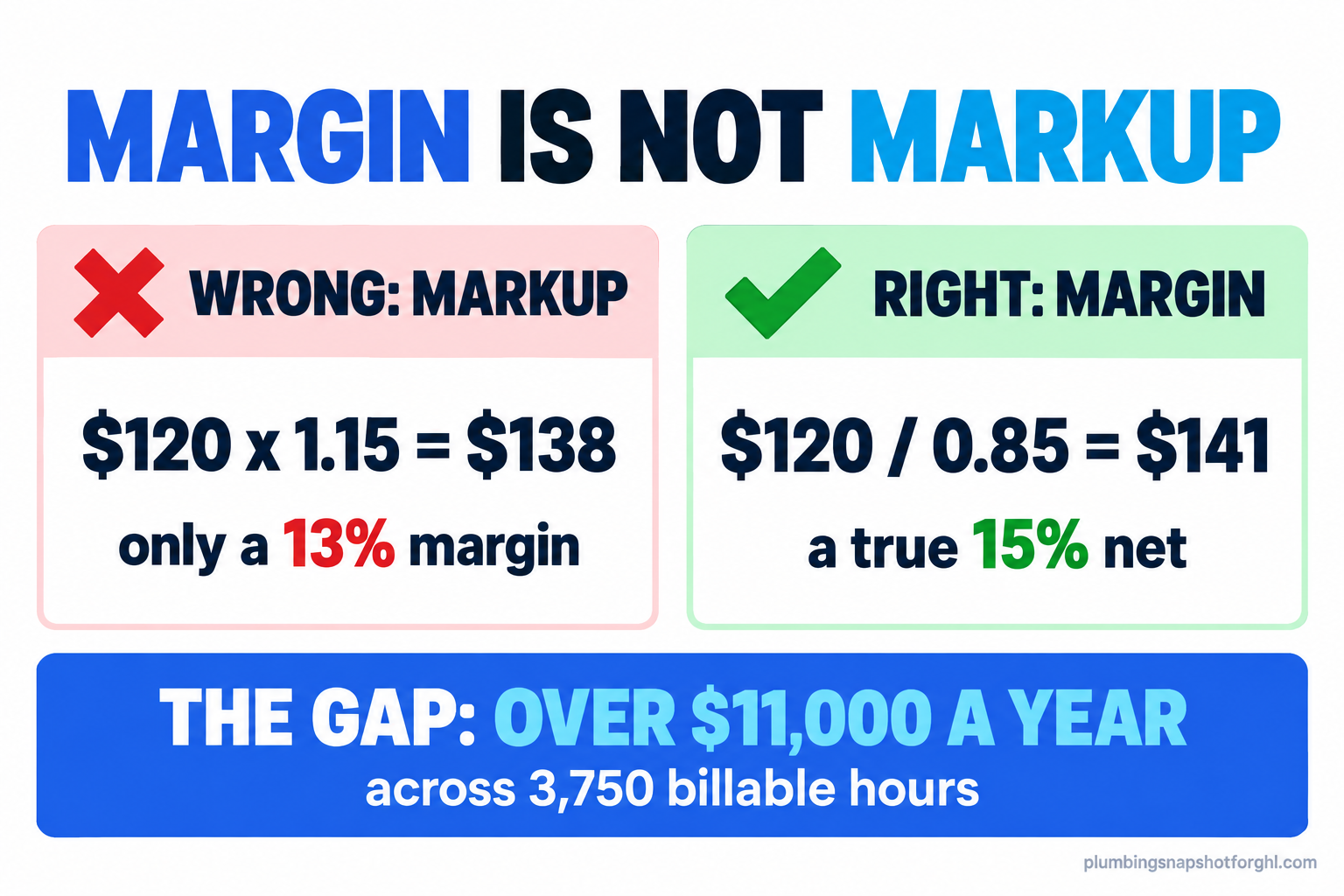
Here is the trap that costs shops real money. To keep 15 percent of the final price as profit, you do not multiply break-even by 1.15. You divide by 0.85 (ServiceTitan).
- Wrong (markup): $120 x 1.15 = $138. Your actual margin is only about 13 percent.
- Right (margin): $120 / 0.85 = $141. A true 15 percent net.
The difference looks tiny per hour. Across 3,750 billable hours it is over $11,000 a year you thought you were keeping and weren’t. Mixing up margin and markup is the single most common pricing error in the trades.
Step 6: Pressure-test against the market
You built a number from your own costs. Now sanity-check it against reality. The market doesn’t set your rate, but it tells you if you’ve made an error. Published 2026 ranges give you goalposts: a standard tank water heater install runs roughly $1,200 to $2,500 (Angi, This Old House), and a drain cleaning by snake typically lands $150 to $400 (Angi).
If your honest number lands above the local market, that is not a reason to discount. The fix is almost never “lower the rate.” It is usually “bill more of the hours you already pay for.” When your rate checks out, turn it into per-job prices in a flat-rate price book, so the number stops depending on which tech is in the driveway.
Solo, 5-truck, and 12-truck: three worked answers
The formula is the same for everyone. The answer is not, because the inputs change as you grow. Here are three real-shaped shops run through all six steps. Treat the numbers as illustrative, then drop in your own.
Target billable hourly rate by shop size, after a 15 to 18 percent net-profit target. Illustrative figures using the formula in this guide.
The same formula, three different answers
| Plan | Solo owner-op | 5-truck shop recommended | 12-truck shop |
|---|---|---|---|
| Price | $129/hr | $139/hr | $149/hr |
| Feature 1 | Billable techs: 1 (you) | Billable techs: 5 | Billable techs: 12 |
| Feature 2 | Loaded labor: ~$70,000 | Loaded labor: ~$440,000 | Loaded labor: ~$1,056,000 |
| Feature 3 | Overhead: ~$45,000 | Overhead: ~$300,000 | Overhead: ~$850,000 |
| Feature 4 | Real billable hours: ~1,050 | Real billable hours: ~6,250 | Real billable hours: ~15,600 |
| Feature 5 | Break-even rate: ~$110/hr | Break-even rate: ~$118/hr | Break-even rate: ~$122/hr |
| Feature 6 | Profit target: 15% net | Profit target: 15% net | Profit target: 18% net |
Look at what’s really going on. The solo owner has the lowest overhead but the lowest utilization, because they are also the office, so the break-even per billable hour is not much lower than the big shop’s. The 12-truck shop carries a general manager, dispatchers, and a building, so overhead balloons, and only higher utilization keeps the rate in range. The lesson: growing does not automatically make your hour cheaper. It just changes which number is fighting you.
Steal this: the one-page rate worksheet
Print this, fill in your own numbers, and you will have a defensible hourly rate in about 20 minutes.
PLUMBER BILLABLE-RATE WORKSHEET

STEP 1 - LOADED LABOR (per year, billable techs only)
  Base wages ............................ $__________
  + Payroll tax (SS, Medicare, FUTA/SUTA)  $__________
  + Workers' comp ....................... $__________
  + Benefits / PTO / bonuses ............ $__________
  = LOADED LABOR ........................ $__________  (A)

STEP 2 - OVERHEAD (per year, everything else)
  Rent/mortgage, insurance, office pay,
  software, phones, advertising, fuel,
  truck payments, accounting, tools ..... $__________  (B)

STEP 3 - REAL BILLABLE HOURS (per year, all techs)
  Paid hours per tech ... 2,080
  x utilization (0.60 to 0.75) .......... __________
  x number of billable techs ............ __________
  = BILLABLE HOURS ...................... __________  (C)

STEP 4 - BREAK-EVEN RATE
  (A + B) / C ........................... $______ /hr  (D)

STEP 5 - ADD PROFIT (divide, do not multiply)
  D / (1 - target margin) ............... $______ /hr
  (D / 0.85 = 15% net   |   D / 0.80 = 20% net)
  = YOUR BILLABLE RATE .................. $______ /hr
And steal this too, the way to say the number out loud without flinching:
“Our rate reflects a fully licensed, insured plumber, the truck stocked to finish today, and a warranty that stands behind the work. For this job that comes to [price]. I can have it done this afternoon. Want me to get started?”
Notice it never apologizes and never reads the hourly rate aloud. The customer buys the outcome and the certainty, not your math. If your techs quote soft or discount on the spot, that is a training problem costing you more than your rate ever will, which we broke down in why your plumbers don’t sell.
Keep it legal and transparent
Two things worth a plain word before you publish a new rate anywhere. First, upfront pricing. A flat, upfront number is easier to defend and better for conversion than an hourly meter the customer watches run.
Second, and this one catches owners off guard: if you advertise, several states require your contractor license number in the ad itself. California requires it in every advertisement, and C-36 contractors must display the company name, address, and license number on both sides of every registered vehicle in letters at least 1.5 inches tall, with civil penalties from $100 to $5,000 (Contractors State License Board). Nevada likewise requires it in all advertising (Nevada State Contractors Board). Your website, truck wrap, and Google ads all count. We cover the full list in plumbing marketing compliance in 2026.
Objections, answered straight
“My competitor charges $99 an hour. I can’t charge $140.” You can, and you may have to. You do not know your competitor’s overhead or whether they are quietly losing money (plenty are). If your math says $140, you have an efficiency or value problem to solve, not a rate to slash. Racing a competitor to the bottom just means you both get there.
“Won’t a higher rate scare customers off?” A confident, upfront number loses fewer jobs than a vague “it depends.” The homeowner with a flooding laundry room wants certainty and a plumber who shows up, and will pay for both. Your rate filters out the tire-kickers, which is a feature.
“I’m a solo guy. Isn’t this overkill?” It is the opposite. You have the thinnest cushion and the lowest utilization, so an underpriced hour hurts you fastest. The worksheet is the highest-paid twenty minutes you will work this month.
“My pricing changes by job. Why one hourly number?” The hourly rate is the engine, not the price list. You build one correct rate, then use it to price every job consistently. That is the whole reason the flat-rate price book exists. And if you are shopping the big platforms to do this for you, know that they give you a calculator, not your numbers, and they carry their own cost, which we lay out in what plumbing software actually costs in 2026.
The Tuesday call, revisited
So the customer asks your rate. This time you built the number from your own four figures, checked it against the market, and baked in profit by dividing not multiplying. You say it without a flinch, because you know it is right. Pull your P&L, count your real billable hours, run the steps, and stop guessing at the most important number in your business.
How much should a plumber charge per hour in 2026?
There is no single right number. For most independent U.S. plumbing shops the true billable rate lands somewhere between $110 and $160 an hour once you cover loaded labor, overhead, and a 10 to 20 percent profit margin. The correct figure for your shop comes from your own costs and billable hours, not a market average.
What is a break-even hourly rate?
It is the hourly rate that covers every dollar you spend with zero profit left over. The formula is (loaded labor + overhead) divided by your total billable hours. Charge below it and you lose money on every hour of work.
Why is loaded labor higher than the wage I pay?
The wage is only what the tech takes home. On top of it you pay the employer share of payroll taxes, workers' compensation, unemployment insurance, and any benefits. That typically adds 25 to 40 percent, so a $30 wage costs you closer to $42 an hour all-in.
How do I calculate billable hours for a plumber?
Start with about 2,080 paid hours a year per tech, then multiply by a realistic utilization rate of 60 to 75 percent. Drive time, restocking, callbacks, and gaps between jobs are paid but not billable, so a tech realistically bills 1,150 to 1,550 hours. Solo owners who also run the office often bill closer to 1,000.
What is the difference between margin and markup when setting a rate?
Markup multiplies your cost up (cost x 1.15). Margin is a share of the final price (cost / 0.85). To keep 15 percent of the sale as profit, divide by 0.85, do not multiply by 1.15. Confusing the two quietly shrinks your real profit on every job.
How often should I update my hourly rate?
At least quarterly, and any time a major input changes: a raise, a new truck, an insurance renewal, or a jump in fuel or software costs. A rate you set two years ago is almost certainly wrong today.