
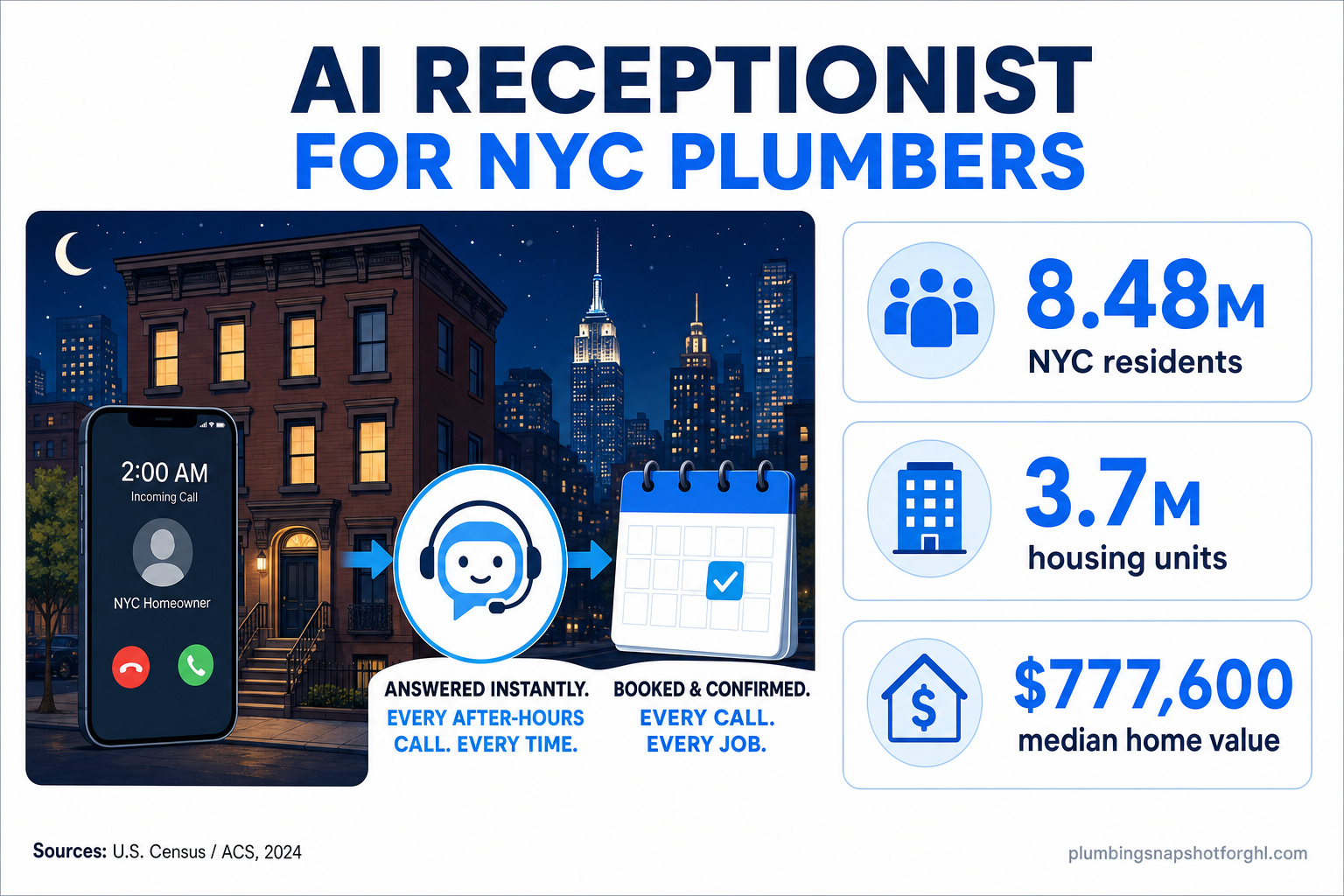
For a New York City plumbing shop, an AI receptionist is a voice-and-text system that answers every call your team can’t — day, night, weekend, holiday — triages the emergency, books the routine job, and texts your on-call tech, all in seconds. In a market with roughly 8.48 million residents, about 3.7 million housing units, and thousands of competing plumbers, the shop that answers first usually wins the job — and the one that goes to voicemail at 2 AM watches a four-figure repipe book with the next plumber on the map. This guide puts real 2026 numbers on what a missed call costs an NYC plumber, what 24/7 coverage actually runs, and how an AI receptionist closes the gap without a $150,000 payroll line.
In this guide
- What an AI receptionist actually does for a plumbing shop
- The real cost of a missed call in New York City
- Why speed decides which plumber gets the job
- Why NYC plumbers get hit harder than most
- What 24/7 coverage really costs: in-house vs. answering service vs. AI
- The ROI math for a New York plumbing shop
- What to look for in an AI receptionist
- Frequently asked questions
- About the author
- Related reading
What an AI receptionist actually does for a plumbing shop
An AI receptionist isn’t a robotic phone tree that reads “press 1 for service.” It’s a conversational voice-and-text agent, trained on your services, your service area, and your pricing rules, that handles a call the way your best dispatcher would — calm, fast, and accurate — and then does something a voicemail never can: it takes action.
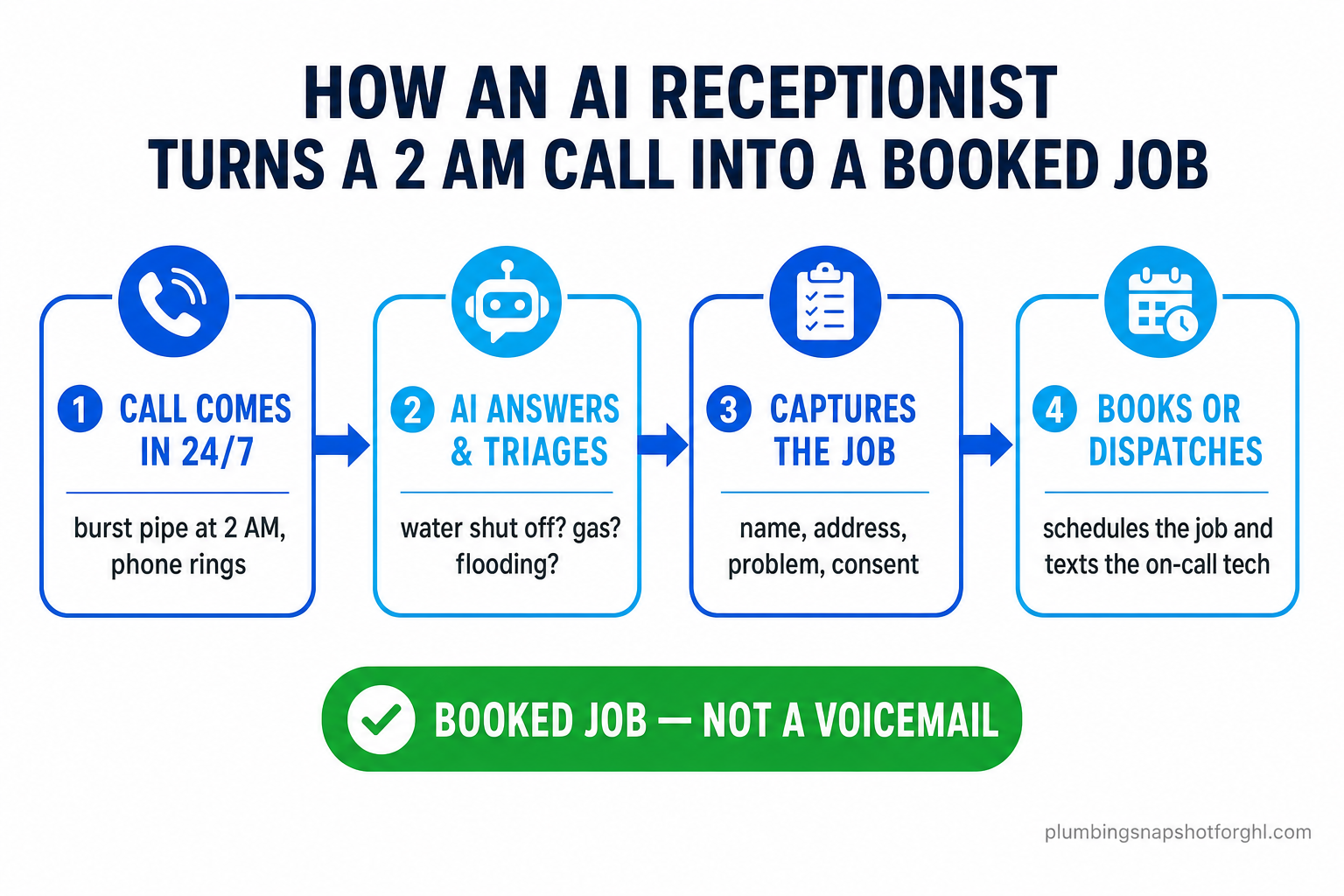
For a plumbing operation, a good AI receptionist runs the same triage sequence on every call:
- Picks up instantly, 24/7. No ring-out, no “our office is closed,” no voicemail. The call is answered on the first ring at 9 AM Tuesday and 3 AM Sunday alike.
- Identifies the emergency. It asks the three questions a dispatcher would — Is the water shut off? Do you smell gas? Is it actively flooding? — and grades severity.
- Captures the job. Name, address or borough, the problem (burst supply line, no hot water, sewer backup), and consent to text back.
- Books or dispatches. A routine job drops straight onto your calendar; a true emergency texts your on-call tech with the address and the problem and fires an instant confirmation to the homeowner so they stop calling other shops.
The difference between that and a missed call isn’t subtle. A missed call is a lost stranger. A handled call is a booked ticket with a name, a number, and a time. For a deeper build-level walkthrough of how those flows are wired, see the after-hours AI receptionist playbook.
The real cost of a missed call in New York City
New York City is the largest home-services market in the country, and the numbers explain why every unanswered call stings. There are about 8.48 million residents as of the July 2024 estimate (U.S. Census Bureau), living across roughly 3.7 million housing units — the largest housing stock the city has ever recorded, per the 2023 NYC Housing and Vacancy Survey. The median owner-occupied home is worth about $777,600 (Census / ACS), and the plumbing industry across New York State runs to roughly $11.6 billion with about 8,511 plumbing businesses competing for the work (IBISWorld).
Read those four numbers together and the picture is clear: a huge base of aging homes generating steady high-ticket work, and thousands of plumbers a phone tap away. In that market, the constraint on your growth usually isn’t demand — it’s whether you were the one who picked up. Every call that hits voicemail in New York doesn’t disappear; it rings the next shop on the list.
Why speed decides which plumber gets the job
The most important fact in this entire article isn’t about plumbing — it’s about human behavior under stress. When something breaks, people call, and they keep calling until someone answers. The first plumber to respond has a decisive advantage, and the research is unusually clear on how fast that advantage decays.
The landmark MIT / InsideSales Lead Response Management study — built on more than 15,000 leads and over 100,000 call attempts — found that contacting a lead within 5 minutes instead of 30 makes you about 100× more likely to reach them and 21× more likely to qualify the opportunity (study PDF). The Harvard Business Review audit of 2,241 U.S. companies put the same effect in reverse: firms that responded within an hour were 7× more likely to qualify a lead than those that waited just one hour longer, and 60× more likely than those who waited 24+ hours (HBR).
How much more likely you are to qualify a lead based on how fast you respond. Source: Harvard Business Review, “The Short Life of Online Sales Leads”.
Now the uncomfortable half: most businesses are slow. That same HBR study found the average company took 42 hours to respond to an inbound lead, and 23% never responded at all. Meanwhile, 77% of customers say they expect to interact with someone immediately when they reach out to a company (Salesforce). The gap between what homeowners expect (instant) and what most plumbers deliver (hours, or never) is exactly the gap an AI receptionist closes — because its response time is essentially zero, at every hour, on every call.
Why NYC plumbers get hit harder than most
Every plumbing shop loses jobs to missed calls. New York shops lose more, for three structural reasons.
The housing stock is old. The majority of NYC homes were built before 1970 (U.S. Census, Year Structure Built via NYCdata). Old buildings mean aging supply lines, corroded cast-iron drains, failing water heaters, and the kind of sudden, time-critical failures that don’t wait for business hours. More old pipe equals more emergency calls — and more emergency calls after 6 PM.
Density compresses the timeline. In a dense city with a 1.4% rental vacancy rate — the lowest since 1968 (2023 NYCHVS) — a leak in one unit is a landlord’s emergency in three. Building owners and managers, who are the real plumbing buyers even though most residents rent, cannot wait until Monday. They call down their list until someone answers.
The competition is one tap away. With ~8,511 plumbing businesses in New York State (IBISWorld), the homeowner’s next option is never more than a search away. There is no loyalty premium on a burst pipe at midnight — there’s only “who picked up.” This is the same dynamic that makes missed-call text-back so valuable on the phone channel, but the AI receptionist goes further: it doesn’t just text the caller back, it holds the conversation and books the job.
What 24/7 coverage really costs: in-house vs. answering service vs. AI
“Just answer the phone 24/7” sounds simple until you price it. There are 168 hours in a week; a full-time receptionist covers about 40 of them. At the BLS median wage of $37,230/year (Bureau of Labor Statistics) — before payroll taxes, benefits, sick days, and turnover — true round-the-clock human coverage takes roughly four full-time hires, or well over $150,000 a year in wages alone. For a small or mid-size NYC plumbing shop, that math simply doesn’t close.
That leaves three realistic ways to cover the phone. Here’s how they stack up.
Three ways to answer after-hours plumbing calls
| Plan | In-house receptionist(s) | Live answering service | AI receptionist (Snapshot) recommended |
|---|---|---|---|
| Price | $37K+/yr each | ~$135–$1,695/mo | Flat monthly |
| Feature 1 | Full control and your own voice | Real humans, 24/7 coverage | Answers every call, 24/7, instantly |
| Feature 2 | ~40 hrs/week covered per hire | Per-minute or per-call billing | Trained on your services & pricing |
| Feature 3 | Needs ~4 FTEs for true 24/7 | Costs scale up with call volume | Triages, books, and dispatches |
| Feature 4 | Sick days, turnover, training | Agents don't know your shop | Unlimited calls, no per-minute meter |
| Feature 5 | Voicemail after hours anyway | Often just takes a message | Texts your on-call tech automatically |
| Feature 6 | $150K+/yr for round-the-clock | Rarely books into your calendar | Feeds one CRM & follow-up system |
| See snapshot pricing |
Live answering services are the traditional middle option, and they work — but they bill by the minute or the call (commonly a few hundred to a few thousand dollars a month as volume grows), and most agents can only take a message, not book the job into your calendar or dispatch your on-call tech. For a full cost breakdown of live services versus AI, see our guide to the plumbing answering service. The AI receptionist’s edge is structural: it answers unlimited calls at a flat monthly rate, it actually books and dispatches instead of leaving a message, and because it lives in the same system as your CRM, the captured lead follows up automatically instead of dying in an inbox.
Here’s what one unanswered call can be worth, so the flat monthly cost has something to sit next to.
Typical U.S. job value at stake on a single missed plumbing call (sewer line shown at the midpoint of a $1,388–$5,323 range). Sources: HomeAdvisor, Angi (water heater), Angi (sewer line).
The ROI math for a New York plumbing shop
Put the two numbers side by side and the decision makes itself. An AI receptionist runs a flat monthly fee. A single recovered job — one after-hours water-heater replacement at around $1,300, or one sewer-line job that can top $5,000 (Angi) — covers that fee many times over, often in the first week.
This is also why the AI receptionist tends to be the highest-ROI automation a plumbing shop can install: it doesn’t try to create new demand, it stops you from leaking the demand you already have. Track it against your core numbers — booked-call rate, speed-to-lead, after-hours capture — and the effect shows up fast. (If you don’t track those yet, start with our guide to plumbing business KPIs.)
What to look for in an AI receptionist
Not every “AI phone answering” tool is built for a plumbing shop. If you’re evaluating options for a New York operation, these are the features that separate a real receptionist from a glorified voicemail.
The reason we wire all seven together in the done-for-you snapshot — the receptionist, the calendar, the dispatch text, the CRM capture, and the compliant follow-up — is that a missed detail anywhere in that chain turns a captured call back into a lost one. Answering the phone is step one; booking the job and never dropping the lead is the system. That system is also the backbone of a broader plan to get more plumbing leads without buying more of them.
What is an AI receptionist for a plumbing company?
It's an AI-powered voice-and-text system that answers your plumbing shop's calls in real time — including nights, weekends, and holidays — triages how urgent the problem is, captures the caller's details, and then books a routine appointment onto your calendar or dispatches your on-call tech for an emergency. Unlike a phone tree or voicemail, it holds a real conversation and takes action, and unlike a live answering service it's trained specifically on your services, service area, and pricing rules and runs at a flat monthly cost with no per-minute meter.
How much does an AI receptionist cost vs. hiring or a live answering service?
A single in-house receptionist earns a median of about $37,230/year (BLS), and because one person covers roughly 40 of the 168 hours in a week, true 24/7 human coverage takes around four full-time hires — well over $150,000 a year. Live answering services run roughly $135 to $1,695 a month and bill by the minute or call, so costs climb with volume, and most agents only take a message. An AI receptionist answers unlimited calls at a flat monthly rate and actually books and dispatches — which is why one recovered after-hours job usually covers its cost many times over.
Do NYC plumbers really need 24/7 call answering?
In New York City, the case is unusually strong. The majority of NYC homes were built before 1970, so aging pipes and water heaters generate steady, time-critical emergency work; the rental vacancy rate is just 1.4%, so a leak in one unit is a landlord emergency across several; and with about 8,511 plumbing businesses in New York State, the homeowner's next option is one tap away. Emergencies happen at night and on weekends, which is exactly when the highest-value, lowest-competition jobs come in — and exactly when most competitors' phones go to voicemail.
Why does answering fast matter so much for plumbing calls?
Because the first plumber to respond usually wins the job. The MIT/InsideSales lead-response study found that contacting a lead within 5 minutes instead of 30 makes you about 100 times more likely to connect and 21 times more likely to qualify it, and Harvard Business Review found that responding within an hour makes you 7 to 60 times more likely to qualify a lead than waiting. Yet HBR also found the average company takes 42 hours to respond and 23% never do. An AI receptionist responds in seconds on every call, which is a decisive edge in an emergency trade.
Will an AI receptionist actually book jobs while I sleep?
Yes — that's the entire point. Because plumbing emergencies happen overnight and on weekends, a large share of high-value jobs come in outside business hours. The AI receptionist picks up instantly at any hour, runs the same triage your dispatcher would, and either books a routine slot onto your calendar or texts your on-call tech with the address and the problem, while firing an instant confirmation to the homeowner so they stop calling other shops. A 2 AM burst-pipe call becomes a scheduled job instead of a voicemail nobody hears until Monday.
Is AI text-back to callers compliant with texting laws?
It can and must be. When the receptionist captures a phone number and follows up by text, it needs clear opt-in consent, an identified sender, and an easy opt-out — the same TCPA basics that apply to any plumbing SMS. Our snapshot builds that consent step into the call and text flow so your follow-up messaging stays compliant by default. See our TCPA guide for plumbers for the specifics.
About the author
Hector Salinas is the GHL Automation Lead for Plumbing Snapshot for GHL, based in Phoenix, AZ. He spent nine years dispatching for a 12-truck plumbing operation before he ever touched a CRM, where he learned firsthand how a single missed after-hours call turns into a lost five-figure job. He now maps every call flow, triage script, and emergency-dispatch sequence in the Plumbing Snapshot, and writes the way he’d brief a new service manager — plainly, with the revenue math attached.
Related reading
- Plumbing Answering Service: Cost, Options & the AI Alternative — the full cost breakdown of live services vs. AI.
- The After-Hours AI Receptionist Playbook — how the 2 AM call-capture flow is actually built.
- Missed-Call Text-Back for Plumbers — recover the calls you can’t pick up on the phone channel.
- Plumbing Business KPIs — the numbers that tell you whether you’re capturing demand or leaking it.
- How to Get More Plumbing Leads — where 24/7 answering fits in the full lead system.
- The After-Hours AI Receptionist feature — see exactly what the snapshot’s receptionist does.