
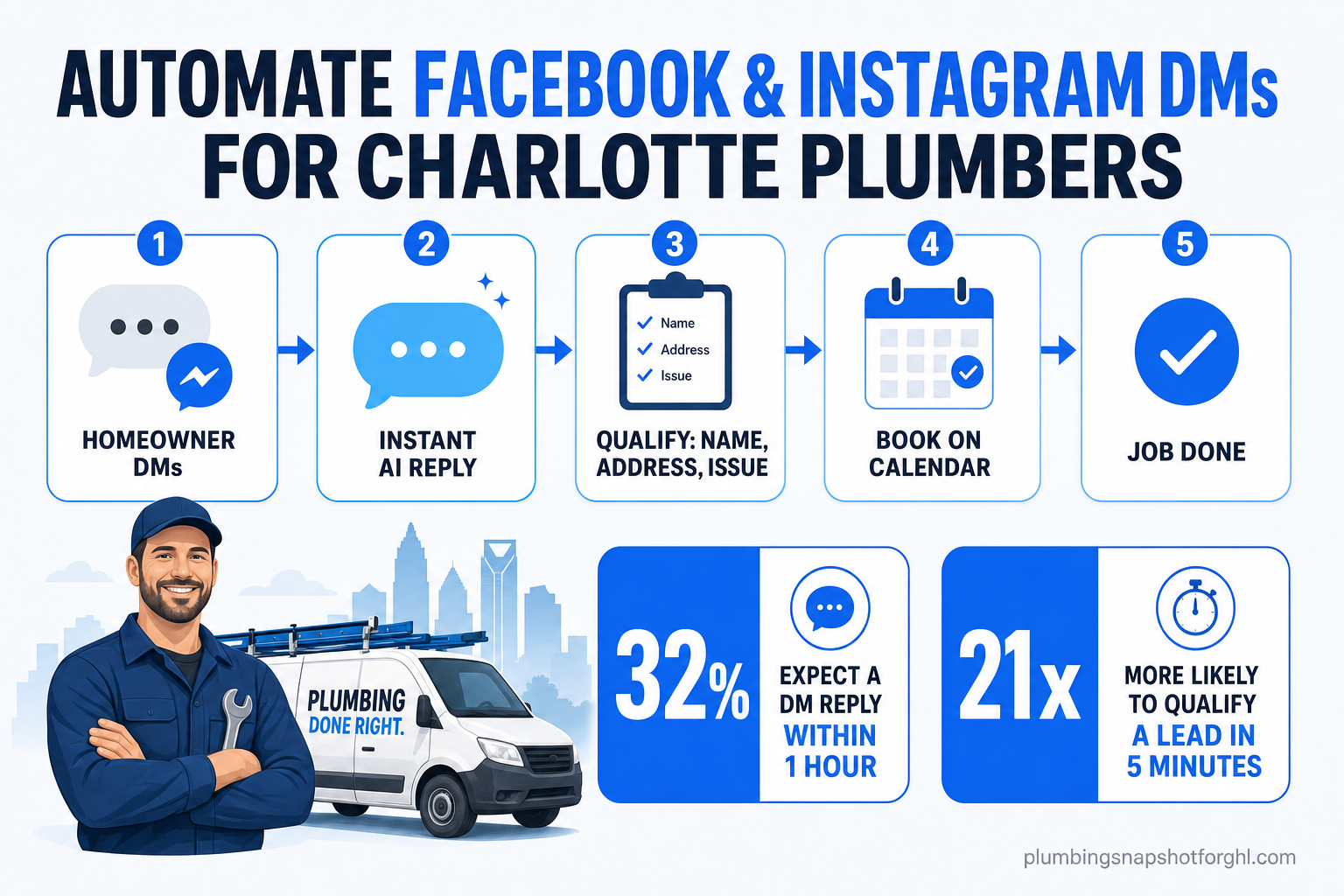
To automate Facebook and Instagram DMs for a Charlotte plumbing shop, you connect both inboxes to one system, write reply logic that instantly answers common questions and collects the homeowner’s name, number, address, and issue, auto-reply to public comments with a nudge to DM, then book the qualified lead straight onto your calendar — all 24/7, without a human watching the phone. That last part is why it matters: roughly 1 billion people now message a business every week across Messenger, Instagram, and WhatsApp (Meta), homeowners increasingly start there instead of dialing, and the shop that answers first usually wins the job. In a metro of roughly 2.8 million people (Axios Charlotte) served by a share of the country’s roughly 132,000 plumbing businesses (IBISWorld), the burst-pipe DM you answer in 30 seconds is the one your competitor answered “tomorrow.” This is the exact playbook to close that gap.
In this guide
- The short answer: why automate FB & IG DMs
- What DM automation actually is (and isn’t)
- The 6-step DM automation playbook
- The response-time math a Charlotte shop can’t beat by hand
- DIY vs. done-for-you: what it really costs
- Frequently asked questions
- About the author
- Related reading
The short answer: why automate FB & IG DMs
Because the message is already a lead, and the clock is already running. When a Charlotte homeowner with a leaking water heater types “do you service Ballantyne?” into your Instagram DMs at 9:40 PM, they are not window-shopping — they have a problem and they are contacting shops in order until someone answers. 64% of consumers have switched to a competitor after a poor customer experience (Emplifi) — and a DM that goes unanswered for hours is exactly that — while 32% now expect a reply within an hour (Emplifi). The problem isn’t that plumbers don’t care — it’s that the person who can answer is under a house, on a ladder, or asleep, and a large share of that demand lands after hours, on nights and weekends.
Automation removes the human bottleneck from the first 60 seconds. It doesn’t replace your judgment or your crew — it makes sure the conversation starts instantly, captures the details you need, and books the appointment before the homeowner moves to the next shop on the map. Think of it as a dispatcher who never sleeps, never misses a message, and works every comment and DM across both platforms at once.
I’ve onboarded plumbing shops all over the Carolinas, and the pattern is always the same: they’re not losing jobs on price, they’re losing them on silence. A DM that sits eight hours is a job that booked with someone else. Automate the first reply and you stop the leak — everything else is upside.
What DM automation actually is (and isn’t)
DM automation is a set of rules and AI-assisted replies that watch your Facebook and Instagram inboxes (and the comment sections under your posts), respond instantly in your shop’s voice, qualify the homeowner, and hand a booking-ready lead to your calendar and CRM. It is not a spam bot blasting strangers, and it is not a rigid “press 1 for service” tree that frustrates people. Done right, most homeowners can’t tell the first reply was automated — it answers their actual question and moves them toward an appointment.
Here’s the important distinction for the trades:
- It IS: an instant “Thanks — yes, we handle water heaters across Charlotte. What’s the address and is it leaking now or just not heating?” that captures name, number, address, and issue, then offers a booking link.
- It ISN’T: an auto-DM to everyone who likes a post, a fake five-star review, or a canned reply that ignores what the person asked. Those tactics violate Meta’s platform rules and, for SMS follow-up, TCPA consent requirements — and they burn trust.
The 6-step DM automation playbook
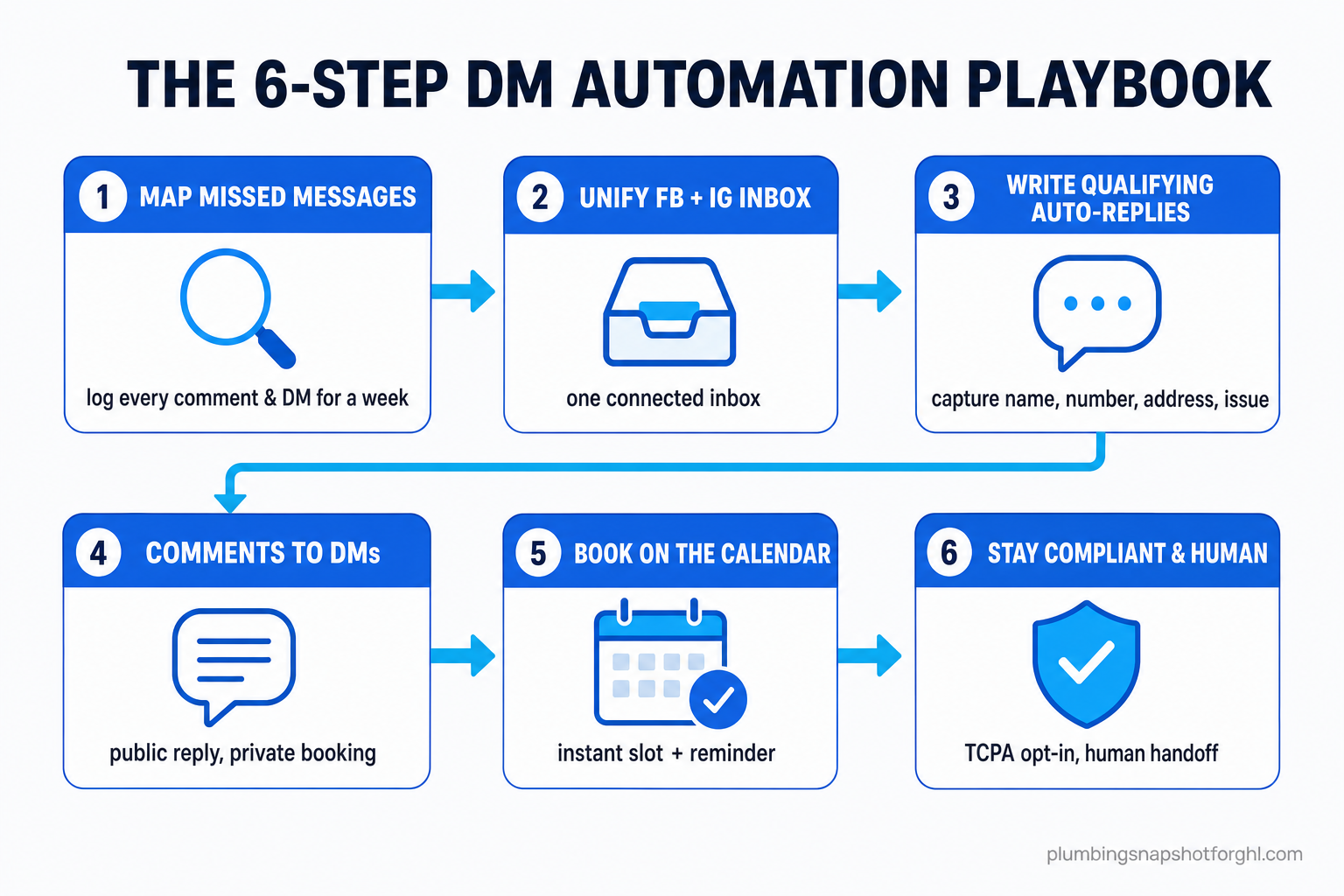
Follow these six steps in order. The first two are setup; the last four are where the jobs come from.
Step 1 — Map the messages you’re already missing
Before you automate anything, spend one week logging every comment and DM across Facebook and Instagram: what people asked, when it arrived, and how long it took you to reply. Almost every shop finds three leaks — questions asked in public comments that never got a reply, DMs that sat overnight, and after-hours messages that got a next-day answer (if any). This is your baseline. It’s also your proof: when you see how many “do you do X?” messages arrived while you were on a call, the case for automation makes itself. Tie this to the same speed-to-lead discipline you’d apply to the phone.
Step 2 — Unify Facebook + Instagram into one inbox
Connect both business accounts to a single messaging platform so every comment and DM lands in one place with the homeowner’s history attached. This is the foundation: you cannot automate what’s scattered across two apps and three devices. Because Instagram and Messenger share Meta’s business messaging infrastructure, one connected system can watch and reply to both. The goal is a single stream where a lead who commented on a Facebook post and later DM’d your Instagram is recognized as one person, not two mystery contacts.
Step 3 — Write auto-replies that qualify, not just greet
This is the heart of it. A greeting (“Thanks for reaching out!”) is worthless; a qualifying reply moves the job forward. Your automated first response should do four things in one message: confirm you handle the service, ask the one question that scopes the job, request the address and phone, and offer to book. For a plumbing shop, build reply logic around your real call types:
- Water heater: “Yes, we service and replace water heaters across Charlotte. Is it leaking, or just not making hot water — and what’s the address?”
- Drain/sewer: “We handle drain and sewer backups same-day. Which drain, and is water backing up now?”
- Emergency/burst pipe: “That’s an emergency — we can dispatch. What’s the address and a good callback number?”
Each reply captures name, number, address, and issue — the four fields dispatch needs — and ends with a booking link. An AI-assisted agent handles the messy middle (odd phrasing, follow-up questions) in your shop’s voice, 24/7.
Step 4 — Turn public comments into private DMs
Every “how much for a water heater?” left in a public comment is a lead and a trust signal other homeowners see. Set your automation to reply to the comment publicly (“Great question — sent you a DM with details 👇”) while opening a private DM that runs the Step 3 qualifying flow. This does two jobs at once: it keeps your comment sections active (which the algorithm rewards with reach) and it pulls the actual booking conversation somewhere you can collect contact details. Public answer for reach, private DM for the job.
Step 5 — Book straight onto the calendar
A qualified lead that still requires a human to call back and schedule is a lead that can still go cold. Close the loop by having the automation offer real appointment slots and write the booking to a shared calendar the moment the homeowner picks one — with an automatic confirmation and reminder to cut no-shows. This is the same online-booking mechanic you’d put on your website, wired into the DM. The homeowner goes from “do you do water heaters?” to a confirmed Tuesday 10 AM slot without anyone in the shop touching a phone.
Step 6 — Stay compliant and keep it human
Two guardrails keep this from backfiring. First, consent: if you move the conversation to SMS reminders and follow-ups, you need clear opt-in, because TCPA governs automated texts — build the opt-in language into your flow (our TCPA guide for plumbers covers the exact wording). Second, the human handoff: route anything the AI can’t confidently handle — a complex commercial job, an upset customer, a pricing negotiation — to a real person with full context, immediately. Automation should own the first 60 seconds and the routine qualifying; your team owns the judgment calls.
The response-time math a Charlotte shop can’t beat by hand
Here’s why this is an automation problem and not a “hire someone” problem. The window that decides whether a DM becomes a job is measured in minutes, and it’s open nights and weekends when no one is staffing the inbox.
What homeowners expect from social messaging — and how often businesses miss it. Sources: Emplifi Social Pulse Report 2025 (via Social Media Today), Emplifi (via Business Wire), and Harvard Business Review — The Short Life of Online Sales Leads.
The single most important number in lead response comes from MIT’s landmark study with InsideSales: firms that contact a web lead within 5 minutes are 21 times more likely to qualify it than firms that wait 30 minutes, and the odds of even reaching the lead drop roughly 100x over that same half hour (MIT / InsideSales). Yet Harvard Business Review’s audit of 2,241 companies found the average first response to a web lead was 42 hours, and 23% never responded at all (HBR). A plumber crawling under a house physically cannot answer in five minutes. An automated agent answers in five seconds — every message, every platform, every hour.
Sources: MIT / InsideSales Lead Response Study, Emplifi 2025, Emplifi (Business Wire), Gartner.
Put a dollar figure on it. If your Facebook and Instagram send even 20 message-based leads a month and slow replies lose a third of them, that’s ~7 lost jobs. At a Charlotte water-heater install of roughly $1,800–$3,000 — never mind a repipe or sewer job in the five figures — recovering just one or two of those a month pays for the entire system many times over. Silence is the most expensive thing in your inbox.
DIY vs. done-for-you: what it really costs
You can absolutely build this yourself. The question is whether the setup and upkeep are a good use of the person who should be running trucks. Here’s the honest comparison:
| DIY build | Done-for-you | |
|---|---|---|
| Setup time | 20–40 hrs wiring inboxes, reply logic, calendar, CRM | Live in days; we wire it |
| Reply speed | As fast as you can watch two apps | Seconds, 24/7, both platforms |
| Comment → DM automation | Manual, easy to forget | Automatic on FB + IG |
| Books to calendar | You build it | Included, with reminders |
| TCPA/opt-in wording | Your research | Compliant flows built in |
| Ongoing tuning | You, forever | Managed for you |
| Cost | Your time + tool fees | $397/mo per brand, no setup fee |
Doing it by hand isn’t wrong — plenty of sharp operators wire their own GoHighLevel workflows. But if you’d rather skip the build and the babysitting, our done-for-you social media service runs it for you: three AI agents handle comments (Facebook, Instagram, TikTok), DMs (Facebook & Instagram messages — qualify, collect details, book), and website chat, all 24/7 in your shop’s voice, with every lead and appointment landing in a CRM under your own login. It’s the whole response system for $397/month per brand (up to 4 brands for $997/mo), white-label, no setup fee, cancel with 15 days’ notice — less than a part-time hire, and it never sleeps through a burst-pipe DM.
Frequently asked questions
Can you really automate Facebook and Instagram DMs for a plumbing business?
Yes. You connect both business inboxes to one messaging platform, write reply logic that instantly answers common questions (water heaters, drains, burst pipes) and collects the homeowner's name, number, address, and issue, then book the qualified lead onto your calendar automatically. Because Instagram and Messenger share Meta's business-messaging infrastructure, one connected system can watch and reply to both 24/7. The homeowner stays inside Messenger or Instagram; the automation runs behind the scenes.
How fast does an automated DM reply actually respond?
Within seconds, around the clock. That speed is the entire point: MIT's study with InsideSales found that contacting a lead within 5 minutes makes it 21 times more likely to qualify than waiting 30 minutes, and 32% of consumers now expect a DM reply within an hour (Emplifi). A plumber on a job physically can't answer in minutes, especially for the many messages that arrive after hours, on nights and weekends. An automated agent can — every message, every platform, around the clock.
Isn't automated DM replying just spam that violates Meta's rules?
Not if it's reactive. Auto-DMing everyone who follows or likes you is spam and violates Meta's platform rules. The version that works is purely responsive: a homeowner messages you first, and the system replies instantly, answers their real question, qualifies them, and offers to book. That's welcome, on-brand customer service — the opposite of spam. The line is unsolicited outreach (bad) vs. instant responses to inbound messages (good).
What about TCPA compliance if the conversation moves to text?
You need clear opt-in before sending automated SMS reminders or follow-ups, because TCPA governs automated texts. Build the consent language directly into your DM flow — a simple 'Reply YES to get appointment reminders by text' captures it. Keep records of consent and honor STOP requests. Our TCPA guide for plumbers covers the exact wording. Done-for-you systems have compliant opt-in flows built in.
Do I keep ownership of my accounts and the leads?
Yes. You stay the owner of your Facebook and Instagram accounts — you simply connect the accounts you already have during onboarding. Every lead the automation captures and every appointment it books lands in a CRM under your own login, with the homeowner's name, phone, address, and full conversation, so you can see everything at any time and are never locked out.
How much does done-for-you DM automation cost for a Charlotte plumbing shop?
Our done-for-you social media service is $397/month per brand with no setup fee, 100% white-label, and cancellation with 15 days' notice. It includes three AI agents — one for comments (Facebook, Instagram, TikTok), one for Facebook & Instagram DMs that qualify and book, and one for website chat — plus a full content engine published across all 9 channels. Running up to 4 brands is $997/month, useful for multiple locations or agencies reselling to plumbing clients. For comparison, that's less than a single part-time hire, and it works 24/7.
About the author
Yvonne Castellanos is the Snapshot Strategist and Agency Partner Success lead for Plumbing Snapshot for GHL, based in Charlotte, NC. She has onboarded plumbing contractors from solo owner-operators to regional outfits, and focuses on the boring money: response pipelines, review flywheels, and the retention automations that keep a plumbing brand booked between emergencies. She writes case-grounded playbooks for operators who want the system to prove ROI in the first 30 days.
Related reading
- Social Media Marketing for Plumbers: Why Yours Isn’t Booking Jobs — the broader social system this DM automation plugs into.
- Missed-Call Text-Back for Plumbers — the same speed-to-lead fix, applied to the phone.
- Online Booking for Plumbers — the calendar mechanic that closes the DM loop.
- TCPA for Plumbers — keep your automated texts compliant.
- Done-For-You Social Media for Plumbers — the three AI agents that run comments, DMs, and web chat for you.