
In Los Angeles, the plumber with more recent 5-star Google reviews wins the “plumber near me” search — and the fastest way to get there is to stop asking by hand and automate the request. A done-for-you system texts and emails every customer a one-tap review link the moment the job is marked complete, so reviews arrive steadily instead of whenever someone remembers to ask. The data backs the payoff: about 70% of customers leave a review when they’re simply asked (Search Engine Land), yet most shops ask almost no one. Close that gap and you clear the rating bar LA homeowners now demand, move up the Map Pack, and turn finished jobs into your best lead source.
In this guide
- The short answer for LA plumbers
- Why Google reviews decide who gets the Los Angeles call
- The three things LA homeowners actually judge: rating, recency, volume
- Why “please leave us a review” fails
- What more reviews are worth in dollars
- The automated review-harvesting system, step by step
- Do it compliantly: no gating, real consent
- What to realistically expect
- Frequently asked questions
- About the author
- Related reading
The short answer for LA plumbers
If you run a plumbing shop anywhere from the Valley to Long Beach, the single highest-leverage marketing move you can make is a system that automatically requests a Google review from every customer, minutes after the job closes. Los Angeles is one of the most saturated home-services markets in the country — California is the largest state for plumbers by a wide margin (IBISWorld) — so the “plumber near me” Map Pack is a knife fight. What separates the three shops Google shows first from the twenty it buries below the fold isn’t who does the best pipe work. It’s who has the most, the most recent, and the highest-rated reviews.
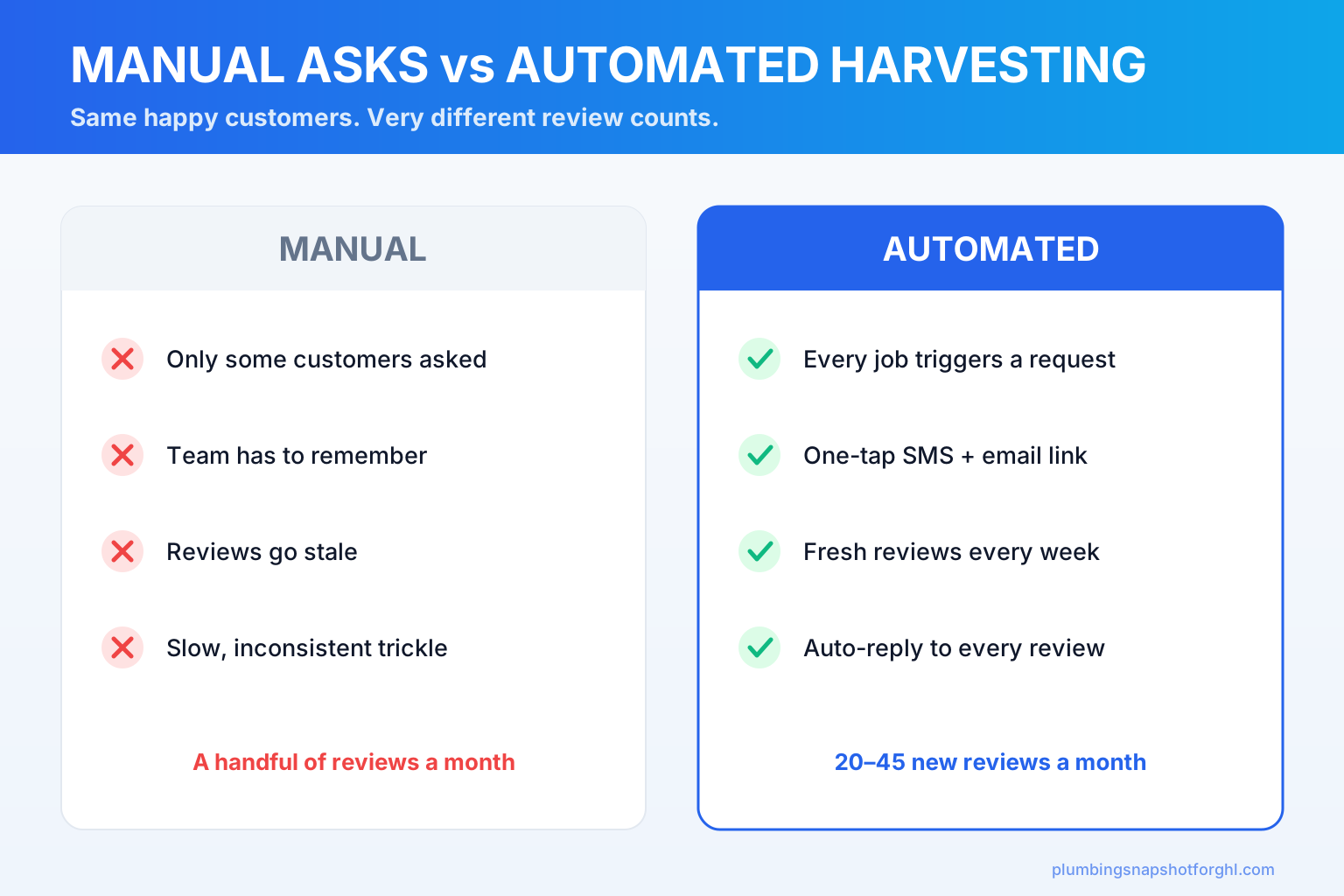
You can’t win that by asking by hand. A busy LA plumber runs 6–10 jobs a day across brutal traffic; nobody on the truck is going to reliably stop and coach every homeowner through leaving a Google review. Automation does it the same way every time: the job gets marked complete in your CRM, and a friendly text plus a backup email goes out with a one-tap link straight to your Google review form. That’s the entire mechanism — and it’s the difference between a trickle of reviews and a steady stream.
Every plumbing shop I onboard already has happy customers. What they don’t have is a system that asks all of them. Reviews aren’t a reputation problem — they’re a follow-up problem, and follow-up is exactly what automation is for.
Why Google reviews decide who gets the Los Angeles call
When a homeowner in LA has water spreading across the kitchen floor, they do one thing: pull out a phone and search. Google shows a Map Pack of three local plumbers, each with a star rating and a review count sitting right under the name. That little row of stars is the first — and often only — comparison the customer makes before tapping “Call.”
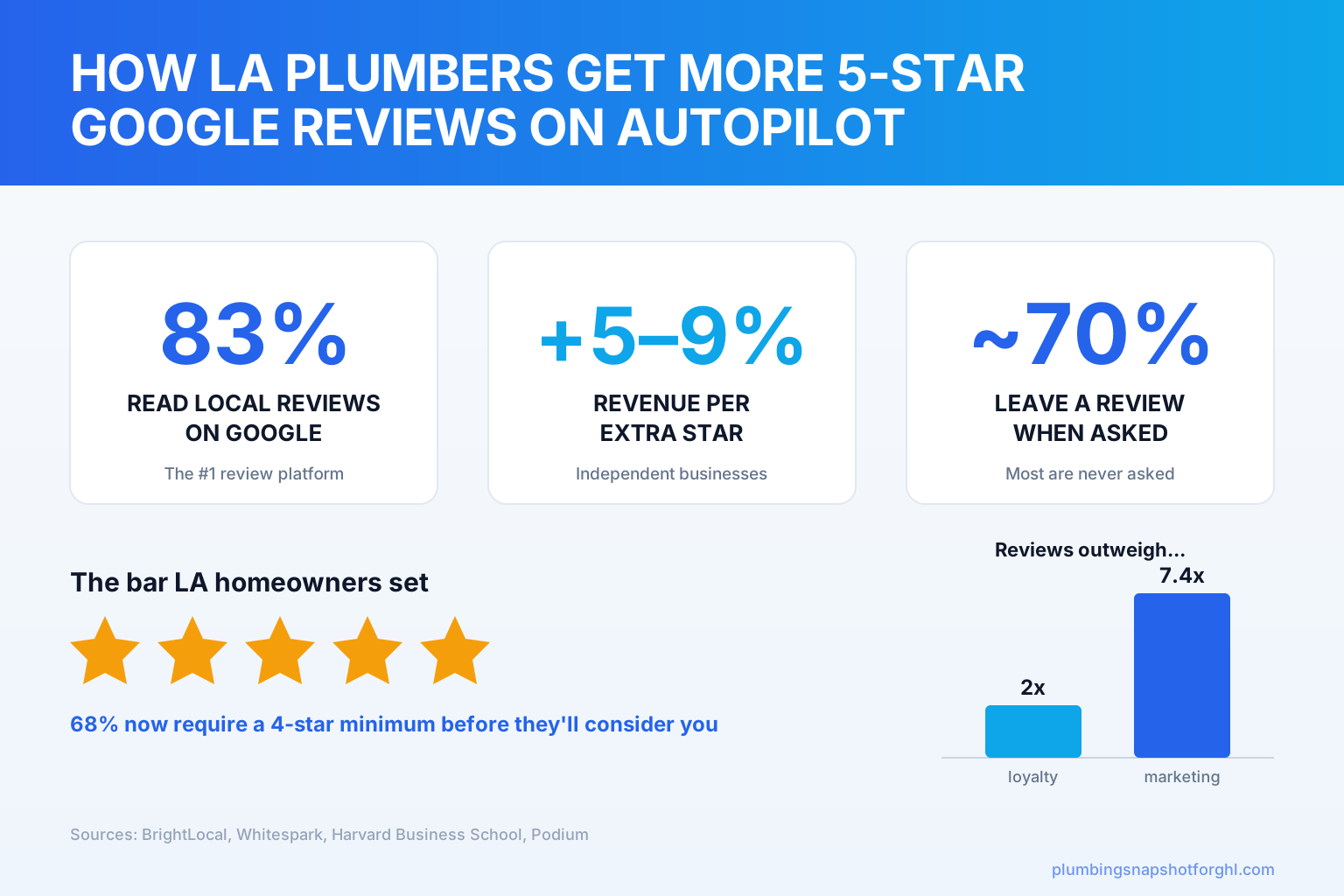
Two things are happening in that data at once. First, reviews are how people choose — and it isn’t close. Analysis compiled by Podium found reviews are roughly 2x more likely to be an important factor in choosing a local business than loyalty or repeat habit, and about 7.4x more important than traditional marketing (Podium). You can outspend a competitor on Google Ads all day; if their stars beat yours, the click still goes to them.
How much more likely online reviews are to be an important factor in choosing a local business, versus other influences (multiples). Source: Podium — Online Review Statistics.
Second, reviews are how you rank. Whitespark’s Local Search Ranking Factors study puts review signals — count, velocity, rating, and keywords in the review text — at roughly 16% of what determines Local Pack position, the second-largest lever after your Google Business Profile itself (Whitespark). So a healthy, growing review profile does double duty in LA: it lifts you into the three-pack, and it wins the click once you’re there. That’s why review harvesting sits at the center of any serious local SEO plan for plumbers.
The three things LA homeowners actually judge: rating, recency, volume
“Get more reviews” is too vague to act on. Homeowners are really judging three separate things, and an automated system is the only practical way to keep all three healthy at once.
Rating — clear the bar or get skipped. The minimum acceptable rating keeps climbing. BrightLocal’s consumer research found 68% of consumers now require at least a 4-star rating before they’ll consider a business — up sharply from around half a couple of years earlier (BrightLocal). A 3.8-star plumber in a city full of 4.7-star competitors isn’t in the running, no matter how good the work is.
Recency — old reviews decay. This is the one most plumbers miss. 84% of consumers say reviews older than three months aren’t relevant to them (BrightLocal). A profile with 60 reviews where the newest is from last year reads as “this shop was good once.” Fresh reviews signal “this shop is busy and trusted right now” — and freshness only comes from a steady, every-job cadence, which is exactly what automation guarantees.
Volume — enough reviews to trust. Consumers read multiple reviews across multiple sites before they trust a business, so a handful isn’t enough to feel safe with a stranger who’s about to work on your home. Volume also stabilizes your average: when you’re collecting reviews continuously, one grumpy 1-star gets diluted fast instead of tanking a thin profile.
Why “please leave us a review” fails
Here’s the gap that automation closes. When customers are actually asked to leave a review, about 70% of them do it (Search Engine Land). The problem is almost never willingness — it’s that most customers are never asked, or are asked in a way that adds friction (“search us on Google and scroll down to reviews”).
Two fixes move the needle: ask everyone automatically, and ask by text. SMS is simply where messages get seen. Industry benchmarks put SMS open rates around 98% against roughly 20% for email, and text messages get engaged with far faster than email. (Treat these as widely cited marketing benchmarks, not peer-reviewed figures — but the direction is not in dispute: a text gets read; an email often doesn’t.)
Approximate message open rates, SMS vs. email — industry marketing benchmarks, not peer-reviewed research. A review request is only as good as whether it gets read. Source: widely cited SMS vs. email engagement benchmarks (e.g. Podium).
So the winning pattern is: text first with a one-tap link, back it up with an email for anyone who prefers it, and let the system — not a memory — decide who gets asked. That’s the same speed-to-follow-up logic behind missed-call text-back: the message that gets read is the one that works.
What more reviews are worth in dollars
Reviews aren’t a vanity metric; they move revenue in a measurable way. The landmark study on this comes from Michael Luca at Harvard Business School, which found that a one-star increase in a business’s rating is associated with a 5–9% increase in revenue — an effect concentrated among independent (non-chain) businesses, which is exactly what a local plumbing shop is (Michael Luca, Harvard Business School).
Put LA numbers on it. Say your shop books around $120,000 a month. Moving your Google rating from a 4.2 to a 4.6 — squarely within reach when you’re collecting steady 5-star reviews on every job — sits inside that one-star band. Even the low end of Luca’s range implies thousands of dollars a month in additional booked work, month after month, from a system that runs itself. That’s before you count the ranking lift that puts you in front of more searchers in the first place.
The automated review-harvesting system, step by step
Here’s the actual mechanism we wire into the Plumbing Snapshot. It’s five steps, and after setup none of them need a human.
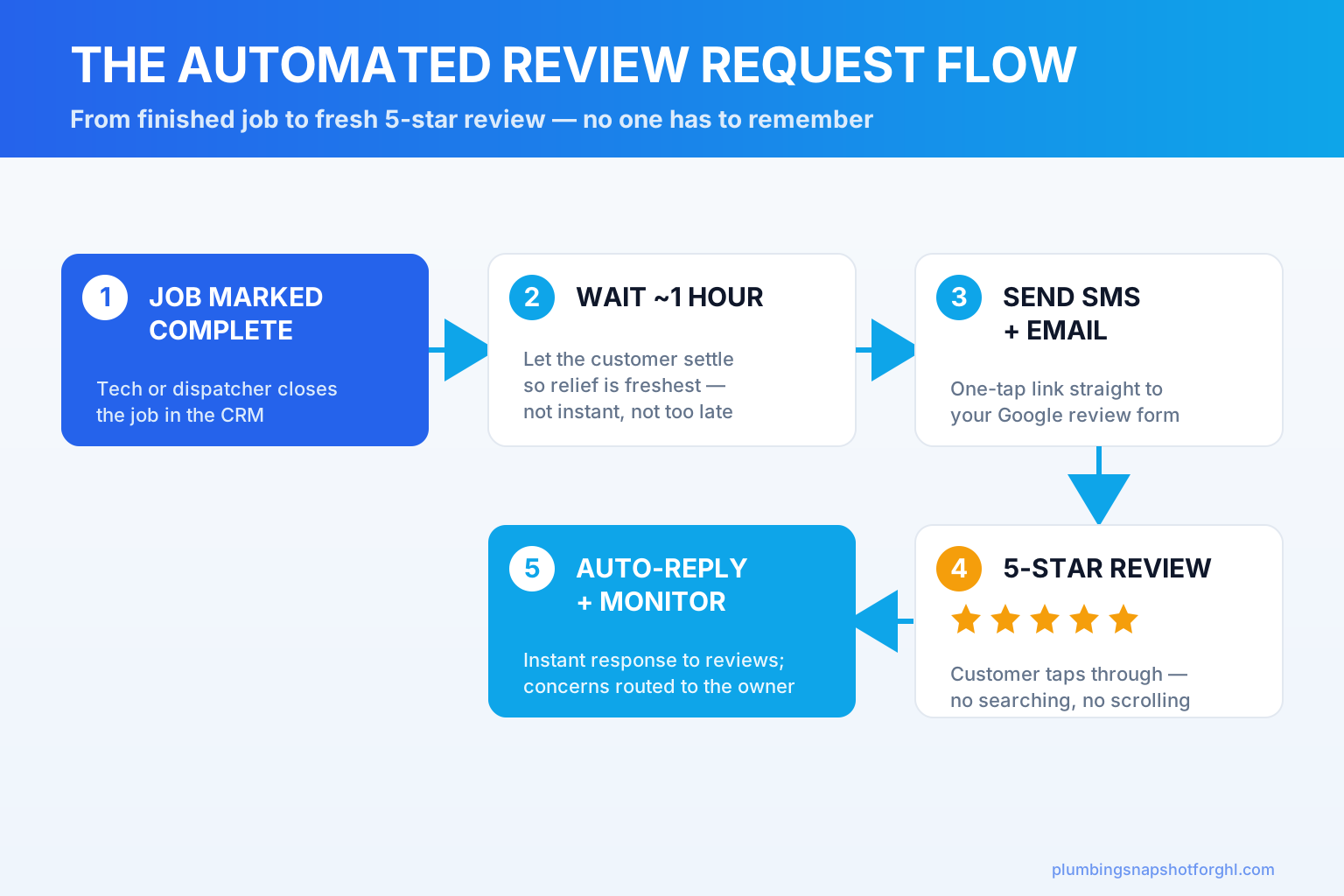
- Trigger on job completion. When your tech or dispatcher marks the job complete (or the invoice is paid) in the CRM, the workflow fires. No separate step to remember — the review request is stitched into how you already close jobs.
- Wait for the right moment. A short delay — usually 30–60 minutes — lets the customer settle after the tech leaves, so the ask lands when the “problem solved, water’s back on” relief is freshest. Not so fast it feels robotic, not so slow they’ve moved on.
- Text first, email as backup. The customer gets a short, human SMS thanking them by name with a one-tap link straight to your Google review form — no searching, no scrolling. A backup email goes to anyone who doesn’t tap the text within a day.
- Make the review one tap. The link opens the Google “write a review” screen directly. Every extra step you remove lifts completion; that frictionless path is why the ~70%-who-are-asked number actually shows up in your review count.
- Auto-reply and monitor. New reviews trigger an instant, appropriate response — and 88% of consumers would use a business that responds to all its reviews, versus just 47% for one that never responds (BrightLocal). Negative feedback routes privately to the owner immediately so you can make it right fast, without it being ignored.
This is the same category of always-on follow-up as an after-hours answering system or online booking: the shop that responds instantly and consistently wins, and consistency is what software is for. We go deeper on the pipeline mechanics in how to 2x your review pipeline.
Do it compliantly: no gating, real consent
Two rules keep this system legitimate — and they matter, because getting them wrong can get your reviews wiped or your shop in legal trouble.
Handled right, compliance isn’t a brake on review volume — it’s what makes the volume durable. A profile built on genuine, every-customer requests holds up; one built on gaming the system doesn’t.
What to realistically expect
Be skeptical of anyone promising “100 reviews in 30 days.” Here’s the honest shape of it: if you run, say, 150 jobs a month and start asking all of them by automated text, a realistic 15–30% conversion to a posted review — well below the ~70% ceiling once you account for wrong numbers, opt-outs, and busy people — still puts 20–45 new reviews a month on your profile. For most LA shops that’s a step change from the handful they collect now, and it’s recurring. Within a few months you’ve stacked enough recent 5-star reviews to clear the 4-star bar, refresh your recency, and climb the Map Pack — the three things that actually decide who gets the call.
Frequently asked questions
How do Los Angeles plumbers get more Google reviews fast?
Stop asking by hand and automate the request. The system that works: the moment a job is marked complete in your CRM, an automated text (with an email backup) sends the customer a one-tap link straight to your Google review form. Because about 70% of customers leave a review when they're actually asked, asking every customer at the right moment — instead of whoever your team remembers — is what turns a trickle into a steady stream. In a crowded market like LA, that steady flow of recent 5-star reviews is what moves you up the Map Pack.
How many Google reviews does a plumber need to rank in Los Angeles?
There's no fixed number — you need to be competitive with the shops already in the three-pack for your searches, and you need recency. Review signals make up roughly 16% of Local Pack ranking, and 84% of consumers say reviews older than three months aren't relevant. Practically, that means a plumber who collects a handful of new reviews every week will out-rank one sitting on a larger but stale pile. Aim for a continuous cadence, not a one-time target.
Is it against Google's rules to ask customers for reviews?
Asking every customer for an honest review is allowed and encouraged. What's prohibited is 'review gating' — surveying customers first and steering only the happy ones to Google while diverting unhappy ones away from a public review. A compliant system asks all customers for a public review and routes concerns to the owner in addition to (never instead of) the public ask. You should also collect SMS consent to stay TCPA-compliant.
Why use text messages instead of email for review requests?
Because texts get read. Industry benchmarks put SMS open rates near 98% versus roughly 20% for email, and texts are engaged with far faster. A review request only works if the customer sees it, so the best-performing systems text first with a one-tap Google link and use email only as a backup for people who don't respond to the text.
What's a one-star rating increase actually worth to my shop?
Harvard Business School research (Michael Luca) found a one-star increase in rating is associated with a 5–9% revenue increase, with the effect concentrated among independent businesses — which is exactly what a local plumbing shop is. For a shop booking six figures a month, moving from, say, a 4.2 to a 4.6 can mean thousands of dollars a month in additional booked work, on top of the extra visibility a higher rating and fresher reviews earn you in search.
Does the Plumbing Snapshot handle review automation for me?
Yes. The Plumbing Snapshot for GHL ships with the full review-harvesting workflow pre-built: a job-completion trigger, one-tap SMS and email review requests, automated review responses, private routing of negative feedback to the owner, and TCPA-compliant consent and opt-out handling. It's done-for-you — you approve the message copy and it runs on every job. You can see it alongside the rest of the system on the pricing page or book a short walkthrough.
About the author
Yvonne Castellanos is the Snapshot Strategist and Agency Partner Success lead for Plumbing Snapshot for GHL, based in Charlotte, NC. She runs partner success for agencies that resell the Plumbing Snapshot to local shops and has onboarded contractors from solo owner-operators to regional outfits running recurring maintenance memberships. Her focus is the boring money: review pipelines, maintenance-plan flywheels, and the retention automations that keep a plumbing brand booked between emergencies — and she writes case-grounded playbooks for exactly that.
Related reading
- How to 2x Your Plumbing Review Pipeline — the deeper mechanics behind a self-running review engine.
- Local SEO for Plumbers: Rank in the Google Map Pack — where your growing review profile pays off in rankings.
- Missed-Call Text-Back for Plumbers — the same instant-follow-up logic, applied to the calls you miss.
- The Maintenance-Plan Flywheel — turn one-time jobs into recurring revenue and repeat review opportunities.
- TCPA for Plumbers — keep your SMS review requests and follow-ups compliant.