
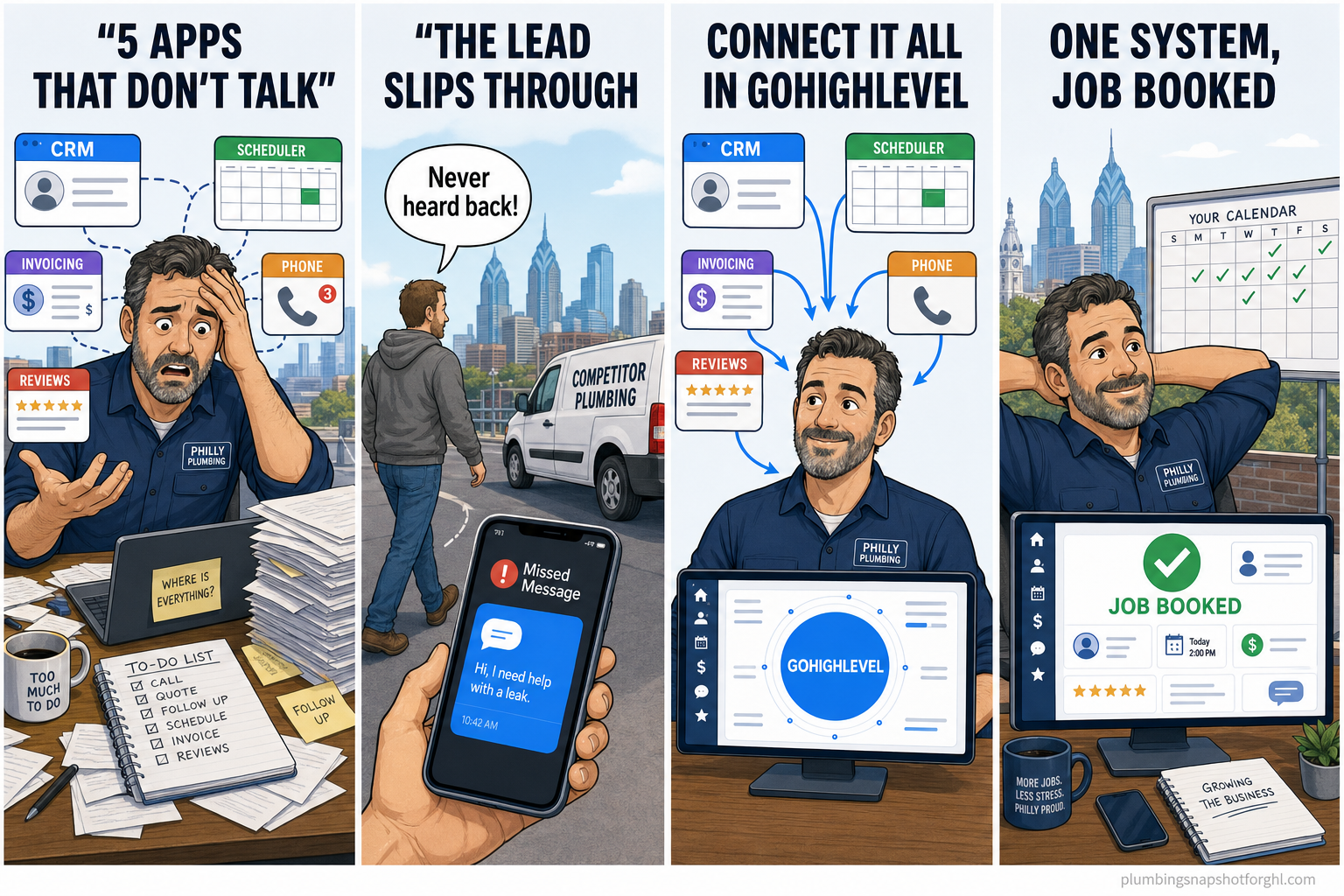
A Philadelphia plumbing shop loses jobs to disconnected software when its CRM, scheduler, invoicing, phone system, and review tool each hold a piece of the customer and none of them talk — so office staff re-key the same job three times, leads sit in an app nobody checks after 5 PM, review requests never fire, and no single screen shows what’s actually happening. The fix isn’t another app. It’s a custom integration that makes the tools you already run behave like one system — and for plumbing shops that usually means wiring everything into a single GoHighLevel hub. In a metro of roughly 6.3 million people (USAFacts) served by a slice of the country’s roughly 132,000 plumbing businesses (IBISWorld), the shop whose systems catch every lead and fire every follow-up automatically is the one that books the burst-pipe call your competitor’s software dropped.
In this guide
- The short answer: why a disconnected stack costs Philly plumbers jobs
- The 5 leaks a duct-taped plumbing software stack springs
- What a disconnected stack actually costs a Philadelphia shop
- The fix: custom GoHighLevel development that connects your stack
- Duct-tape vs. a real integration: what it costs
- Frequently asked questions
- About the author
- Related reading
The short answer: why a disconnected stack costs Philly plumbers jobs
Because every seam between two apps is a place a job can fall through. When a homeowner in Fishtown fills out your website form, that lead lands in one tool. Your dispatcher schedules the visit in a second tool. The tech invoices from a third. Your reviews come from a fourth. Nothing automatically hands off to the next step, so a person has to — and people are busy, on trucks, or asleep. The average business takes 42 hours to first respond to a web lead, and 23% never respond at all (Harvard Business Review). That’s rarely because the plumber doesn’t care. It’s because the lead is sitting in an inbox nobody is watching, in an app that doesn’t talk to the calendar.
A disconnected stack doesn’t announce itself with an error message. It leaks quietly: a booked job that never got a confirmation text, a completed water-heater swap that never triggered a review request, a maintenance-plan customer who was never reminded. Each gap is small. Added up across a month, they’re the difference between a shop that’s booked solid and one wondering where the leads went.
I spent nine years dispatching for a 12-truck shop before I ever touched a CRM. The jobs we lost weren’t lost on price — they were lost in the handoff. The lead came in on one screen, the schedule lived on another, and the review request lived in someone’s head. Connect those systems and the leaks close on their own. That’s the whole game.
The 5 leaks a duct-taped plumbing software stack springs
Here are the five places a plumbing shop bleeds time and jobs when its tools don’t share data. If two or three of these sound like your Tuesday, the problem isn’t your team — it’s the seams.
Leak 1 — Your office re-keys the same job three times
When the CRM, the scheduler, and the invoicing app don’t sync, someone types the customer’s name, address, and job details into each one by hand. It feels like “just part of the job,” but it’s a measurable tax. Research from Harvard Business Review found workers toggle between different apps and windows roughly 1,200 times a day, and lose close to 4 hours a week just re-orienting after each switch (Harvard Business Review). A separate study by Qatalog and Cornell University’s Ellis Idea Lab found people spend about 59 minutes a day hunting for information scattered across tools (VentureBeat), and Asana’s Anatomy of Work Index found workers burn 60% of their time on “work about work” — coordinating, searching, and switching — instead of skilled work (Asana, via Business Wire). In a plumbing office, that’s your dispatcher copying an address for the third time instead of answering the next ringing phone.
Leak 2 — Leads slip between systems and go cold
This is the expensive one. A lead that lands in a tool your team doesn’t check in real time is a lead already going cold. The single most cited number in lead response comes from MIT’s study with InsideSales: firms that contact a web lead within 5 minutes are 21 times more likely to qualify it than firms that wait 30 minutes (MIT / InsideSales). When your web form, your Facebook leads, and your missed-call texts all live in separate places, nobody can hit that window. Wire them into one hub with instant missed-call text-back and the clock starts working for you instead of against you.
Leak 3 — Review requests never fire
Your reputation is won in the gap between “job complete” and “please leave us a review.” If “complete” is a status in your field-service app and your review tool never hears about it, that request never sends. Every un-sent request is a 5-star review your competitor is collecting and you aren’t — and in a market as crowded as Philadelphia, review count is often what decides whose name a homeowner taps first. The fix is a trigger: when the tech closes the job, the system automatically starts the review pipeline. That only works if the two systems are connected.
Leak 4 — You’re flying blind on the numbers
With data trapped in five tools, no single screen tells you what’s actually happening — which service types book, which lead sources pay off, how many maintenance plans renewed. So decisions get made on gut feel instead of the KPIs that run a plumbing business. You can’t fix a leak you can’t see, and a disconnected stack hides the very numbers you’d use to find it.
Leak 5 — Recurring revenue quietly slips away
Maintenance-plan reminders, seasonal check-ups, and reactivation of last year’s customers all depend on data moving between systems on a schedule. When it doesn’t, those automations never run, and the recurring revenue that should smooth out your slow months just… doesn’t happen. The maintenance-plan flywheel needs the job history from one system to fire the reminders from another.
The disconnected-stack problem in three numbers (%): share of worker time lost to coordinating, searching and switching between tools; workers who say too many apps hurt their productivity; and web leads businesses never respond to at all. Sources: Asana Anatomy of Work Index 2021 (via Business Wire), Qatalog / Cornell University Ellis Idea Lab (via VentureBeat), and Harvard Business Review — The Short Life of Online Sales Leads.
What a disconnected stack actually costs a Philadelphia shop
Put a clock and a dollar figure on it. Two of those five leaks alone — the re-keying tax and the searching tax — burn close to 9 hours a week of office time per person before anyone has booked a single extra job.
Hours per week a single office worker loses to a disconnected stack. Sources: Harvard Business Review (2022) and Qatalog / Cornell University Ellis Idea Lab (≈59 min/day searching × 5 days).
Now the revenue side. Say your website, Google, and social channels send even 25 leads a month, and slow, seams-in-the-way follow-up loses a third of them — that’s roughly 8 lost jobs. At a Philadelphia water-heater install of about $1,800–$3,000, and with repipes and sewer-line jobs running into five figures, recovering just one or two of those a month more than pays for a one-time integration build. Silence between your systems is the most expensive line item you never see on an invoice.
Sources: Harvard Business Review (2022), MIT / InsideSales Lead Response Study, and Harvard Business Review — The Short Life of Online Sales Leads.
The fix: custom GoHighLevel development that connects your stack
You don’t fix a leaky stack by buying a bigger bucket. You fix it by removing the seams — making the tools you already pay for behave like one system. For plumbing shops, the most practical hub is GoHighLevel, because it already handles the CRM, calendar, SMS, and review requests; the job is to connect your other systems into it so data flows automatically. That’s exactly what custom GHL development does.
Connect your field-service tools to GoHighLevel
If you run ServiceTitan, Housecall Pro, Jobber, or FieldEdge for dispatch and pricebook, you don’t have to rip it out. A custom two-way integration syncs contacts, jobs, and pipeline stages between that platform and your GHL sub-account — so a completed job automatically fires the review request and the maintenance-plan sequence, and no one re-keys a customer record ever again. The same approach connects QuickBooks for invoicing and revenue, your dialer, or a supplier portal. If it has an API or a webhook, it can talk to GHL.
Build the missing piece GHL doesn’t have
Sometimes the gap isn’t between two apps — it’s a feature none of your tools offer. A homeowner job portal where customers see status, photos, and sign authorizations. A custom dashboard that pulls bookings, tech utilization, and lead-source ROI into one screen. A branded AI agent that qualifies emergency vs. routine calls and books the dispatch slot directly into your GHL calendar. These get built on top of your GHL data so everything stays in one place. This is the same consolidation logic behind migrating a plumbing business onto GoHighLevel — fewer seams, fewer leaks.
Duct-tape vs. a real integration: what it costs
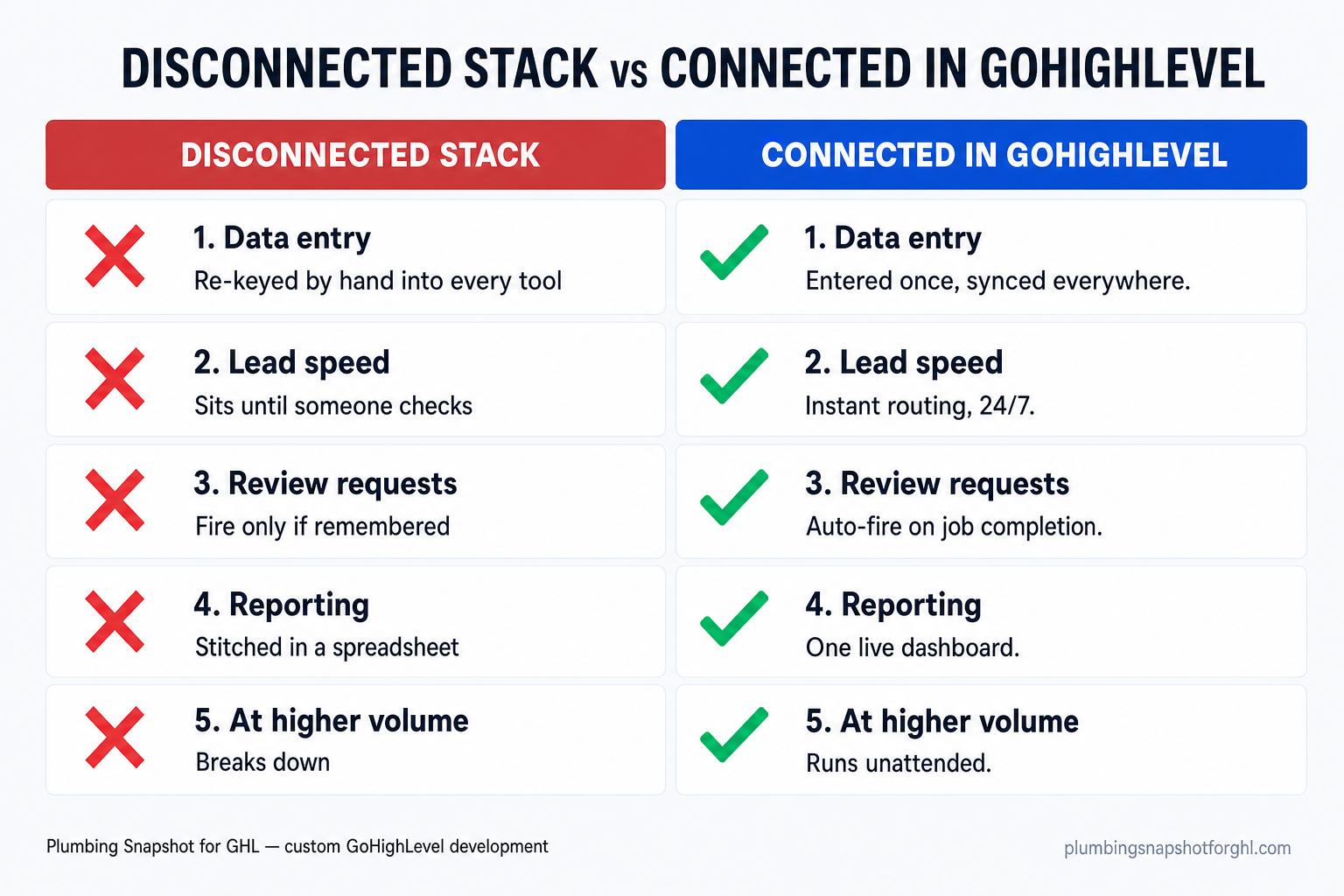
You can keep patching the gaps by hand — Zapier zaps, CSV exports, a VA copying records at 6 PM. It works until it doesn’t, and it never fires in real time. Here’s the honest comparison:
| Manual duct-tape | Custom GHL integration | |
|---|---|---|
| Data entry | Re-keyed into every tool by hand | Entered once, synced everywhere |
| Lead speed | As fast as someone checks the app | Instant routing, 24/7 |
| Review requests | Fire only when someone remembers | Auto-fire on job completion |
| Reporting | Stitched together in a spreadsheet | One live dashboard |
| Breaks when | Volume grows or the VA is out | Runs unattended |
| Cost | Your team’s hours, forever | One-time build from ~$3K; $75/hr retainer |
Wiring your own zaps isn’t wrong — plenty of sharp operators run their own GoHighLevel workflows. But no-code glue breaks at volume and can’t handle the two-way, real-time sync a busy plumbing shop needs. A custom integration from our GHL development team is fixed-price and scoped up front: small integrations start around $3K, with an hourly retainer at $75/hr if you’d rather pay as you go, and a 30-day bug-fix warranty on every build. The fastest way to a real number is a short scoping call.
Frequently asked questions
What does it mean that plumbing software is 'disconnected'?
It means your tools each hold a piece of the customer but don't share it. Your CRM has the lead, your scheduler has the appointment, your invoicing app has the payment, and your review tool has the feedback request — and none of them automatically hand off to the next. So people re-type the same job into each system, and work falls through the gaps between them: a lead nobody follows up, a completed job that never triggers a review. A connected stack passes the data automatically, so the handoffs happen without a human.
How do I connect ServiceTitan or Housecall Pro to GoHighLevel?
With a custom two-way integration built on their APIs. It syncs contacts, jobs, and pipeline stages between the field-service platform and your GoHighLevel sub-account, so a completed job in ServiceTitan or Housecall Pro automatically fires the review-request and maintenance-plan sequences in GHL, and no one re-keys customer records. You keep the field-service tool your techs like; GHL becomes the marketing and follow-up hub. Effectively anything with an API or webhook — including QuickBooks, Jobber, and FieldEdge — can be connected.
Do I have to leave my current field-service software?
No. Integration and migration are different paths. An integration keeps your existing platform and connects it to GHL two-way — ideal when your team relies on ServiceTitan or Housecall Pro for dispatch and you just need the data to flow. A migration moves you fully onto GHL to cut overlapping tools. Many shops start with an integration to stop the immediate bleeding, then migrate redundant pieces later. A scoping call sorts out which fits.
How much does a custom GoHighLevel integration cost for a plumbing shop?
Fixed-price quotes start around $3,000 for small integrations, with larger AI agents, dashboards, or client portals scoped individually. If you'd rather pay as you go, there's an hourly retainer at $75/hr with no minimums, and a 30-day bug-fix warranty is included free on every fixed-price build. Every project is scoped up front with a fixed timeline, so you get a real number before any work starts.
How long does a plumbing GHL integration take to build?
A field-service-to-GHL integration typically takes about 3 to 5 weeks; an AI emergency-triage chatbot 3 to 4 weeks; a custom job-tracking dashboard 5 to 8 weeks; and a full platform migration 2 to 4 weeks depending on data volume. Each build is scoped with a fixed timeline and milestones up front, and older data is preserved — for migrations we usually run the old and new systems in parallel for a short window so nothing is missed.
Is this only for large Philadelphia plumbing companies?
No — the return is often clearest for small and mid-size shops, because they feel the re-keying tax most. When one office manager is entering every job into three systems by hand, connecting those systems gives that person hours back every week and stops leads from cooling off. The math is simple: if a one-time integration recovers even one or two lost jobs a month, it pays for itself quickly, whether you run 2 trucks or 20.
About the author
Hector Salinas is the GHL Automation Lead for Plumbing Snapshot for GHL, based in Phoenix, AZ. He spent nine years dispatching for a 12-truck plumbing operation before he ever touched a CRM, and learned the hard way how a single dropped handoff turns into a lost five-figure job. He now maps the call flows, integrations, and emergency-dispatch automations that keep a plumbing shop’s systems talking to each other, and writes the way he’d brief a new service manager: plainly, with the revenue math attached.
Related reading
- How to Migrate a Plumbing Business to GoHighLevel (San Diego) — when consolidating beats integrating.
- GoHighLevel for Plumbers — the hub your other tools connect into.
- Missed-Call Text-Back for Plumbers — close the speed-to-lead gap the moment a call is missed.
- Double Your Google Reviews in 60 Days — the review pipeline that only fires when systems are connected.
- The Plumbing KPIs That Actually Run Your Business — the numbers a single connected dashboard finally makes visible.
- Custom GHL Development for Plumbers — integrations, AI agents, and migrations, scoped and fixed-price.