

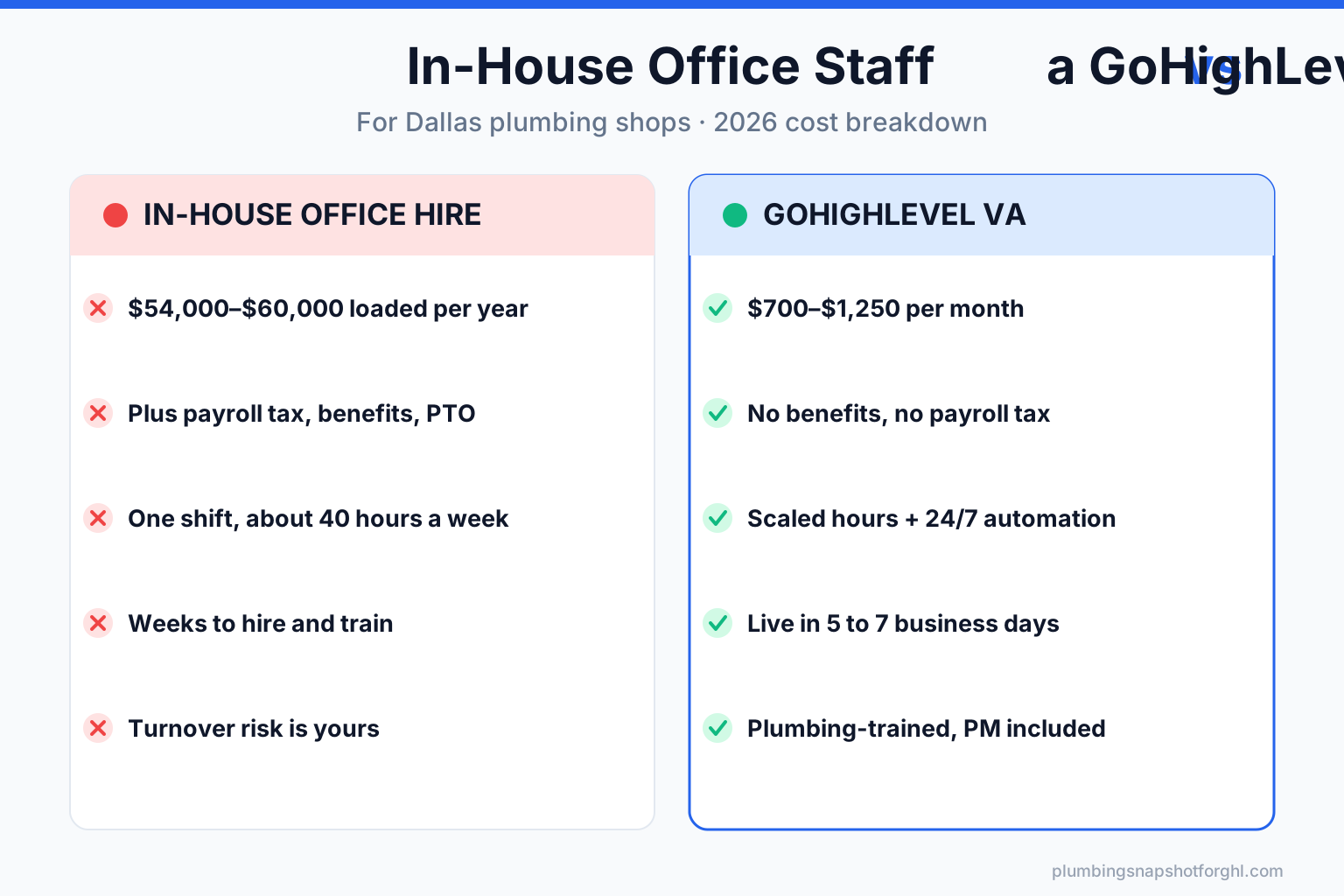
For most Dallas plumbing shops, a done-for-you GoHighLevel VA is the cheaper and more reliable way to run the back office than hiring in-house — and the gap is bigger than the salary line makes it look. A full-time front-office employee in Dallas doesn’t cost you their salary; they cost you 1.25× to 1.4× of it once you add payroll taxes, benefits, and overhead (U.S. Small Business Administration). That turns a $42,830 customer-service rep (U.S. Bureau of Labor Statistics) into a real cost near $54,000–$60,000 a year — for one person, one shift, five days a week. A dedicated GoHighLevel VA runs $700–$1,250 a month, carries no benefits or payroll tax, and comes already trained on plumbing dispatch workflows. This is the head-to-head: what each option actually costs, what each one covers, and which one books more of the jobs a Dallas shop is leaving on the table.
In this guide
- The short answer for a Dallas plumbing shop
- What an in-house office hire really costs in Dallas
- What a GoHighLevel VA costs
- In-house vs GoHighLevel VA: the head-to-head
- Coverage is the real difference — and it books jobs
- The hiring market is working against you
- “But I want someone in my office”
- When an in-house hire is the right call
- The done-for-you path: a plumbing-trained GHL VA
- Frequently asked questions
- About the author
- Related reading
The short answer for a Dallas plumbing shop
If your goal is to answer every call, run your CRM, and keep the pipeline moving without adding $60,000 of payroll, a dedicated GoHighLevel VA beats an in-house office hire for most Dallas plumbing shops — on cost, on speed to launch, and on coverage. An in-house employee makes sense when you need someone physically in the building every day (walk-in counter, parts runner, hands-on office manager over a large team). But the work most plumbing owners are trying to offload — answering and booking calls, updating the pipeline, chasing estimates, sending review requests, running automations — is exactly the work a trained GHL VA does remotely, for a quarter of the loaded cost.
The reason the math tilts so hard isn’t the hourly rate you see on a job board. It’s everything stacked on top of it: the employer’s share of payroll taxes, health coverage, paid time off, workers’ comp, software seats, a desk and a computer, and the very real risk that the person quits in eight months and you pay to hire all over again. A managed VA service folds all of that — recruiting, training, backup, and management — into one flat monthly number. For an owner who should be running trucks and closing jobs, that predictability is worth as much as the savings.
I dispatched for a 12-truck shop before I ever touched a CRM. The office manager we hired was great — until she left for a job with benefits, and we spent three months and a small fortune replacing her while calls went to voicemail. The point isn’t that in-house people are bad. It’s that one desk, one shift, and one resignation is a fragile way to run the phones for a business where the money comes in at 2 a.m.
What an in-house office hire really costs in Dallas
Start with the number everyone anchors on — the salary — then add what actually lands on your P&L.
According to the U.S. Bureau of Labor Statistics, national median pay is $37,230/year for a receptionist (BLS), $42,830/year for a customer-service representative (BLS), and $47,460/year for a secretary or administrative assistant (BLS). If you want an actual office manager running the front of a Dallas plumbing shop, Salary.com puts the Dallas, TX average at about $83,453/year (Salary.com).
Now the multiplier. The Small Business Administration is blunt about it: the true cost of an employee typically runs 1.25 to 1.4 times their base salary once you add the employer’s 7.65% share of Social Security and Medicare (IRS), unemployment tax, workers’ comp, health benefits, and overhead. The SBA’s own example: a $35,000 salary really costs $43,750 to $49,000 (SBA). Apply that to your plumbing front office:
Estimated loaded annual cost (base salary × ~1.3 midpoint multiplier). Base pay: BLS national medians (receptionist $37,230; CSR $42,830) and Salary.com Dallas office-manager average ($83,453). Multiplier: SBA — How Much Does an Employee Cost You?
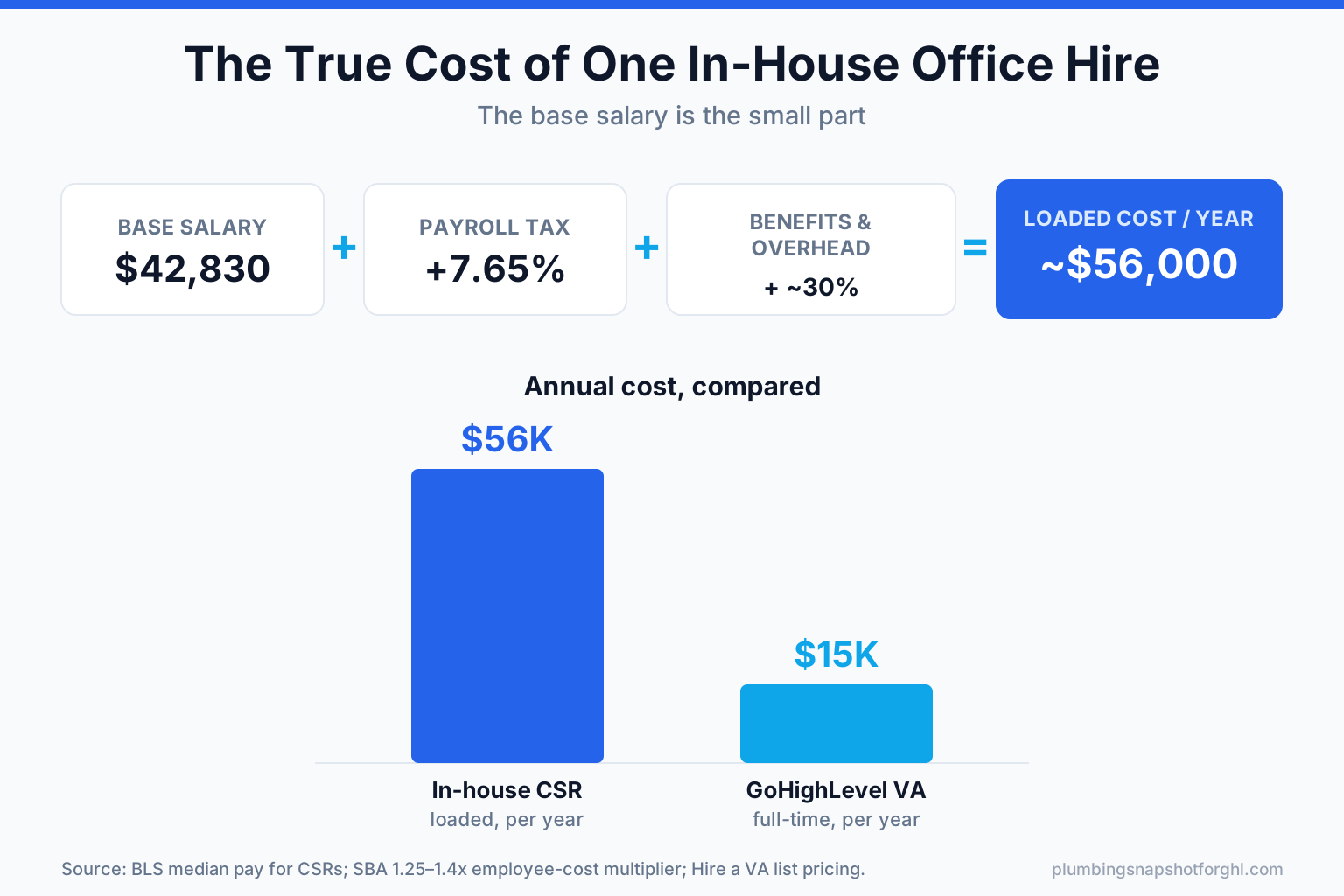
So a Dallas CSR you’d hire at $42,830 is really a $54,000–$60,000 line item once loaded, and a full office manager pushes past $100,000. And that’s before turnover. SHRM’s widely cited research estimates that replacing an employee costs 50% to 200% of their annual salary in recruiting, onboarding, and lost productivity (SHRM, via Waterfall Planning) — so if your $54,000 hire leaves within a year, you’re out tens of thousands more to do it again.
What a GoHighLevel VA costs
A dedicated GoHighLevel VA is priced as a flat monthly service, and the number is the number — there’s no employer tax, no benefits load, and no recruiting bill stacked on top. The plans are:
- Growth — $700/month: 4 hours/day, Monday–Friday (~80 hours/month). Part-time coverage for a growing shop.
- Power — $1,250/month: 8 hours/day, full-time dedicated support (~160 hours/month).
- Elite — $1,500/month: full-time plus developer support for custom pages, APIs, and integrations.
- Pay-as-you-go — $20/hour: no contract, for one-off fixes and setups.
Every plan includes a project manager who monitors the work and a wider team (workflow specialists, voice-AI engineers, A2P experts) behind your VA — so when a tricky webhook or A2P registration comes up, they get the answer instead of you. There’s no separate recruiting cost, no niche-orientation fee, and you’re typically live in 5–7 business days rather than the weeks a real hire takes.
Line those numbers up against the loaded in-house figures and the comparison stops being close:
Estimated annual cost. In-house CSR = $42,830 base (BLS) × ~1.3 loaded (SBA). GHL VA = list monthly price × 12 (Hire a VA).
A full-time GHL VA at roughly $15,000/year versus a loaded in-house CSR at $54,000–$60,000/year is about $38,000–$45,000 saved every year — and that’s the conservative comparison, before you count the turnover, PTO, and management time the VA service absorbs and the employee doesn’t. That’s illustrative math built from published salary data and our list pricing, not a vendor’s “save 70%” slogan — run your own numbers and the direction won’t change.
In-house vs GoHighLevel VA: the head-to-head
Cost is only half the decision. Here’s how the two options compare on the things that actually run a plumbing office.
| What matters for a plumbing office | In-house office hire | GoHighLevel VA |
|---|---|---|
| Real annual cost | $49K–$110K+ (loaded) | $8.4K–$18K |
| What you pay on top of pay | +7.65% FICA, benefits, PTO, workers’ comp, equipment | Nothing — flat monthly fee |
| Time to productive | Weeks to hire + weeks to train | Live in 5–7 business days |
| Turnover risk | Yours — 50–200% of salary to replace | Absorbed by the service (backup VA + PM) |
| GHL / plumbing skill | You train it, or hope they have it | Pre-trained on GHL + plumbing dispatch |
| Coverage | One person, one shift, ~40 hrs/week | Scaled hours; pairs with 24/7 automation |
| Management | You (or your ops lead) | Dedicated project manager included |
| Scaling up or down | Hiring/firing, severance, HR risk | Change your plan |
The pattern is consistent: the in-house column is full of costs and risks you carry, and the VA column moves most of them off your plate for a predictable monthly number. That’s the whole argument for done-for-you — not that you can’t hire a great person, but that you shouldn’t have to become an HR department, a trainer, and a payroll administrator to get the phones answered. Notably, 66% of business owners now handle HR tasks with no help at all, up from 55% the year before (OnPay 2025 Small Business Outlook) — every in-house hire adds to that pile.
Coverage is the real difference — and it books jobs
Here’s the part the salary comparison misses entirely: an in-house desk covers one shift, but plumbing money comes in around the clock. A single receptionist works roughly 40 hours a week. Burst pipes, water-heater failures, and backed-up mains don’t. The nights, weekends, and lunch hours your one hire isn’t at the desk are exactly when a panicked Dallas homeowner is calling — and if you don’t answer, they call the next shop on the map.
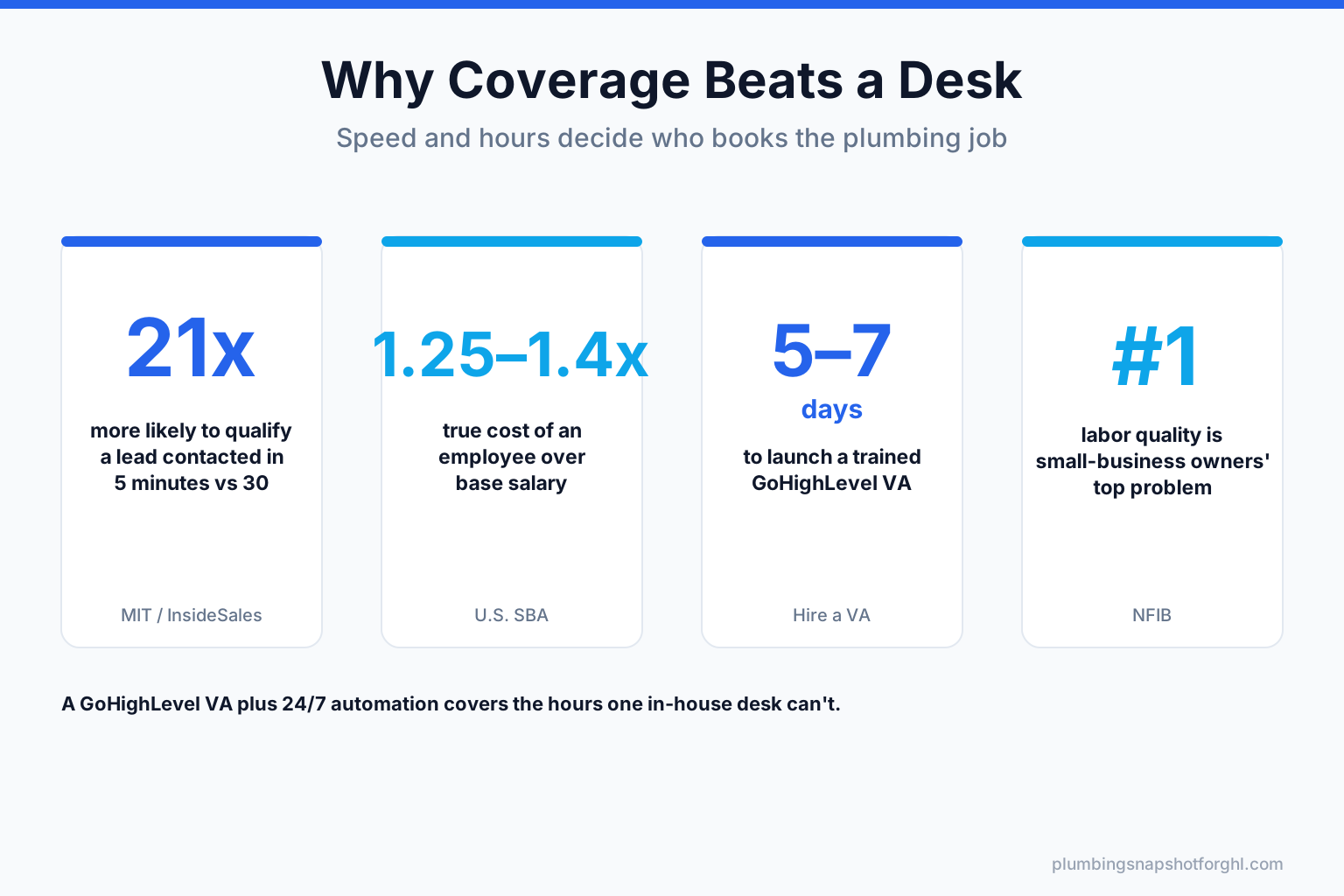
Speed is measurable, and it’s brutal. The landmark MIT / InsideSales lead-response study — 15,000+ leads and 100,000+ call attempts — found that contacting a lead within 5 minutes instead of 30 makes you 21× more likely to qualify that lead (MIT / InsideSales). Harvard Business Review’s audit of 2,241 U.S. companies found the average firm took 42 hours to respond to a web lead, 23% never responded at all, and only 37% responded within an hour — yet those who reached the lead within an hour were 7× more likely to have a meaningful conversation than those who waited just one hour longer (Harvard Business Review).
How much response speed multiplies your odds of qualifying/connecting with a lead. Sources: MIT / InsideSales Lead Response Management study; HBR — The Short Life of Online Sales Leads.
This is where the done-for-you model wins twice. A GoHighLevel VA doesn’t just answer during their hours — they run the automations that answer when nobody can: instant missed-call text-back, the after-hours AI receptionist that qualifies and books the 2 a.m. emergency, and the follow-up sequences that keep an estimate from going cold. One in-house hire simply can’t be at the desk for all of that. The VA plus the automation covers the hours your competitor’s voicemail doesn’t. If you’re weighing pure call coverage, our breakdown of a plumbing answering service vs automation goes deeper on that trade-off.
The hiring market is working against you
Even if you decide you want an in-house person, finding and keeping one in 2026 is genuinely hard. NFIB’s small-business data shows more than a third of owners have job openings they can’t fill — well above the 24% historical average — and owners consistently name labor quality and availability as their single most important problem, far above its long-run norm (NFIB Jobs Report). Front-office roles are among the hardest to keep filled because they’re the easiest for a good employee to leave for a shop that offers benefits or a dollar more an hour.
That’s the quiet risk in the in-house plan: you don’t just pay the loaded salary once. You pay it, you carry the recruiting time, and then you may pay a big slice of it again when the person leaves — SHRM’s 50%–200% of salary replacement estimate (SHRM, via Waterfall Planning). A managed VA service is built to absorb exactly this: if your VA is out or moves on, the service backfills with a trained replacement and the PM keeps the work moving. Your phones don’t go to voicemail because someone gave two weeks’ notice.
The owners who get burned aren’t the ones who hired badly — they hired fine. They got burned by turnover they couldn’t control and a coverage gap they didn’t see until the reviews started mentioning “nobody answered.” Buy the outcome, not the seat.
“But I want someone in my office”
Fair — and for some tasks, you genuinely need a body in the building: a walk-in counter, parts pickups, physically wrangling a large field crew. Nobody should offshore that. But be honest about which tasks actually require presence. Answering and booking calls, keeping the GoHighLevel pipeline current, sending estimates and following up, running review-request and maintenance-plan automations, cleaning up your calendar, and reporting on your plumbing KPIs — none of that needs a desk in Dallas. It needs someone who knows GHL and shows up reliably.
The most common winning setup we see isn’t “VA instead of everyone.” It’s a lean in-house presence for the physical work, plus a GHL VA running the CRM and the phones, plus automation covering the hours neither is working. You get coverage and control without a six-figure office payroll.
When an in-house hire is the right call
To keep this honest, an in-house employee is the better choice when:
- You need someone physically present every day (counter, warehouse, hands-on field coordination).
- You’re a large multi-location operation where a full-time office manager oversees several in-house staff and vendors.
- The role is deeply local and relational — walking permits through a Dallas building department, managing in-person supplier relationships.
- You have the HR maturity to recruit, train, and retain well, and the volume to keep a full-time seat busy.
If that’s you, hire — and consider a GHL VA to handle the CRM and automation around that person so your expensive hire isn’t stuck doing data entry. For most solo-to-mid-size plumbing shops, though, the VA-plus-automation model delivers the same output for a fraction of the loaded cost.
The done-for-you path: a plumbing-trained GHL VA
If you’re a Dallas plumbing operator weighing this, the takeaway is simple: you don’t need to hire, train, and insure a full-time employee to get your phones answered and your CRM run — you need the work done, reliably, for a predictable number. That’s what our Hire a VA service delivers. You get a dedicated GoHighLevel expert already trained on plumbing dispatch, emergency-call pipelines, maintenance-plan automations, and review sequences — backed by a project manager and a full specialist team — starting at $700/month part-time or $1,250/month full-time, live in about a week. No payroll tax, no benefits, no turnover bill, and no HR headache. You run the trucks; we run HighLevel.
Frequently asked questions
Is a GoHighLevel VA cheaper than hiring in-house for a Dallas plumbing shop?
For most shops, yes — significantly. A GHL VA is $700/month part-time (~$8,400/year) or $1,250/month full-time (~$15,000/year) with no payroll tax, benefits, or turnover cost. An in-house customer-service rep earns a $42,830 national median (BLS), but the SBA notes the true cost of an employee is 1.25–1.4× base pay once you add taxes, benefits, and overhead — roughly $54,000–$60,000 loaded. That's about $38,000–$45,000/year more than a full-time VA.
What does an in-house office employee really cost beyond salary?
The Small Business Administration puts the true cost of an employee at 1.25 to 1.4 times their base salary. On top of wages you pay the employer's 7.65% share of Social Security and Medicare, unemployment tax, workers' comp, health benefits, paid time off, and equipment. Their example: a $35,000 salary really costs $43,750–$49,000. For a Dallas plumbing office, that turns a $42,830 CSR into a ~$56,000 line item and a $83,453 office manager into $100,000-plus.
What can a GoHighLevel VA actually do for a plumbing business?
A trained GHL VA answers and books calls, keeps your CRM pipeline current, builds and maintains workflow automations (emergency-dispatch sequences, maintenance-plan reminders, no-show recovery), sends estimates and follow-ups, runs review-collection campaigns, configures telephony and A2P, and reports on your KPIs. Ours are pre-trained on plumbing dispatch workflows, so there's no niche-orientation fee or long ramp.
How fast can I get a VA versus hiring an employee?
A dedicated GHL VA is typically live in 5–7 business days — we open the search the moment you sign up and match you to a trained VA, then a project manager joins your workspace. Hiring an employee usually means weeks of recruiting plus weeks of training before they're productive, and NFIB data shows more than a third of small-business owners currently can't fill the openings they have.
What happens if my VA quits or is sick?
That's the risk a managed service is built to absorb. Your VA sits inside a wider team, so if they're out or move on, the service backfills with a trained replacement and the project manager keeps the work moving — your phones don't go to voicemail. With an in-house hire, turnover is entirely your cost: SHRM estimates replacing an employee runs 50%–200% of their annual salary.
Do I still need an office manager if I hire a VA?
It depends on your size and how much physical, in-person work you have. Many plumbing shops keep a lean in-house presence for counter and field coordination and use a GHL VA to run the CRM, phones, and automations around them — getting coverage and control without a six-figure office payroll. Large multi-location operations may still want a full-time office manager, ideally with a VA handling the GHL work so the manager isn't doing data entry.
About the author
Hector Salinas is the GHL Automation Lead for Plumbing Snapshot for GHL, based in Phoenix, AZ. He spent nine years dispatching for a 12-truck plumbing operation before he ever touched a CRM, and he learned firsthand how a single missed after-hours call — or a single office resignation — turns into lost five-figure work. He now maps after-hours call flows, on-call rotations, and emergency-dispatch automations for the Plumbing Snapshot, and he writes the way he’d brief a new service manager: plainly, with the revenue math attached.
Related reading
- How a GoHighLevel VA Runs the Back Office for Chicago Plumbers — what a dedicated GHL VA actually does day to day.
- Missed-Call Text-Back for Plumbers — the automation that catches the callers a single desk can’t.
- Plumbing Answering Service vs Automation — the deeper trade-off on pure call coverage.
- The After-Hours AI Receptionist Playbook — how to answer the 2 a.m. emergency automatically.
- GoHighLevel for Plumbers — the full automation system your VA runs.
- Hire a VA — a plumbing-trained GHL expert from $700/month.