
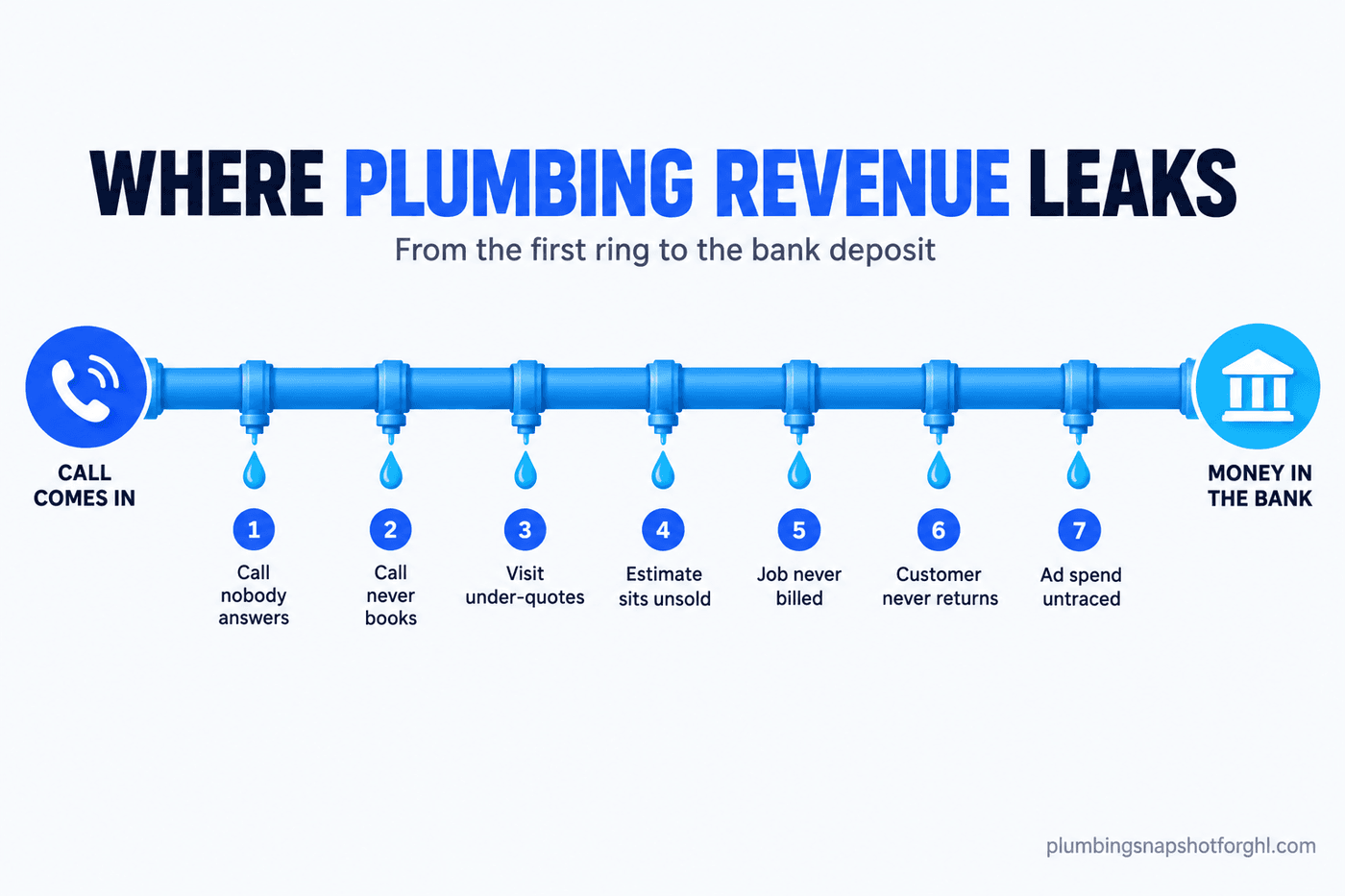
If the phone rings all day and the bank account still looks thin, your problem usually isn’t leads, it’s leaks. The money is already coming toward you. It drains out in the gap between the first ring and the deposit, through seven predictable holes: calls nobody answers, answered calls that never book, visits that never quote real options, estimates that sit unsold, finished jobs that don’t get invoiced, customers who never come back, and ad spend you can’t trace. Plug the leaks and you make more money on the exact same call volume, without spending another dollar on marketing. This is the operator’s teardown of all seven, with the dollar cost, the fix, and the copy you can steal for each.
In this guide
- Why a busy phone can still lose money
- What the leaks cost you right now
- The 7 places plumbing revenue leaks
- Leak 1: The call nobody answers
- Leak 2: The answered call that never books
- Leak 3: The visit that never quotes real options
- Leak 4: The estimate that sits unsold
- Leak 5: The finished job that never gets billed
- Leak 6: The customer you never see again
- Leak 7: The ad spend you can’t trace
- Steal these messages
- Where the biggest leak is by shop size
- Staying legal when you automate the fixes
- Objections
- Frequently asked questions
- About the author
Why a busy phone can still lose money
Because volume and profit are two different things, and the phone only measures volume. You can take forty calls a day, run three trucks flat out, and still watch the account crawl, because the number that pays your mortgage isn’t calls, it’s the share of those calls that turns into collected, high-ticket, repeat work. A shop that answers every call, books half, quotes real options, follows up, invoices same day, and keeps the customer will bury a shop that does twice the call volume and fumbles each step.
Here’s the trap. The plumbing trade is genuinely busy right now. The Bureau of Labor Statistics counts about 510,600 plumbers, pipefitters, and steamfitters in the workforce, projects 7% growth from 2025 to 2035 (faster than the average job), and expects roughly 42,000 openings a year (BLS Occupational Outlook Handbook). Demand is not your problem. Homes keep flooding: water damage and freezing were 27.6% of all homeowners insurance claims in 2022, averaging $13,954 per claim across 2018 to 2022 (Insurance Information Institute). The work is out there, banging on the door.
So if you’re busy and broke, more marketing is almost never the answer. You’d be pouring more water into a bucket with seven holes. The fix is to find the holes and plug them, and you can do that this week for free.
What the leaks cost you right now
More than you think, because plumbing tickets are large and the leaks compound. Every hole passes its water to the next one, so a call lost at Leak 1 was never going to reach the deposit at all. Put a rough dollar figure on it before you look away.
Take a shop that generates 100 service opportunities a month, a mix of calls, form fills, and texts. Watch the water fall out at each stage using ordinary home-services benchmarks:
Illustrative funnel for a shop with 100 monthly opportunities, using mid-range home-services conversion benchmarks. Answer and booking rates from WebFX 2026 home-services benchmarks; follow-up drop-off from Invesp.
Out of 100 chances, this shop keeps 24. That isn’t unusual, it’s normal, and it’s the reason a full schedule doesn’t equal a full account. Now flip it. If you lift the answered rate from 78 to 92, the booking rate from 55 to 68, and add one round of follow-up, you don’t need a single extra lead to roughly double the jobs that reach the deposit. The average plumbing ticket makes the math brutal: a lost job is rarely an $89 service call. It’s a $1,300 water heater or a $7,500 whole-home repipe (Angi). Two recovered jobs a month is often more money than a whole new marketing channel.
The 7 places plumbing revenue leaks
Think of a dollar’s journey from the first ring to your bank. It has to survive seven checkpoints, and most shops leak at every one. Here’s the whole map before we walk it hole by hole.
| # | Leak | Where it happens | The one-line fix |
|---|---|---|---|
| 1 | The call nobody answers | After hours, on a job, on hold | Instant text-back + 24/7 AI answer |
| 2 | The answered call that never books | Price shopper, no script, no urgency | A booking-first phone script |
| 3 | The visit that never quotes options | Diagnostic only, no price book | Flat-rate good/better/best on the truck |
| 4 | The estimate that sits unsold | No follow-up on the quote | A 30-day automated cadence |
| 5 | The finished job that never gets billed | Slow invoicing, no card on file | Same-day invoice + card on file |
| 6 | The customer you never see again | No plan, no review, no reactivation | Maintenance plan + review + reactivation |
| 7 | The ad spend you can’t trace | No call tracking or attribution | Track every source, cut the losers |
None of these needs new leads. Every one is money you already earned the right to collect. Let’s plug them.
Leak 1: The call nobody answers
This is the biggest hole and the one shops defend the hardest. A homeowner with water spreading across the kitchen floor does not leave a voicemail and wait. They hang up and dial the next plumber on the map. The call you missed at 7:40 a.m. while you were under a sink is a booked job for somebody else by 7:43.
Start with how many calls never get picked up at all: about 27% of calls to home-services businesses go unanswered (Invoca). Then the research on response speed piles on. Contacting a lead within 5 minutes instead of 30 makes you about 100× more likely to reach them and 21× more likely to qualify the job (MIT / InsideSales). Yet when Harvard Business Review audited 2,241 companies, the average first response took 42 hours, and 23% never responded at all (Harvard Business Review). Add in that 77% of customers expect to interact with someone immediately when they reach out (Salesforce), and the picture is clear: the reward for simply being the phone that gets answered is enormous.
How it leaks: after-hours calls to voicemail, hold times that make people hang up, form fills nobody sees until morning, and the second line that rings out while you’re on the first.
The fix: an automatic text-back on every missed call within seconds, plus a 24/7 AI answer for the calls a human can’t take. The text buys you the lead while you’re still elbow-deep in a job. Read the full build in missed-call text-back for plumbers and the after-hours AI receptionist playbook.
Leak 2: The answered call that never books
You answered, and still lost it. This leak is quieter because it feels like the customer’s fault. It usually isn’t. A price shopper who “just wanted a number” hung up because whoever answered read the price off a sheet and stopped talking. The call had no script, no urgency, and no next step.
Home-services shops that run a real phone process book 30% to 50% of qualified calls, while shops without one sit well below that (WebFX). The gap between a 35% and a 55% booking rate on the same call volume is a different company at the end of the year.
How it leaks: no booking-first script, quoting exact prices over the phone on a job that needs eyes on it, no urgency for an active leak, and no follow-up text when the caller says “let me think about it.”
The fix: a phone script whose only goal is to book the visit, not to win a debate about price. Give a range, book the diagnostic, confirm by text, and set the follow-up. The person answering doesn’t need to be a closer, they need to get the truck to the door.
Leak 3: The visit that never quotes real options
The truck rolled, the tech diagnosed the problem, and quoted the one repair the customer asked about. Nothing more. That’s a leak, because the highest-margin work is the work the homeowner didn’t know to ask for, and the tech either didn’t see it or didn’t want to “sell.”
This is the leak owners feel as “my techs don’t sell.” They’re not wrong, but the fix isn’t a sales seminar. It’s a flat-rate price book that gives the tech options to present, so quoting is a menu, not a pitch. Good/better/best pricing on the same job lets the customer choose up without the tech feeling like a salesman.
How it leaks: diagnostic-only visits, no flat-rate book so pricing is invented on the spot, no repair-versus-replace conversation on aging equipment, and no photo of the actual problem to justify the number.
The fix: a flat-rate price book every tech follows, presented as options, backed by a photo of the problem. Photo-backed quotes close far better because the homeowner sees what you see. Walk through it in why photo-backed quotes close 2× more water heaters.
Leak 4: The estimate that sits unsold
You quoted the repipe. Then nothing. The estimate is sitting on a kitchen counter next to two competitors’ quotes, and the shop that follows up first usually wins, no matter who was cheapest.
The numbers here are the most wasteful in the whole business. Only about 2% of sales close on the first contact, while roughly 80% require five or more follow-ups (Invesp). And yet 44% of reps quit after one. Most plumbing shops quit after zero. They send the quote and hope.
How it leaks: no same-day recap, no scheduled cadence, relying on the tech to remember, and going quiet the moment the customer goes quiet.
The fix: a 30-day automated follow-up sequence that fires off the “estimate sent” event, a same-day recap text, a value-add on day 2, a nudge on day 3, a decision prompt on day 7, and a last ask before it expires. The full cadence and templates are in plumbing estimate follow-up. Text does the heavy lifting here: SMS runs about a 98% open rate versus 20% for email (Gartner).
Leak 5: The finished job that never gets billed
This one strangles good shops, the busy ones especially. The work is done, the customer is happy, and the invoice goes out four days later, or never, because the paperwork is buried in a truck cab. Money you already earned is sitting as aged receivables instead of cash in the account, and every day it ages, the odds of collecting it drop.
Cash flow, not profit on paper, is what kills busy contractors. You can be profitable and still miss payroll if the money you earned is stuck in unbilled and slow-paid jobs. The fix is unglamorous and it works: invoice on site the moment the job is done, take a card on file, and let the system chase the balance automatically.
How it leaks: invoices sent days late, no card on file so you’re waiting on a check, no automated payment reminders, and no financing option on the big-ticket jobs that stall because the homeowner can’t write a $7,500 check today.
The fix: same-day invoicing from the truck, a card on file at booking, automated payment reminders, and a financing offer on high-ticket work so a repipe isn’t a cash-flow decision for the customer. See plumbing financing and payment plans for the offer side.
Leak 6: The customer you never see again
You fixed the water heater, they paid, and you’ll never hear from them again, until it breaks and they Google someone else. That’s the retention leak, and it’s the most expensive one over time, because you already paid to win this customer. Winning them a second time is nearly free, and you’re not doing it.
Two things plug this hole: a recurring maintenance plan that keeps you in the home on a schedule, and a review request the same day the job closes so the next homeowner finds you first. A shop with 300 plan members has 300 reasons to visit next year and a wall of fresh five-star reviews. A shop without one starts every January at zero.
How it leaks: no maintenance plan offered at the close, no review request while the customer is happy, no database reactivation for the customers you served last year, and no reason for them to remember your name.
The fix: offer the maintenance plan at every close, fire a review request automatically the day the job completes, and run a quarterly reactivation to your existing list. The plays are in the maintenance-plan flywheel, automated Google reviews, and database reactivation for plumbers.
Leak 7: The ad spend you can’t trace
The last leak is the one that funds all the others. If you can’t tell which calls came from which source, you can’t tell which marketing makes money, so you keep paying for the channels that don’t and starve the ones that do. Worse, you can’t even see the leaks above, because you have no numbers on answered rate, booking rate, or close rate.
How it leaks: one phone number on every ad so nothing is traceable, no call tracking, no idea of your booking or close rate, and a gut feeling standing in for a dashboard.
The fix: track every source with its own number, watch the funnel numbers weekly, and move budget toward what books. You don’t need a data team. You need to know your answered rate, booking rate, and close rate, and to check them the way you check your bank balance. Start with the plumbing business KPIs that actually matter.
Steal these messages
The fixes above run on a handful of short messages. Here they are, ready to load into your system. Keep them plain, keep them human, and keep the opt-out on the marketing-style ones.
Six messages, and they close five of the seven leaks. That’s the whole point: the fixes aren’t complicated, they just have to fire every time, which is exactly what a person on a busy truck can’t promise and a workflow can.
Where the biggest leak is by shop size
The seven leaks are universal, but the one bleeding hardest depends on how big you are. Run the diagnosis for your size before you spend a dime.
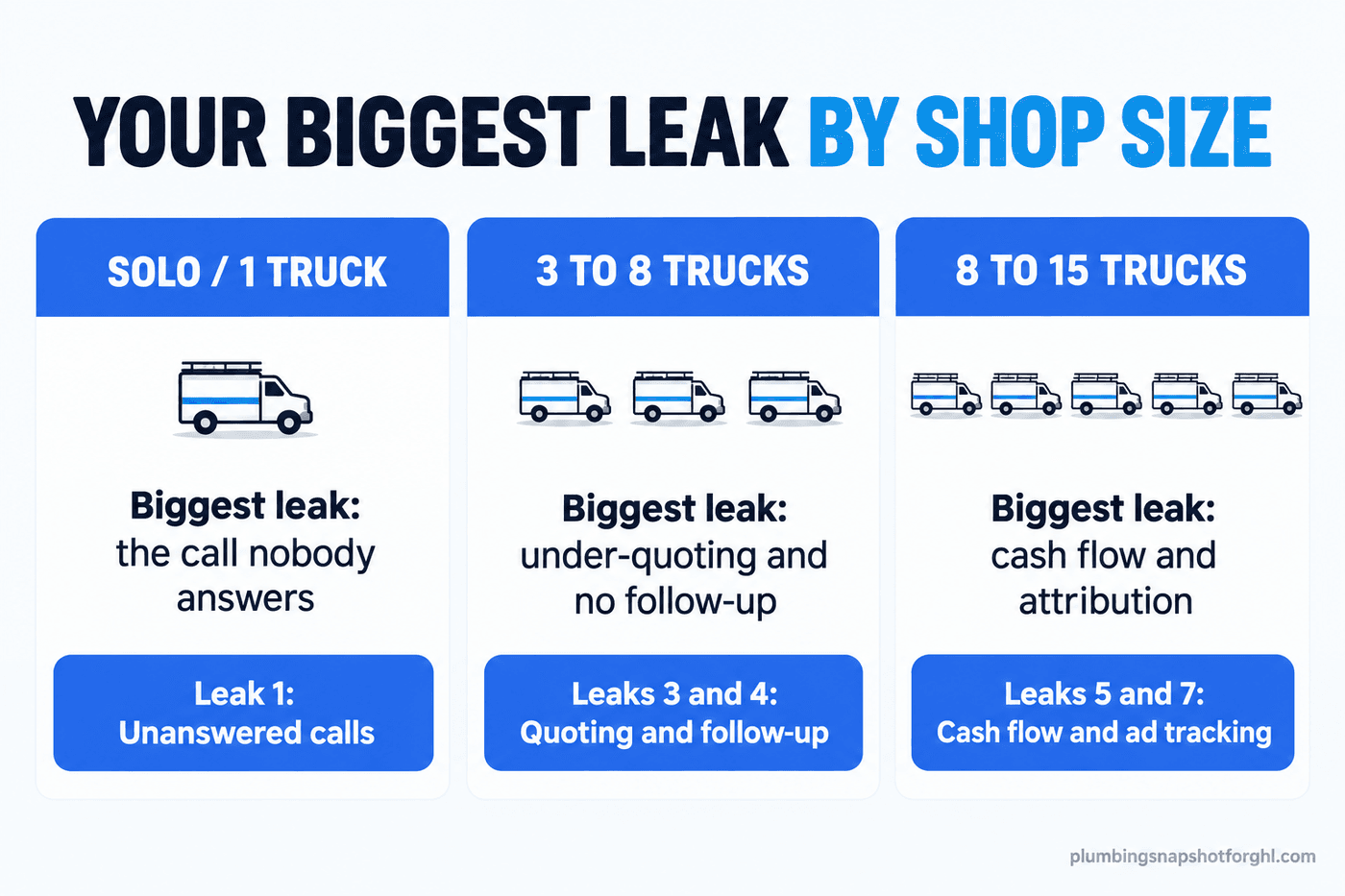
The solo operator (1 truck). Your biggest leak is almost always Leak 1, the call nobody answers, because you are the truck, the office, and the after-hours line, and you physically cannot answer while your hands are wet. You lose the most money to voicemail. Start there: an instant text-back and a 24/7 answer is the single highest-return fix you can make, and it pays for itself the first week you catch a $1,300 water heater you’d have slept through.
The mid-size shop (3 to 8 trucks). You’ve got someone answering the phone now, so your leak moves downstream, to Leaks 3 and 4, the visit that under-quotes and the estimate nobody follows up. Your techs are busy, not sellers, and your quotes die on kitchen counters. A flat-rate price book and an automated follow-up cadence are worth more to you than another Google Ads dollar. This is the size where “my techs don’t sell” and “my quotes go cold” cost the most.
The larger operation (8 to 15 trucks). Your leaks are Leak 5 and Leak 7, cash flow and attribution. At your volume, a four-day invoicing lag is real money tied up, and one untraceable phone number across your ads means you can’t see which of your channels actually pays. Same-day invoicing with a card on file, plus proper call tracking on every source, is where your recovered dollars are. You have the volume, you’re leaking it on the back end.
Staying legal when you automate the fixes
The moment you turn on automatic texts, missed-call replies, follow-ups, and review requests, you’re operating under TCPA and A2P 10DLC rules. This isn’t a reason to avoid automation, it’s a reason to do it right, and the basics are simple.
Register your sending number with the carriers through A2P 10DLC or your texts get filtered before anyone reads them. Put an opt-out (“Reply STOP”) on marketing-style messages and honor it instantly. Keep non-emergency texts inside legal hours, no “still deciding?” pings at 10 p.m. And note the newer requirement that campaign registration carry a privacy policy and terms URL, which took effect in 2026. Replying to a homeowner who just called you is defensible because you have a clear business relationship. Blasting an old list without consent is not. The full framework is in TCPA compliance for plumbing SMS and the 2026 plumbing marketing compliance guide.
Objections
“I don’t have a lead problem, I’m slammed.” Then you definitely have a leak problem, because slammed and profitable are not the same thing. A shop that keeps 24 of every 100 opportunities is leaving the other 76 on the floor. Plugging leaks doesn’t add to your workload, it adds to your deposit from the work you’re already doing.
“My guys are plumbers, not salespeople, and I want to keep it that way.” So keep it that way. The fix for the quoting leak isn’t turning techs into closers, it’s giving them a flat-rate price book with good/better/best options so quoting is reading a menu, not making a pitch. The customer chooses. The tech just presents the options and the photo.
“I already pay for ServiceTitan / Housecall Pro / Jobber, isn’t this their job?” Those are field-service platforms, good at dispatch and invoicing. Where most shops still leak is the marketing-side automation: missed-call text-back, an after-hours AI answer, a follow-up cadence on unsold quotes, and review harvesting. You bolt that on alongside what you have. See what plumbing software actually costs in 2026 for how the pieces fit.
“I’m not technical, this sounds like a project.” It’s an afternoon of setup, or none if it’s done for you. You approve the messages, connect your number, and it runs. If you’d rather never touch it, hire a done-for-you GHL VA to own it, or have the Plumbing Snapshot installed in 24 hours.
Frequently asked questions
Why is my plumbing business busy but not profitable?
Because volume and profit are different things. A busy phone measures how many people call, not how many turn into collected, high-ticket, repeat work. Revenue leaks in seven predictable spots between the first ring and the deposit: unanswered calls, answered calls that never book, visits that under-quote, unsold estimates, unbilled jobs, lost repeat customers, and untraceable ad spend. Fix the leaks and the same call volume produces far more money.
What's the single biggest revenue leak for a small plumbing shop?
For a solo or 1-truck operator, it's almost always the call nobody answers. You are the truck, the office, and the after-hours line, so you can't answer while your hands are wet, and homeowners with an active leak call the next plumber rather than leave a voicemail. Contacting a lead within 5 minutes instead of 30 makes you about 21x more likely to qualify it (MIT/InsideSales), so an instant missed-call text-back plus a 24/7 answer is usually the highest-return fix a small shop can make.
How do I know which leak is costing me the most?
Pull last month's numbers and count five things: opportunities in, calls answered within 5 minutes, visits booked, jobs sold, and invoices paid within 3 days. The stage with the steepest drop-off is your worst leak. Solo shops usually leak most at the answer stage, mid-size shops at quoting and follow-up, and larger shops at cash flow and attribution.
Do I need to make my techs into salespeople?
No. The quoting leak is fixed with a flat-rate price book that gives techs good/better/best options to present, not a sales seminar. The customer chooses their option, and the tech just presents the menu, backed by a photo of the actual problem. That keeps quoting honest and consistent and closes more high-margin replace work without turning a plumber into a closer.
How much revenue can plugging these leaks actually recover?
It depends on your ticket size, but the payoff is large because plumbing jobs are expensive. A lost job is often a $1,300 water heater or a $7,500 repipe (Angi). A shop keeping 24 of every 100 opportunities that lifts its answered, booking, and follow-up rates can roughly double the jobs reaching the deposit on the same lead volume. Recovering even two jobs a month is frequently more money than an entire new marketing channel would add.
Is it legal to send automated texts to customers?
Yes, when you follow TCPA and A2P 10DLC rules: register your sending number with the carriers, include an opt-out (Reply STOP) on marketing-style messages and honor it immediately, keep non-emergency texts inside legal hours, and make sure your campaign registration carries a privacy policy and terms URL, which became a requirement in 2026. Replying to a homeowner who just called you is defensible; blasting an old list without consent is not.
Can I plug these leaks without switching my main software?
Yes. Most of the leaks are on the marketing-automation side: missed-call text-back, after-hours answering, estimate follow-up, review harvesting, and reactivation. You can add those alongside a field-service platform like ServiceTitan, Housecall Pro, or Jobber. The Plumbing Snapshot wires those flows into GoHighLevel and connects to your booking, so you keep your dispatch and invoicing tools and close the marketing leaks they don't cover.
Related posts
- Missed-Call Text-Back for Plumbers (2026): plug Leak 1 with an instant reply on every missed call.
- Plumbing Estimate Follow-Up (2026): the 30-day cadence that closes Leak 4.
- Why Photo-Backed Quotes Close 2× More Water Heaters: fix the under-quoting at Leak 3.
- The Maintenance-Plan Flywheel: turn one-time jobs into repeat revenue at Leak 6.
- The Plumbing Business KPIs That Actually Matter: the numbers that expose every leak.
- What Plumbing Software Actually Costs in 2026: how the tools fit and what you really pay.
Sources
- BLS: Plumbers, Pipefitters, and Steamfitters (Occupational Outlook Handbook)
- Insurance Information Institute: Homeowners and Renters Insurance facts + statistics
- Invoca: How much missed sales calls cost home-services businesses
- MIT / InsideSales: Lead Response Management study (via LeadAngel)
- Harvard Business Review: The Short Life of Online Sales Leads
- Invesp: The Importance of Sales Follow-Ups (statistics)
- Gartner: Tap Into the Marketing Power of SMS
- WebFX: 2026 Home Services Marketing Benchmarks
- Salesforce: State of the Connected Customer
- Angi: Cost to Repipe a House (2026)
About the author
Yvonne Castellanos runs partner success at Plumbing Snapshot for GHL, based in Charlotte, NC. She has onboarded plumbing contractors from solo owner-operators to regional outfits running recurring maintenance memberships, and her focus is the boring money: the review pipelines, maintenance-plan flywheels, and retention automations that keep a plumbing brand booked between emergencies. She is the person shops call when they’re busy but not profitable and can’t find the leak.
Want the seven leaks closed for you? Get the Plumbing Snapshot, book a demo, or talk to a real person.