It is 9:15am. A homeowner with a water heater dripping onto the garage floor dials your shop. Someone picks up. But it is your lead tech between jobs, and the call goes: “Yeah, we do water heaters. Pricing depends. Give me your number and I’ll have the office call you back.” The homeowner says thanks, hangs up, and dials the next plumber on the list. That call was answered. It just didn’t book.
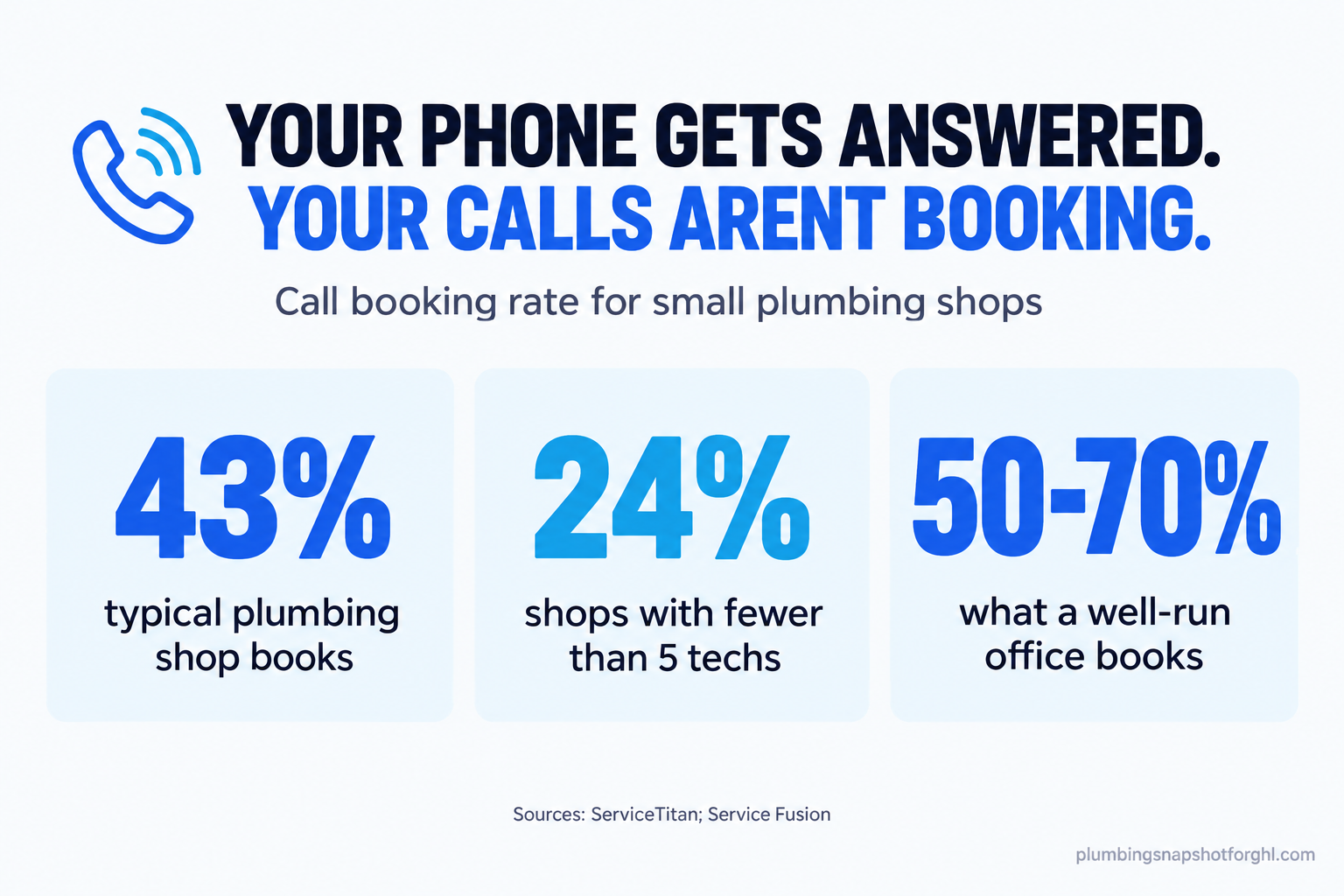
Your call booking rate is the share of inbound calls that turn into a scheduled appointment, and for most small plumbing shops it is far lower than the owner thinks. ServiceTitan’s data put the typical shop at a 42% booking rate, with plumbing at 43%, while shops with fewer than five techs book just 24% (ServiceTitan). A well-run office books 50% to 70% (Service Fusion). The gap is jobs you already paid to get, walking out the door after the phone was answered. This guide is the system that closes it, plus the script your office can steal.
In this guide
- What is a call booking rate for plumbers?
- Why your real booking rate is lower than you think
- What the booking gap actually costs you
- The 6-stage call-booking system
- Steal this: the exact plumbing phone script
- How call booking changes by shop size
- The one number to track every week
- Common objections, answered
- Frequently asked questions
- About the author
What is a call booking rate for plumbers?
Your call booking rate is simple arithmetic: appointments booked divided by calls that could have been booked. If 100 real service calls come in this week and 43 end with a time on the calendar, your rate is 43%. It is not your close rate, which is whether the tech sells the job at the house. Booking happens on the phone.
Almost no owner-operator tracks it, because it hides. You see the jobs that booked. You never see the caller who said “let me think about it” and quietly hired the shop that answered better. Those calls do not show up as a loss on any report. A low booking rate drains revenue silently, from calls you were sure you handled fine because, after all, somebody picked up.
It matters more for a small shop than a big one because of coverage. A 25-truck operation has trained office staff whose one job is to book the call. A 1-to-5-truck shop answers with whoever is free, usually the owner on a ladder or a tech in a crawlspace: good plumbers who were never trained to run a phone call, and it shows in the numbers.
Why your real booking rate is lower than you think
Start one layer up, at whether the call even reaches a person. Invoca’s 2026 report, built from more than 70 million calls, found that across home services only 52% of inbound calls are answered by a person (Invoca). Nearly half ring out, hit voicemail, or die in a phone tree, and most callers who miss a human do not leave a message. They dial the next name.
Now stack the second leak on top. Of the calls that do reach a person, Invoca found 55% of home services businesses never ask the caller to buy or book the job (Invoca). More than half the time, a human answers, qualifies the problem, and then just lets the caller go. No slot offered. The call ends warm and books nothing.
Put the two leaks together. Out of 100 calls, roughly half reach a human, and of those a typical shop books 43%, around 22 jobs. A shop that answers more and asks for the appointment every time, booking at 65%, lands closer to 34. Same marketing, same town. The only difference is how the call gets run.
What the booking gap actually costs you
Here is the part that should sting, because it is money you already spent. Plumbing leads are not cheap: LocaliQ’s benchmark data put the cost per lead for home services search at $90 to $130, and Local Services Ads at $50 to $70 (LocaliQ). Every ring of that phone has a price tag you already paid.
So run it on your own board. Generate 100 real calls a month and book 43%, and you get 43 jobs. Lift that to 60% with a trained process and you book 60. That is 17 extra jobs a month from calls you were already paying for. Some are a few hundred dollars, some are a water heater or repipe worth thousands. That is not a rounding error. It is a second truck.
There is a slower cost underneath it. Roto-Rooter’s homeowner survey found 57% of homeowners get quotes from two or three companies before choosing (Roto-Rooter). The caller you did not book did not vanish. They booked a competitor who now owns that customer’s next water heater and the neighbor they refer. One fumbled call is a customer handed to the shop across town.
The 6-stage call-booking system
A good booking rate is not charm. It is a repeatable process with six stages, from the first ring to a confirmed time. For each one, here is how to run it and the way it breaks in a small shop.
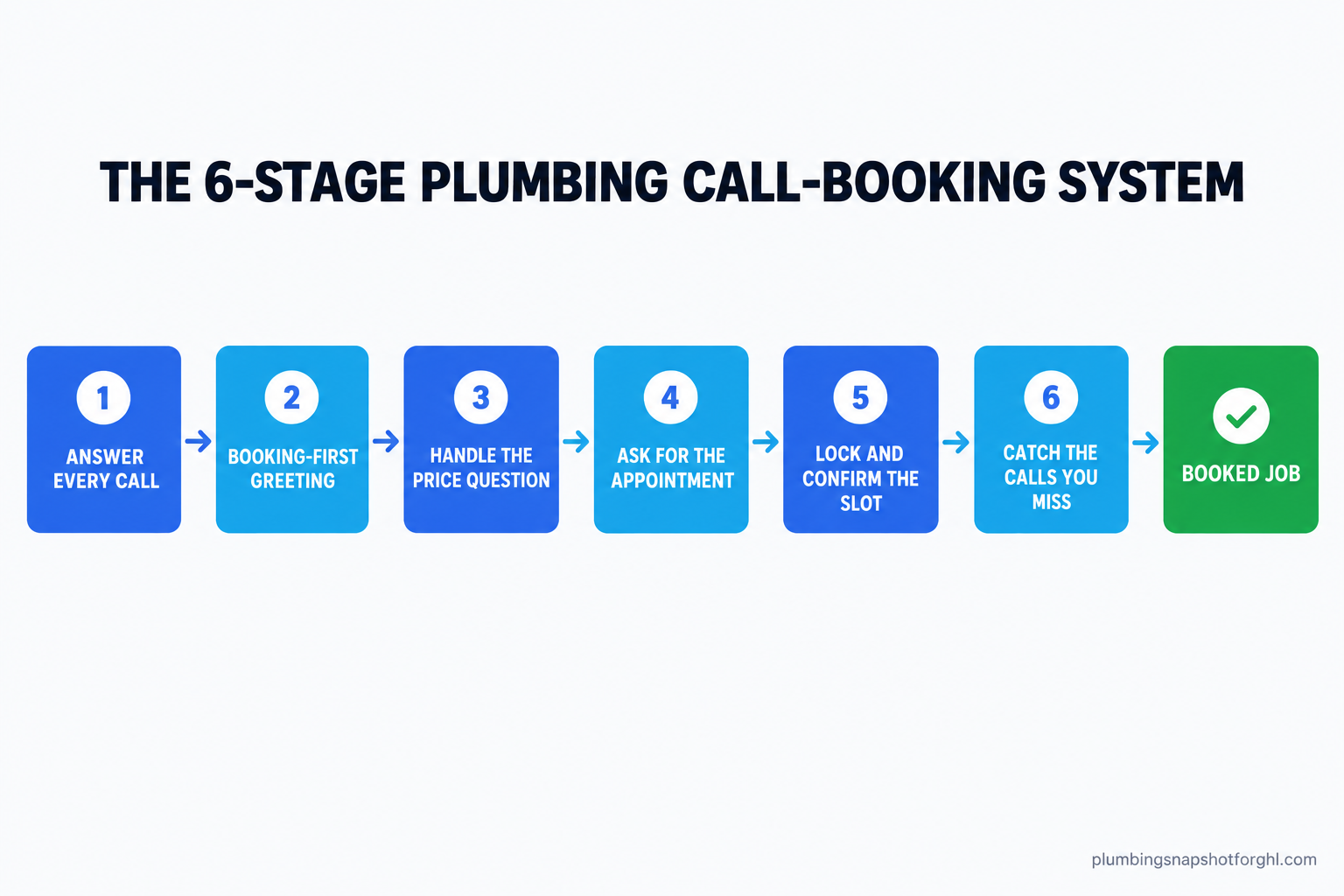
Stage 1: Answer every call, or catch it in seconds
How to run it. The call has to reach someone, or something, that can book. During the day that means a dedicated person, not whoever is closest. When nobody can grab it, an automated text fires within seconds so the caller does not move on. See our missed-call text-back guide.
How it breaks. The phone rings to a tech turning a wrench, who lets it go to voicemail or answers distracted and books nothing. Since only about half of home services calls reach a person (Invoca), coverage is the first place jobs leak.
Stage 2: Open with a booking-first greeting
How to run it. The greeting sets the whole call. A booking-first open names the shop and moves straight toward help: “Thanks for calling [Shop], this is Dana, are you dealing with an emergency or planning something?” That one question sorts the call in five seconds.
How it breaks. “[Shop], hold please,” or a flat “how can I help you” that invites the caller to interview you on price. A weak greeting puts a nervous homeowner in control, and nervous people stall.
Stage 3: Control the call and handle price without quoting blind
How to run it. Homeowners lead with “how much to replace a water heater?” because it is the only question they know to ask. Do not quote blind. Acknowledge, then redirect: “It depends on the unit and your setup, so we send a licensed tech to give you a firm written price, no obligation. The visit is [your fee or free]. Let’s get you a time.” You answered the question and steered to the booking at once.
How it breaks. Either you blurt a phone price the caller uses to shop you, or you dodge it so hard you sound evasive. Both lose the call.
Stage 4: Ask for the appointment, out loud, every time
How to run it. This is the stage 55% of shops skip (Invoca). Offer a specific time instead of asking whether they want to book: “I have a tech near you this afternoon between 2 and 4, or tomorrow at 9. Which works better?” Two choices, both a yes. Assume the booking and let them pick.
How it breaks. The call ends with “give us a call back if you want to set something up.” You just handed the decision, and the job, to the customer, who calls whoever makes it easiest. If you fix one stage, fix this one.
Stage 5: Lock the slot and confirm it
How to run it. Get the address and a mobile number, put it on the calendar while they are on the line, and tell them a confirmation text is coming. Our appointment automation sends the confirmation and reminder so it sticks.
How it breaks. A soft “we’ll pencil you in” with no confirmation. The homeowner is not sure they are really booked, keeps shopping, and books someone who sent a calendar invite. A booking you do not confirm is one you can lose.
Stage 6: Catch and recover the calls you miss
How to run it. You will miss calls. The difference is whether a missed call is a dead end or a recovered job. A missed-call text fires instantly, an AI receptionist answers and books after hours, and an online booking link lets night-time callers grab a slot.
How it breaks. No safety net. The call rings out, no text goes back, and the homeowner is gone. Stages 1 through 5 cover only the calls a human reaches. Stage 6 covers the other half.
Steal this: the exact plumbing phone script
Here is the script. Give it to whoever answers your phone and keep it taped by the handset for two weeks. It moves every real call toward a time on the calendar without sounding like a robot.
Three rules make it work. Never let a call end without a specific time offered out loud. Honor the price question but never quote blind. Confirm every booking in writing. For the full library of texts around the booking, see our plumbing text message templates.
How call booking changes by shop size
The same system runs differently depending on who is holding the phone. Here is how it plays out at three sizes.
Solo owner-operator. You are the plumber and the phone, and you cannot answer mid-repair, so your rate is a coverage problem first. Let automation handle stages 1 and 6: a missed-call text fires the second you cannot pick up, and an AI receptionist or online booking link catches the call so you are not choosing between the sink and the customer. When you do talk to someone, run stages 2 through 5 off the script. Our answering service breakdown compares the options.
Office manager or one CSR. One person has the phone but is also doing dispatch, invoicing, and ten other things, so their booking rate suffers from interruption, not skill. The lift is the script plus protecting their focus, while automation handles overflow and after-hours. This shop usually jumps from the low 40s into the 50s just by making the booking ask non-optional.
Small CSR team, 3 to 8 techs. With two or three people answering, the problem is consistency: one books at 65%, another at 35%, and you cannot see the difference without tracking it. The fix is a shared script, call recording so you can coach real calls, and a weekly booking-rate number per person. See our speed-to-lead guide for the overflow layer on forms and messages.
The one number to track every week
You cannot improve a number you do not watch. Most shops track revenue and jobs completed, which tell you nothing about the phone. Track booking rate weekly: use call tracking to count inbound calls, count how many booked that week, and divide. If it is under 50%, you have a process leak, not a marketing problem, and more ad spend only pours water into a bucket with a hole. The number by itself changes behavior, because the moment your office knows it is being watched, the booking ask stops getting skipped.
Track it per person once you have more than one answerer, and record the calls. Nine times out of ten the leak is stage 4: the appointment never got asked for. Coaching that one habit moves the number faster than anything else you can do.
Common objections, answered
“My people are plumbers, not salespeople. I don’t want them sounding pushy.”
Booking is not selling. A homeowner with water on the floor wants to be told what happens next. Offering a specific time is service, not pressure. The pushy version is the one that never asks and leaves a stressed customer to figure out the next step alone.
“We already answer the phone. Isn’t that enough?”
Answering is stage 1 of six. A typical shop answers plenty of calls and still books only 43% of them (ServiceTitan), because the call gets fumbled on price or ends without an appointment offered. Answering gets you in the game. The booking ask wins it.
“Won’t an AI receptionist or automated text annoy my customers?”
The opposite, in practice. A 2026 survey found 69% of consumers would rather a business reach them by text than by phone (EZ Texting), and HubSpot found 60% of customers define an immediate response as 10 minutes or less (HubSpot). A fast, specific text beats a voicemail that never gets returned. The annoying experience is silence.
“I already pay for ServiceTitan or another field-service platform.”
Those platforms manage work you already booked: scheduling, dispatch, invoicing. They do not run your greeting, handle the price question, or fire a text to a missed call. Booking rate is the step before the job exists in your software, and no back office fixes a gap at the phone.
Frequently asked questions
What is a good call booking rate for a plumbing company?
A good rate is generally 50% to 70% of callable inbound calls, with top performers above 70% (Service Fusion). ServiceTitan's data put the typical shop at about 42%, plumbing at 43%, and shops under five technicians at just 24%. Below 50% means the problem is call handling, not marketing.
How do I calculate my plumbing shop's booking rate?
Divide appointments booked by the real inbound calls that could have been booked over the same period. If 100 service calls came in this week and 45 ended with a scheduled appointment, your booking rate is 45%. Use call tracking to count calls accurately, and pull the number weekly.
Why do my plumbing calls get answered but not booked?
The three common leaks: the person answering gives a phone price the caller uses to shop you, the call ends without a specific appointment time being offered, and nobody confirms the booking in writing. Invoca found 55% of home services businesses never ask the caller to book at all, which is the biggest reason.
Should a plumber quote prices over the phone?
Generally no, not a firm number for repair or replacement work. The honest answer depends on the unit and the home's setup, so acknowledge the question, explain that a licensed tech gives a firm written price on site with no obligation, and pivot straight to booking the visit. Quoting blind turns your shop into a price the caller uses elsewhere.
Can a solo plumber improve booking rate without hiring office staff?
Yes. For a solo the biggest leak is coverage, not skill, because calls arrive while you are under a sink or driving. Missed-call text-back, an after-hours AI receptionist, and an online booking link catch and book those calls automatically. When you do talk to a caller, a script that always offers a specific time does the rest.
Back to that 9:15am water heater call. Run it with the system in place and it ends differently: the greeting sorts the emergency, the price question gets handled, a tech is offered for 2 o’clock, and a confirmation text lands before the homeowner hangs up. Same call, same shop. The only thing that changed is that this time, somebody asked for the appointment. That is the whole game.
About the author
Tyler Brennan is Compliance and Conversion Editor at Plumbing Snapshot. He started in field service marketing writing Google Ads for drain and sewer specialists, then moved into the unglamorous side of automation: keeping SMS and AI messaging compliant while it still converts. He owns the consent and conversion guidance in the Plumbing Snapshot and pressure-tests every call flow against the law and the homeowner’s patience.