It is 8:10am and you are kneeling in a crawlspace when the phone buzzes. You cannot stop to answer. By the time you climb out, the homeowner with a leaking water heater has already called the next name on the list. A plain voicemail will not save that job. A text, sent in the next thirty seconds, often does.
This is a library of the exact text messages a plumbing shop should send, from the first missed call to the review request, with the timing for each, how each one breaks, and the consent language that keeps you legal in 2026. Copy them and swap in your shop name. Text messages get read: industry benchmarks put SMS open rates near 98%, far above email, and most are opened within minutes (Sakari SMS benchmarks 2025-2026).
In this guide
- Why texts book jobs a phone call alone will not
- The 7 moments every plumbing shop should be texting
- Stage 1: The missed-call text-back
- Stage 2: The new-lead first reply
- Stage 3: Appointment confirmation and reminder
- Stage 4: The tech-on-the-way text
- Stage 5: The estimate follow-up sequence
- Stage 6: The review request
- Stage 7: Reactivation and maintenance reminders
- How the texting system changes by shop size
- The compliance layer you cannot skip
- Common objections, answered
- Frequently asked questions
- About the author
Why texts book jobs a phone call alone will not
The people answering your phone are the same people turning wrenches, so calls get missed. A study of 85 small businesses found only about 37.8% of inbound calls reach a live person, meaning roughly 62% go unanswered (411 Locals). For a trade where the owner is on a truck all day, it is usually worse.
Then there is speed. Harvard Business Review audited 2,241 companies and found the average first-response time to a new lead was 42 hours, and 23% never responded at all (Harvard Business Review). A homeowner with a burst pipe does not wait that long.
A text closes both gaps. It answers when you cannot, and it answers fast, while the homeowner is still deciding. When the call does not happen, the conversation still starts.
The 7 moments every plumbing shop should be texting
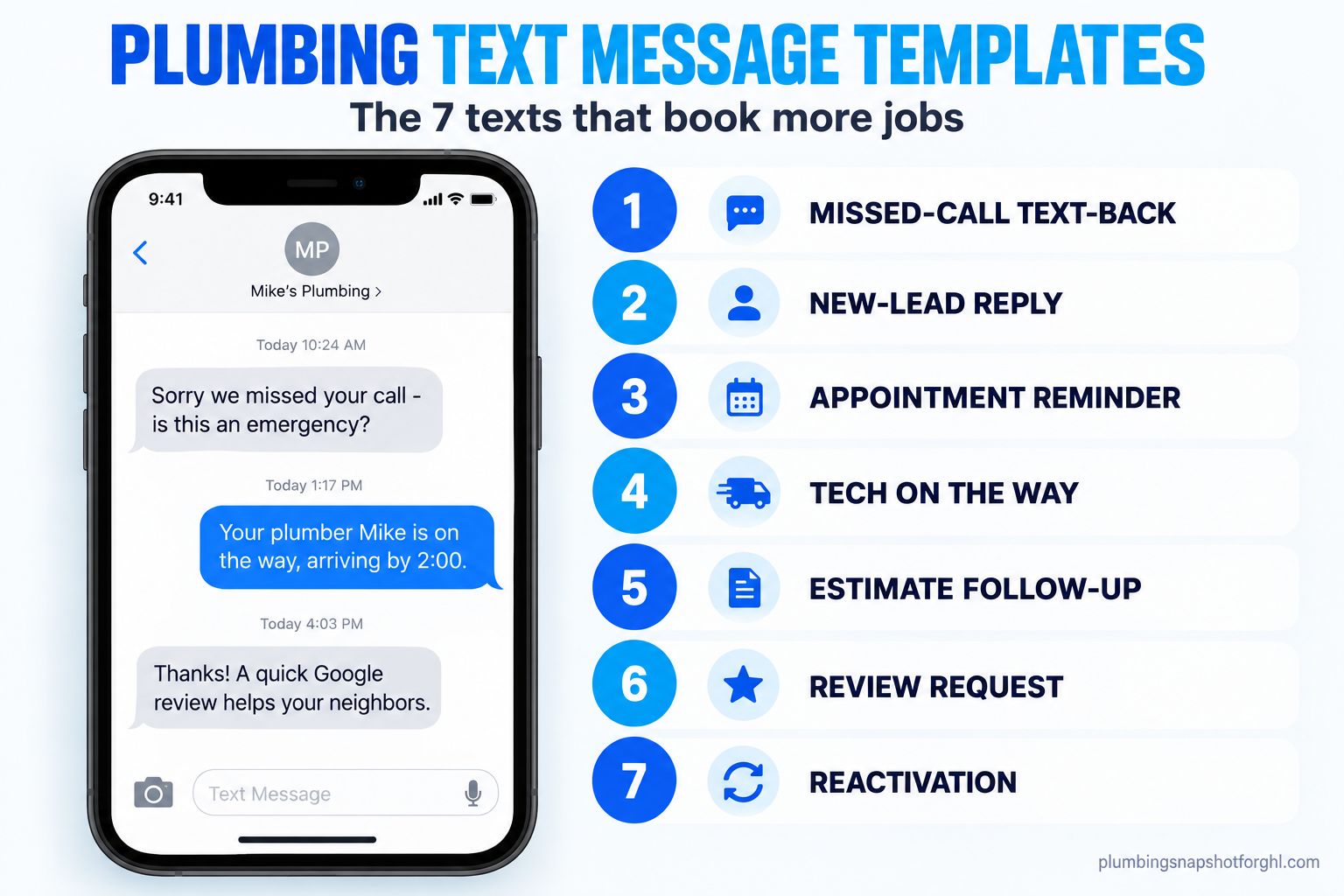
You do not need 40 clever messages, just the right one at seven moments. Miss any and a job leaks out of your pipeline.
Everything in square brackets is a placeholder. Keep messages short, one ask each, signed with your shop name, with an opt-out on any non-reply.
Stage 1: The missed-call text-back
The single highest-value text a plumbing shop can send, and most do not. When a call goes unanswered, an automatic text goes out in seconds, turning a dead voicemail into a live conversation.
Timing. Instant. It has to land while the phone is still in the homeowner’s hand.
How it breaks. Sent to a landline it never arrives, so route those to a callback task. And if nobody watches the replies, “YES it is flooding” gets silence, which is worse than no text. Something has to catch the reply and escalate a real emergency to a live call. More: missed-call text-back for plumbers.
Stage 2: The new-lead first reply
A lead is not only a phone call. It is the web form at 11pm, the Google Business Profile message, the Local Services Ads lead, the Facebook DM. Each needs a reply in about a minute, because the first shop to respond usually wins (speed to lead for plumbers).
Timing. Under a minute, any hour. The automated version fires instantly, then hands you a warm thread.
How it breaks. It is too generic. “Thanks for your inquiry” sounds like a robot and gets ignored, so name the real detail: the water heater, the slab leak, the clogged main. And do not ask three questions at once. Get the address and whether it is active, then qualify the rest on the call.
Stage 3: Appointment confirmation and reminder
Booked jobs still fall apart. Two texts fix most of it: an instant confirmation at booking and a reminder the day before, with an easy way to reschedule (how to reduce plumbing no-shows).
Timing. Confirmation the second the slot is booked. Reminder the afternoon or evening before, when the customer can still move their morning.
How it breaks. Sent too early, the reminder is forgotten again by the appointment; sent too late, it is useless. The “clear access” line saves real money: a tech who cannot reach the shutoff burns 20 billable minutes per visit.
Stage 4: The tech-on-the-way text
The text customers love most. When the tech leaves, a message goes out with a name, a photo if you have one, and an arrival window. It cuts the “where is my plumber” calls and makes a stranger at the door feel safe.
Timing. About 30 minutes out, matched to your drive time.
How it breaks. The window is a lie. Text “arriving by 2:00” and roll up at 3:15 and you have trained the customer to distrust every future text. Build a buffer into the window, and send a quick “running 30 minutes behind, still coming” if the day slips.
Stage 5: The estimate follow-up sequence
Unsold estimates are where the most money quietly dies. A tech quotes a $6,800 repipe, the homeowner says “let me think,” and the quote goes cold because nobody followed up. A short sequence over a week recovers a real slice (plumbing estimate follow-up).
Timing. Day 1, day 3, day 7, then stop. If payments fit the job, day 7 is a natural place to mention them; see plumbing financing and payment plans.
How it breaks. Shops either never follow up or nag daily until the customer blocks the number. Three texts over a week, each adding a real reason to act, is the line. The “just say so and I will get out of your inbox” line gives an easy exit and keeps you off a spam report.
Stage 6: The review request
Reviews are how the next homeowner decides you are worth calling. Ask right after the job closes, while the relief is fresh. Ask by text, not email, and make the link a single tap (getting more Google reviews on autopilot).
Timing. About an hour after the job, same day. One gentle nudge two days later is fine; a third is nagging.
How it breaks. Blasting a review link at everyone, including the customer whose job went sideways, earns a public one-star. Ask how it went first, and route anything less than happy to a private reply so you fix it before it goes public. Full system: double your Google reviews in 60 days.
Stage 7: Reactivation and maintenance reminders
Your old customer list is the cheapest lead source you own, but only if you stay in their phone. Two texts do the work: a seasonal maintenance reminder and a reactivation nudge for quiet customers (database reactivation for plumbers).
Timing. Maintenance follows the season: water heater checks in fall, outdoor-faucet and backflow in spring. Reactivation goes to customers quiet 6 to 12 months. Do not text the same person both in one week.
How it breaks. This stage is most likely to draw a compliance complaint, because it is marketing, not a reply to a live job. You must have consent and a working STOP, and cap how often any one person hears from you. Done right it is close to free revenue; done wrong it is a spam report and a filtered number.
How the texting system changes by shop size
Same seven moments for everyone. What changes is how many you automate and who watches the replies.
The solo owner-operator (1 truck)
Automation is the only way you hit this on time. Start with the two that recover the most money: the missed-call text-back (Stage 1) and the appointment reminder (Stage 3). Keep replies simple: if someone texts that it is flooding, your phone rings; everything else books through a link.
The growing shop (around 5 trucks)
Now someone is on the phones, but they miss the lunch rush and the DMs pile up. Turn on all seven stages, route every channel into one inbox, and give your intake person a two-way thread so they can run five conversations at once, which is what two-way SMS is built for. Pull a weekly report of calls that never got a text-back; you will usually find a repipe in it.
The established operation (up to 15 trucks)
Here texting is a measured process. Track one team KPI: median time to first reply across every channel. Run the tech-on-the-way and estimate follow-up as standard on every job. Use routing rules so emergencies, warranty calls, and quote requests land in the right queue, and run after-hours coverage so the overnight burst pipe escalates to the on-call tech instead of waiting for the 7am shift.
The compliance layer you cannot skip
Fast texting only works if it is legal texting. The moment you automate SMS you are under the Telephone Consumer Protection Act (TCPA) and A2P 10DLC carrier registration, and getting it wrong is expensive. Plain-English version; full walkthrough in TCPA compliance for plumbing SMS.
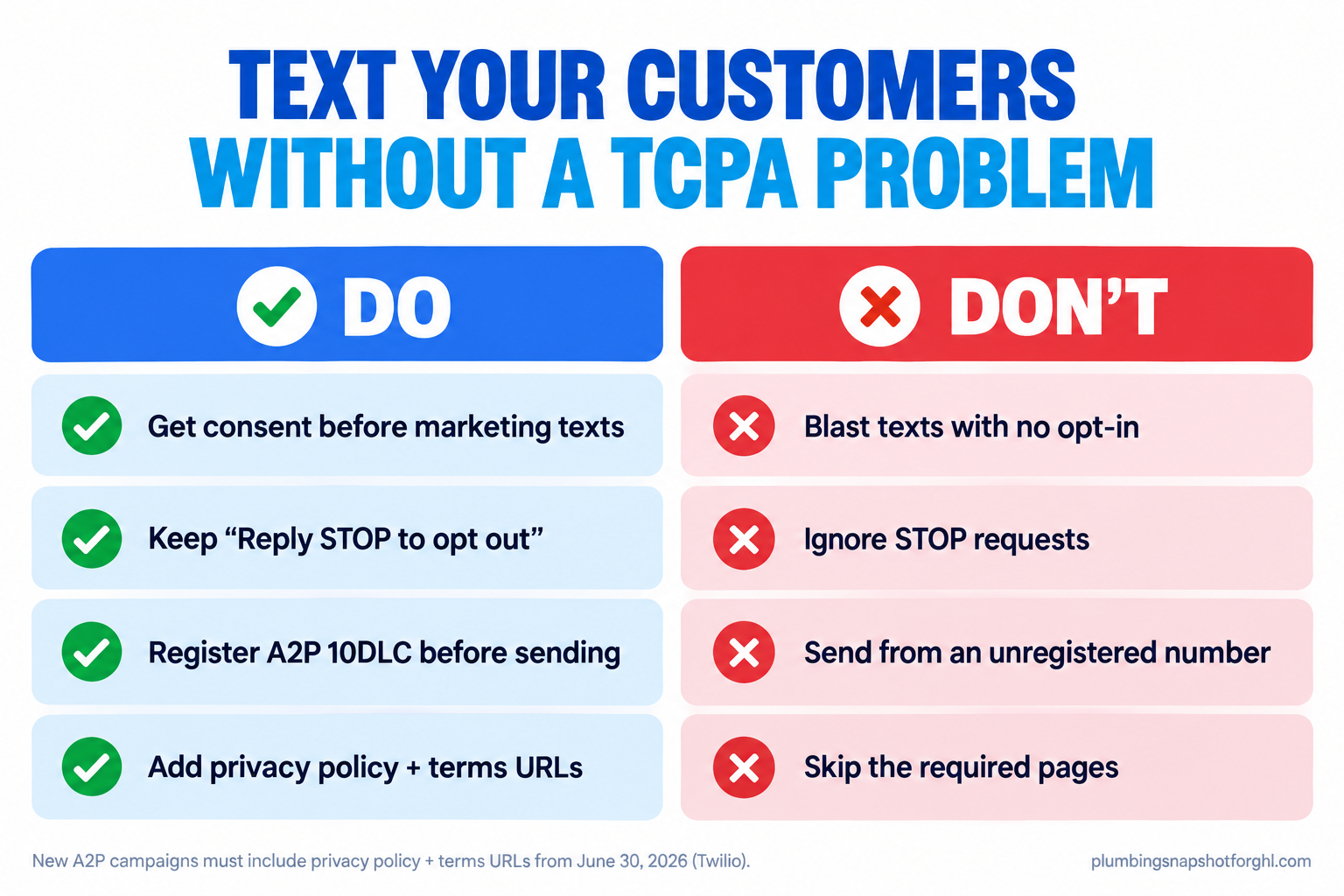
You need consent. Before marketing texts like reactivation or maintenance reminders, the customer must have agreed to receive them. A text-back to someone who just called you stands on firmer ground. The FCC’s stricter “one-to-one consent” rule was vacated by the Eleventh Circuit in January 2025, so it is not in force, but ordinary prior express consent still is (National Law Review).
You need a working STOP. Every customer must be able to opt out, and you must honor it (FCC). Keep “Reply STOP to opt out” on your marketing texts and make sure STOP actually stops them.
You need A2P 10DLC registration. Carriers filter unregistered business texting. Starting June 30, 2026, a new A2P campaign must include a privacy policy URL and a terms and conditions URL, or registration is rejected (Twilio). That is a website change: most shops need those two pages live first. GoHighLevel documents the same requirements (HighLevel).
Set this up before you turn on automated texting, not after. The rules that most often trip up plumbing shops are in 3 things that make your plumbing marketing illegal in 2026.
Common objections, answered
“Won’t customers find all these texts annoying?” Only if you send the wrong ones or too many. Nobody is annoyed by a tech-on-the-way text or an appointment reminder; those are the ones customers thank you for. Annoyance comes from marketing blasts with no consent and no STOP, so keep transactional texts frequent and marketing texts rare.
“I already pay for ServiceTitan or Housecall Pro. Doesn’t it do this?” Most platforms send some of these, usually reminders and on-the-way texts. Shops get stuck on the missed-call text-back, the multi-step estimate follow-up, and reactivation, which often need add-ons. What matters is that all seven moments are turned on, not just the two that came default.
“Do I have to be technical to set this up?” No. You have to be clear about what should fire when, which is what this guide gave you. The wiring is either a weekend of setup or a done-for-you install like the Plumbing Snapshot.
Frequently asked questions
What is the most important text a plumbing shop can send?
The missed-call text-back. Roughly 62% of small-business calls go unanswered, and an instant text turns that dead voicemail into a live conversation while the homeowner is still deciding who to call. It recovers more lost jobs than any other single message.
Are these plumbing text message templates TCPA compliant?
The templates include STOP opt-out language where it matters, but compliance is more than wording. You also need consent on file, A2P 10DLC registration, and a privacy policy and terms URL for new A2P campaigns as of June 30, 2026. Treat the templates as the copy and the compliance section as the setup.
How many follow-up texts should I send on an unsold estimate?
Three over a week: day 1 with the quote, day 3 with a reason to act, and day 7 as a soft close that also gives the customer an easy way to opt out. More than that reads as nagging and risks a spam report.
Should I ask for a review by text or email?
Text, about an hour after the job closes. Texts are read within minutes and a one-tap review link gets far more responses than an email that sits unopened. Screen for unhappy customers first and route their feedback to a private reply.
Do I need A2P 10DLC registration to send these?
Yes, for US business texting. Carriers filter unregistered traffic, so your messages may never arrive. Register your number and campaign, and from June 30, 2026 include a privacy policy URL and terms URL when you register a new campaign.
The bottom line
Go back to that crawlspace at 8:10am. Without a texting system you climb out, see a missed call, and learn an hour later the homeowner already booked someone else. With one, you climb out to a thread that already started: a text went out in 30 seconds, the homeowner said the water heater is leaking, and a slot is held. Same plumber, same truck. The only difference is the words that went out while your hands were full.
Start with Stage 1 this week, then add one stage a week. In seven weeks you have a system that runs the whole lifecycle, on time, whether you are awake or not.
About the author
Tyler Brennan started in field-service marketing writing Google Ads for drain and sewer specialists, then moved into the unglamorous but essential side of automation: keeping SMS and AI messaging compliant while still converting. He owns the TCPA, opt-in, and consent guidance in the Plumbing Snapshot, and pressure-tests every two-way-SMS flow against both the law and the homeowner’s patience.
Related reading: