

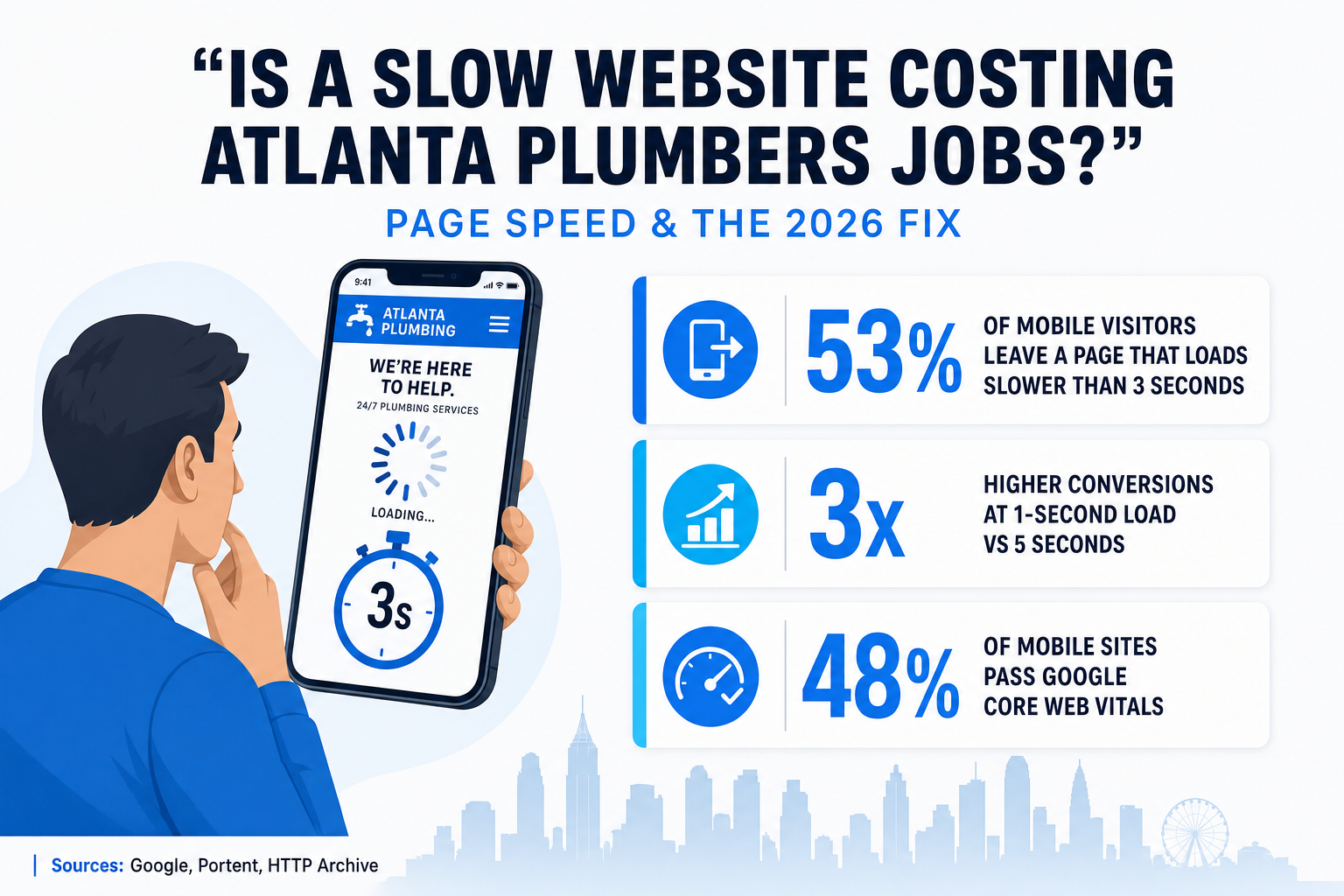
A slow website costs an Atlanta plumber jobs before the phone ever rings. A homeowner in Kirkwood searches “water heater leaking Atlanta” on their phone, taps your result, and watches a blank screen for four seconds — then gives up and taps the next shop, which loaded instantly. You paid for that click through ads, SEO, or your Google Business Profile, and you lost the job to a faster page, not a better plumber. Page speed is the quiet leak in almost every plumbing website, and closing it is one of the cheapest lead upgrades you can make. This guide shows the 2026 data on what slow load times actually cost, how Google’s Core Web Vitals score your site, why it hits Atlanta especially hard, and exactly what a fast site looks like.
In this guide
- The hidden leak: what a slow website actually costs a plumber
- The numbers: how load time bleeds leads
- Core Web Vitals: the scoreboard Google and homeowners share
- Why slow sites hit Atlanta plumbers especially hard
- Mobile is where the job is won or lost
- Slow site vs. fast site: the same shop, two outcomes
- What “fast” actually looks like — and how to get there
- Mistakes that quietly slow a plumbing site
- Frequently asked questions
- About the author
- Related reading
The hidden leak: what a slow website actually costs a plumber
Most plumbers can tell you their cost per lead from Google Ads to the dollar. Almost none can tell you how many of those leads their own website quietly kills on arrival. That’s the hidden leak: you pay for the click, the visitor lands, the page crawls, and they leave — and it never shows up as a “lost job” anywhere in your books. It just looks like a low conversion rate you assume is normal.
It isn’t normal. The average home-services website converts around 7.8% of visitors into leads (First Page Sage) — meaning roughly nine in ten already leave without contacting you. Page speed decides how many of that nine you claw back. A homeowner with a burst supply line under the sink is not going to wait. They are anxious, on their phone, and one tap from three competitors. Every second your page takes to appear is a second they spend deciding to leave.
Plumbers obsess over their ad budget and never look at the page the ad points to. You can double your lead flow without spending another dollar on traffic — just by making the page load before the homeowner loses patience. Speed is the cheapest conversion lever there is.
The reason this matters more for plumbing than for most trades is timing. Your highest-value calls — the failed water heater, the flooded basement, the 2 AM slab leak — come in when the homeowner is stressed and impatient. That’s the exact moment a slow site does the most damage.
The numbers: how load time bleeds leads
The data on page speed is old news to Google and new news to most contractors. It is also blunt.
Start with abandonment. Google’s own research found that 53% of visits to a mobile site are abandoned if the page takes longer than 3 seconds to load (Google). Half your mobile traffic — the traffic you paid for — is gone at the three-second mark. And the drop-off accelerates: as mobile page load time grows from 1 second to 5 seconds, the probability that a visitor bounces increases 90% (Think with Google).
Increase in the probability a mobile visitor bounces as page load time grows from 1 second. Source: Think with Google.
Now the money side. Portent’s analysis of more than 100 million page views found that a site loading in 1 second converts roughly 3× better than one loading in 5 seconds, with conversion rates highest in the 0–4 second range and falling off a cliff after that (Portent). This isn’t a rounding error — it’s the difference between a website that pays for itself and one that just sits there looking nice.
And the gains show up at astonishingly small margins. In Deloitte’s “Milliseconds Make Millions” study with Google, improving mobile load time by just 0.1 seconds lifted retail conversion rates 8.4%, raised average order value 9.2%, and increased travel-site conversions 10.1% (Deloitte / web.dev). Akamai’s retail research put it another way: a 100-millisecond delay cut conversions about 7%, and a two-second delay more than doubled bounce rates (Akamai).
Percentage lift from a 0.1-second improvement in mobile load time, by vertical. Source: Deloitte “Milliseconds Make Millions” (via web.dev).
Translate that into plumbing terms. If your site sees a few hundred visits a month and a slow page is costing you even a handful of booked jobs — and a single water-heater replacement or sewer job can run four figures — the “cost” of slow load time is not abstract. It’s a specific number of jobs, every month, walking to the shop with the faster page.
Core Web Vitals: the scoreboard Google and homeowners share
Google turned “your site feels slow” into a measured scoreboard called Core Web Vitals — three metrics that grade real-world experience for real visitors:
- Largest Contentful Paint (LCP) — how long until the main content appears. Good: 2.5 seconds or less.
- Interaction to Next Paint (INP) — how quickly the page responds when someone taps or clicks. Good: 200 milliseconds or less. (INP replaced First Input Delay in March 2024.)
- Cumulative Layout Shift (CLS) — how much the page jumps around while loading. Good: 0.1 or less.
These thresholds are Google’s, measured at the 75th percentile of your real visitors (web.dev). They matter for two reasons at once. First, they mirror what a homeowner feels: slow to appear, laggy to tap, and content that shifts under their thumb so they mis-tap the “call” button. Second, Core Web Vitals are used by Google’s ranking systems (Google Search Central) — a slow site ranks lower and converts worse, a double penalty.
Here’s the opportunity: most of your competitors are failing this test. According to the HTTP Archive’s 2024 Web Almanac, only about 48% of mobile sites pass all three Core Web Vitals (HTTP Archive). Passing isn’t table stakes yet — it’s still an edge.
Why slow sites hit Atlanta plumbers especially hard
Atlanta is a market where a fast website pays off more than average, for three concrete reasons.
It’s a large, high-value pool of homeowners. Atlanta has roughly 494,800 residents across about 236,000 households, with a median owner-occupied home value near $439,600 and a median household income around $85,652 (U.S. Census Bureau QuickFacts). These are homeowners with valuable property to protect and the means to pay for fast, quality work — but with only about 46.4% of homes owner-occupied, the owners you want are a specific, competitive slice worth capturing on every single visit.
The housing stock is aging. The median Atlanta home was built around 1989 (U.S. Census Bureau), and large stretches of the metro — the bungalows of Kirkwood and East Atlanta, the mid-century homes of Decatur and Brookhaven — are considerably older. Aging homes mean aging supply lines, original water heaters, and cast-iron drains: a steady stream of repipes, replacements, and emergency calls. That’s exactly the high-ticket work you can’t afford to lose to a slow page.
It’s a competitive, mobile-first search market. Atlanta homeowners research on their phones, compare shops, and decide fast. When several plumbers show up in the map pack, the one whose site loads instantly gets the tap and the call; the one that hangs on a spinner gets skipped. In a metro this size, that speed gap compounds into a real book of business over a year.
Mobile is where the job is won or lost
Nearly all of this comes down to the phone in the homeowner’s hand. Mobile now drives the majority of web traffic — around 60% globally (Statcounter) — and for an emergency trade like plumbing the mobile share of urgent, “I need someone now” searches is higher still. That’s precisely where slow sites fail hardest: on a phone, on a spotty cellular connection, running heavy WordPress themes and a stack of plugins.
This is the trap most plumbing sites fall into. A page that looks fine on the shop’s office desktop can crawl on a homeowner’s phone in a parking lot with two bars of signal — and that’s the visitor who matters most, because they have a live problem and their wallet out. The 53% who abandon after three seconds are overwhelmingly on mobile.
A chat widget helps you catch the visitor who does stay, and speed is what keeps enough of them around to reach it. The two work together: get the page in front of the homeowner fast, then give them an instant way to book. See how the capture side works in our guide to the AI chat widget for plumbers and online booking.
Slow site vs. fast site: the same shop, two outcomes
Picture two Atlanta plumbers with identical trucks, identical reviews, and identical Google Ads budgets. The only difference is the website.
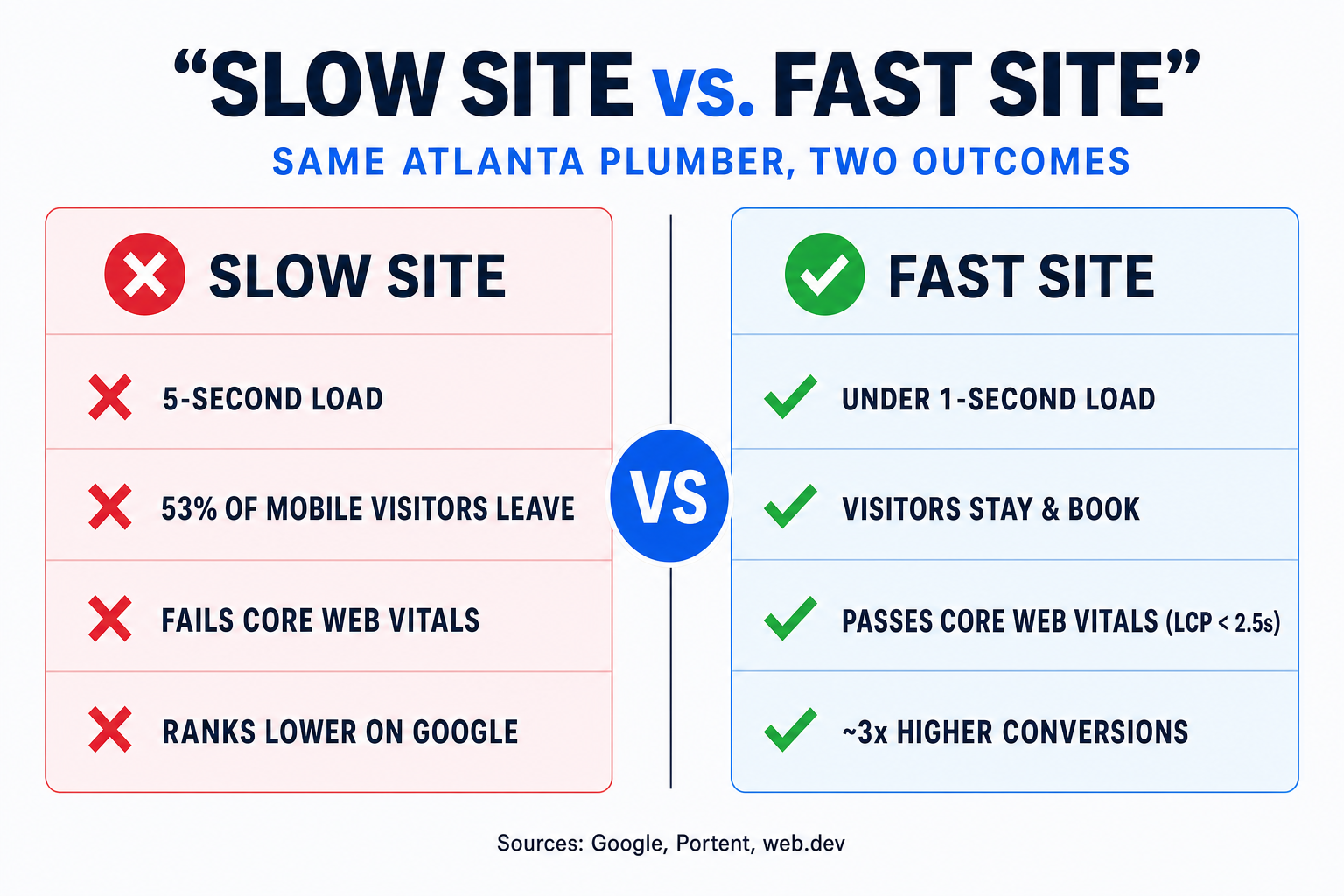
Same trucks, same reviews, same ad spend. One shop books the job; the other never knew the homeowner existed. Over a year in a market the size of Atlanta, that’s not a marginal difference — it’s the gap between a website that carries its weight and one that quietly loses money.
What “fast” actually looks like — and how to get there
“Just make it faster” is easy to say and hard to do on a bloated platform. The reliable path is to build on architecture that’s fast by default rather than trying to bolt speed onto a heavy site with caching plugins.
A genuinely fast plumbing site in 2026 looks like this:
- Static-first architecture. Pages are pre-built and served as plain HTML, not assembled on every request by a database and a dozen plugins. Frameworks like Astro ship almost no JavaScript by default, which is why they routinely hit 90+ PageSpeed where typical WordPress builds struggle. We break down the platform trade-offs in Astro vs. WordPress for plumber websites.
- Real image discipline. Compressed, correctly sized, lazy-loaded images — the single most common cause of a slow LCP on plumbing sites.
- A CDN close to the homeowner. Pages served from an edge network (like Cloudflare) so an Atlanta visitor loads from a nearby location, not a distant server.
- Clean Core Web Vitals by design. Reserved space for images and embeds so nothing shifts (low CLS), and light interactivity so taps respond instantly (low INP).
- Capture built in. A fast page is wasted if there’s nothing to catch the visitor — so booking, a chat widget, and review automation are wired in from day one.
You can chase all of that yourself, or have it done for you. Our done-for-you plumbing website is built on Astro with a guaranteed 90+ PageSpeed score, managed Cloudflare hosting, city and neighborhood location pages for metro Atlanta, schema/AEO/GEO markup, and a built-in AI chat widget and review automation — the whole fast-site checklist, installed and maintained, at $497 one-time plus $97/month, live in about 10 working days.
Mistakes that quietly slow a plumbing site
Notice that every one of these is a build problem, not a budget problem. You don’t fix them by spending more on ads — you fix them by building on the right foundation. That’s exactly why we ship a site that’s fast by design and keep it fast, instead of handing you a heavy template and a caching plugin and wishing you luck.
How fast should a plumbing website load?
Aim for the main content to appear in under 2.5 seconds on mobile — that's Google's 'good' threshold for Largest Contentful Paint. Faster is better: Google found 53% of mobile visitors abandon a page that takes longer than 3 seconds, and conversion rates are highest for sites that load in the 0–4 second range. A well-built site should score 90 or above on Google's PageSpeed Insights for mobile.
What are Core Web Vitals and do they affect my Google ranking?
Core Web Vitals are three metrics Google uses to grade real-world experience: Largest Contentful Paint (loading, good ≤ 2.5s), Interaction to Next Paint (responsiveness, good ≤ 200ms), and Cumulative Layout Shift (visual stability, good ≤ 0.1). Yes — Google has confirmed Core Web Vitals are used by its ranking systems, so a slow site both ranks lower and converts worse. Only about half of mobile sites currently pass all three, so passing is a real competitive edge.
Why does website speed matter so much for a plumber specifically?
Because your highest-value calls come from stressed homeowners with an active emergency — a leaking water heater, a flooded basement — searching on their phone with the next shop one tap away. They have no patience for a slow page. Faster load times directly raise the share of those visitors who stay and book: Portent found sites loading in 1 second convert about 3× better than at 5 seconds.
Do Atlanta plumbers really need to worry about page speed?
Atlanta is a strong case for it: roughly 494,800 residents, about 236,000 households, a median home value near $439,600, and aging housing stock (median build year around 1989) that generates steady high-ticket plumbing work. It's also a competitive, mobile-first search market — when several plumbers appear in the map pack, the fastest-loading site tends to win the tap and the call.
Will switching to a faster website hurt my Google rankings?
Done properly, a migration to a faster, well-structured site helps rankings rather than hurting them — as long as URLs are mapped, redirects are set, and schema and content are preserved. A fast site with proper location pages, clean sitemap/robots/llms files, and good Core Web Vitals typically starts ranking in its service area within a few months. The key is a careful build, not a rushed swap.
How do I check my current website's speed?
Run your homepage and your top service pages through Google's free PageSpeed Insights at pagespeed.web.dev. Check the mobile score and the three Core Web Vitals. Test the emergency and water-heater pages specifically, since those are the ones urgent homeowners land on first. A mobile score under 90 or an LCP over 2.5 seconds means you have a fixable leak costing you leads.
About the author
Tyler Brennan is the Compliance & Conversion Editor for Plumbing Snapshot for GHL, based in Columbus, OH. He started in field-service marketing writing Google Ads for drain and sewer specialists, then moved into the unglamorous work of making the page the ad points to actually convert — including the speed, structure, and consent details most contractors never audit. He writes checklists a busy plumbing operator can actually follow, with the revenue math attached.
Related reading
- Astro vs. WordPress for Plumber Websites — the platform decision behind a fast site.
- Local SEO for Plumbers — get found in the Atlanta map pack once your site is fast.
- AI Search for Plumbers — why speed and structure also win AI answer engines.
- AI Chat Widget for Plumbers — capture the fast-loading visitor before they leave.
- Online Booking for Plumbers — the self-scheduling flow a fast page books into.
- How to Get More Plumbing Leads — where a fast website fits in the full lead system.
- The Done-For-You Plumbing Website — a guaranteed 90+ PageSpeed Astro site, built and maintained for you.