
Two-way SMS is a texting channel where a homeowner and your shop hold a real back-and-forth conversation by text — they ask “can you come look at my water heater today?”, you reply, qualify the job, and book it, all in the thread they already live in. It is not a one-way blast and it is not just the auto-text that fires after a missed call. It is the way most homeowners now prefer to reach a business: 90% of people say they’d rather text a company than call it, and in 2024 text messaging passed both email and phone to become consumers’ top choice for customer support (EZ Texting, 2024 Consumer Behavior Report). For a plumbing shop, that shift is money — because the job goes to whoever answers first, and a text gets answered in seconds while a voicemail sits until Monday. This guide lays out the 2026 data, shows exactly where two-way texting books jobs across a plumbing job’s lifecycle, and covers how to run it without breaking texting law.
In this guide
- What is two-way SMS for a plumbing business?
- Why texting beats calling and email — the 2026 data
- Homeowners now expect to text you
- Where two-way SMS books jobs across the plumbing lifecycle
- Speed-to-lead: the first text usually wins the job
- Two-way SMS vs missed-call text-back vs the phone
- Texting law: do it compliant or don’t do it
- What it looks like when it works
- Mistakes that waste two-way SMS
- Frequently asked questions
- About the author
- Related reading
What is two-way SMS for a plumbing business?
Two-way SMS is conversational texting between your shop and a customer — both sides send and receive — running on a business number so the whole team and your CRM see the thread, not one tech’s personal phone. A homeowner texts “my kitchen drain is backing up, do you do same-day?” and gets a real reply that answers the question, confirms the service area, and offers a time. That’s the difference from a one-way marketing blast (you → them, no reply expected) and from a plain missed-call text-back (a single automatic “sorry we missed you” after a call).
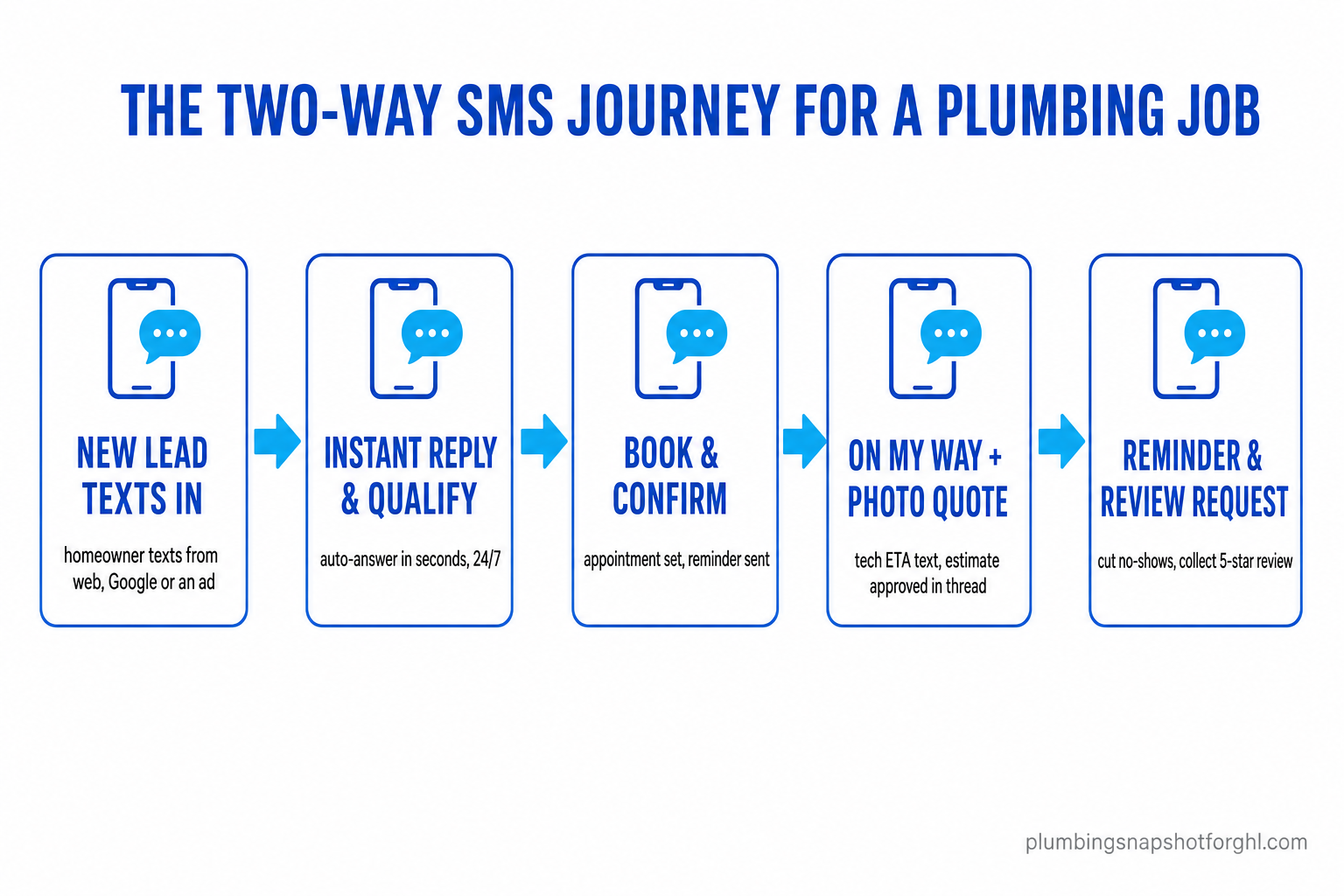
In a plumbing operation, two-way texting shows up at every stage of a job:
- A new lead texts in from your website, Google Business Profile, or an ad.
- You confirm the appointment and send a reminder the day before.
- The tech texts “on my way, 20 minutes out” with a photo and name.
- You send a photo-backed quote and the homeowner approves it by text.
- After the job, you text a one-tap review link and, months later, a maintenance-plan nudge.
Every one of those is a moment where a phone call gets ignored or goes to voicemail, but a text gets read and answered. Done by hand, it’s impossible to keep up with. Wired into a system, it runs itself.
Why texting beats calling and email — the 2026 data
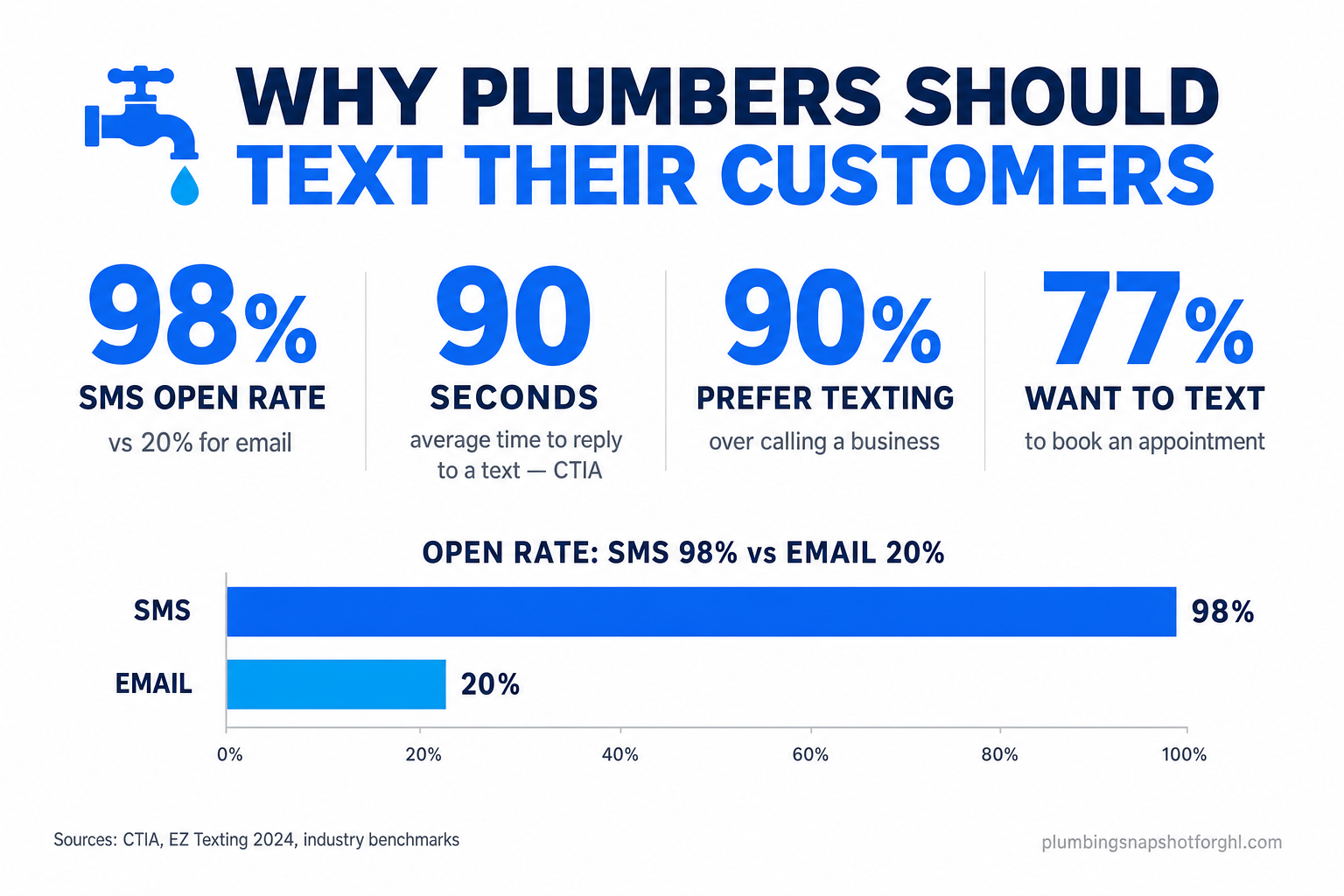
The core reason texting works is boring and decisive: people actually read texts, and they read them immediately. SMS carries about a 98% open rate, versus roughly 20% for email, and 90% of text messages are read within three minutes of arriving (SimpleTexting, 2024). An email confirmation or a follow-up buried in a spam-filtered inbox is a message you paid to send and nobody saw. A text is a message that gets seen before the homeowner puts the phone down.
Speed of reply is the other half. The average person answers a text in about 90 seconds; the average email waits roughly 90 minutes for a reply (CTIA, via Kenect). For a trade where the customer is standing in a puddle, the channel that gets a two-minute reply beats the one that gets a two-hour reply every single time.
Average open rate by channel. Source: SimpleTexting, 2024 Texting & SMS Marketing Statistics.
Every plumber I talk to already knows email follow-up is dead — the confirmations bounce around a spam folder and the quotes never get opened. Texting isn’t a marketing gimmick for the trades. It’s just meeting the homeowner in the one app they answer in ninety seconds.
Homeowners now expect to text you
This isn’t a preference at the margins — texting has become the default. In EZ Texting’s 2024 Consumer Behavior Report, text messaging (35%) edged out email (31%) and phone (29%) as consumers’ number-one choice for customer support for the first time, and 90% of people said they’d rather text a business than call it (EZ Texting, 2024). Roughly 79% of consumers are opted in to receive texts from businesses, and opt-ins grew about 11% year over year.
Consumers’ #1 preferred channel for customer support, 2024. Source: EZ Texting, 2024 Consumer Behavior Report.
The appointment number is the one that should get a plumbing owner’s attention: 77% of consumers want to text a business to schedule an appointment (SimpleTexting, 2024). That maps exactly onto how plumbing gets booked. The homeowner who won’t call a stranger at 9 PM to ask about a leaking valve will fire off a text — if your shop can receive one and answer it. A business that can only be reached by phone is quietly telling three out of four homeowners to book somewhere else.
Where two-way SMS books jobs across the plumbing lifecycle
Two-way texting isn’t one feature — it’s a thread that runs the entire job, and each stage plugs a specific leak. Here’s where it earns its keep from first contact to repeat customer.
Two of those stages have hard numbers behind them. Day-before text reminders cut no-shows by about 38% in controlled study data (BMJ Quality & Safety / Imperial College London) — every prevented no-show is a truck-roll you didn’t waste and a slot you can refill. And texted review requests convert far better than emailed ones for the same reason everything else here does: they get opened. If you want the no-show math specifically, we broke it down in how plumbers reduce no-shows.
Speed-to-lead: the first text usually wins the job
In the trades, the shop that responds first usually gets the job — and texting makes “first” effortless. The classic MIT / InsideSales Lead Response Management study, built on more than 100,000 call attempts, found that contacting a web lead within 5 minutes instead of 30 makes you about 100× more likely to reach them and 21× more likely to qualify the lead (study summary). That decay is measured in minutes, not hours.
Homeowners feel the same urgency. Salesforce’s research found 83% of customers expect to interact with someone immediately when they contact a company (Salesforce, State of the Connected Customer). A manual texting setup — one shared cell phone, one person, business hours only — can’t hold that standard. An automated two-way SMS system can: it fires an intelligent first reply the instant a lead texts, any hour, qualifies the job, and books it or escalates a true emergency to your on-call tech.
Two-way SMS vs missed-call text-back vs the phone
These three tools get lumped together, but they cover different moments — and you want all three feeding one system.
The point is they’re complementary, not competing. In the Plumbing Snapshot, all three run off one platform, so a lead that comes in by phone, by missed-call text-back, or by a cold two-way text lands in the same pipeline and follows the same automated sequence. That’s the difference between three disconnected apps and a system where no lead falls through a crack.
Texting law: do it compliant or don’t do it
Business texting is governed by the TCPA, and the fines for getting it wrong are per-message, so this is not a corner to cut. The rule of thumb is simple: get clear consent before you text, identify your shop in the message, and make opt-out easy. In practice that means:
- Consent first. You need express consent to send marketing or promotional texts — a checkbox at booking, a keyword opt-in, or a form the homeowner submits. A phone number you scraped or bought is not consent.
- Identify yourself. Every message should make clear it’s from your plumbing shop, not an anonymous number.
- Honor STOP instantly. Opt-out has to be one word and immediate. A compliant system handles STOP automatically and suppresses that contact.
- Keep records. If a consent is ever questioned, you want a timestamped log of when and how it was given.
None of this is a reason to avoid texting — it’s a reason to run it on a system built for compliance instead of a personal phone. The Plumbing Snapshot bakes the consent step, sender identity, and automatic opt-out handling into every flow. For the full breakdown, read our TCPA guide for plumbers.
What it looks like when it works
Picture a Tuesday night. A homeowner walks into the laundry room and finds water pooling under the washer hookup. It’s 9:20 PM. They’re not going to call a stranger and risk voicemail, so they pull up two plumbing shops and text both: “Water leaking under my washer valve, can someone come tomorrow?”
Shop A has a number that only rings a phone. The text goes nowhere until someone glances at it in the morning — maybe 10 AM, maybe later.
Shop B runs two-way SMS. Within seconds the homeowner gets: “Sorry about the leak! We can help. That sounds like a supply-valve failure — shut the valve if you can reach it. We have a slot tomorrow 8–10 AM or 12–2 PM. Which works?” The homeowner replies “8–10,” gets a confirmation with the tech’s name, a reminder at 7:30 AM, and an “on my way” text at 7:55. By the time Shop A reads the message, the job is already on Shop B’s truck.
Same leak, same night, same homeowner. One shop had a conversation; the other had an unread text. Multiply that across a full month of after-hours and won’t-call-first homeowners, and two-way SMS isn’t a convenience — it’s a measurably bigger book of business.
Mistakes that waste two-way SMS
Notice that every one of these is a setup problem, not a budget problem — which is exactly why we wire the shared inbox, the instant 24/7 replies, the consent capture, the booking, and the follow-up together in the done-for-you snapshot instead of leaving you to run a plumbing business off a group text. It fits alongside the rest of the plan to get more plumbing leads.
What is two-way SMS for a plumbing business?
Two-way SMS is conversational texting between your shop and a customer — both sides send and receive — running on a business number so your whole team and CRM see the thread instead of it living on one tech's personal phone. A homeowner can text 'can you come look at my water heater today?' and get a real reply that qualifies the job and books it. It covers the whole job: first contact, appointment confirmation, day-of 'on my way' texts, photo-quote approval, and the after-job review request.
How is two-way SMS different from missed-call text-back?
Missed-call text-back is a single automatic message that fires only after someone calls you and the call goes unanswered — it's a recovery tool for the phone channel. Two-way SMS is the full back-and-forth conversation: the homeowner who texts you first, the booking, the reminders, the quote approval, the follow-up. They work best together — missed-call text-back catches dropped calls, and two-way SMS carries every other texting moment — ideally both running off one system.
Do homeowners actually want to text a plumber?
Yes, and it's now the majority preference. In 2024, text messaging became consumers' number-one choice for customer support (35%), ahead of email (31%) and phone (29%), and 90% of people said they'd rather text a business than call it. Most tellingly for the trades, 77% of consumers said they want to text a business to schedule an appointment. A shop that can only be reached by phone is turning away a large share of homeowners who would happily book by text.
Is texting customers legal for plumbers?
It's legal when you follow the TCPA: get clear consent before texting (a checkbox at booking, a keyword opt-in, or a submitted form), identify your business in the message, and make opt-out easy by honoring STOP instantly. The fines for non-compliant texting are per message, so it should run on a system that captures consent, identifies the sender, and handles opt-outs automatically — not off a personal phone. Our TCPA guide for plumbers covers the specifics.
Will two-way SMS really reduce no-shows?
Text appointment reminders have been shown to cut no-shows by about 38% in controlled study data, because texts get read (about a 98% open rate) where emailed or voicemail reminders don't. For a plumbing shop, each prevented no-show is a wasted truck-roll avoided and a booking slot you can refill — which is why a day-before reminder text plus a day-of 'on my way' message is one of the highest-ROI automations you can run.
Can two-way SMS run automatically, or do I need someone texting all day?
It runs automatically. A done-for-you system sends an intelligent first reply the instant a lead texts — any hour — qualifies the job, and books it or escalates a true emergency to your on-call tech, while a shared team inbox lets a human jump in whenever a conversation needs it. Reminders, 'on my way' texts, and review requests are triggered by the job's status in your CRM, so you get the speed of automation without hiring a person to watch a phone.
About the author
Tyler Brennan is the Compliance & Conversion Editor for Plumbing Snapshot for GHL, based in Columbus, OH. He started in field-service marketing writing Google Ads for drain and sewer specialists, then moved into the unglamorous but essential side of automation: keeping SMS and AI messaging compliant while still converting. He owns the TCPA, opt-in, and consent guidance in the Plumbing Snapshot and pressure-tests every photo-quote and two-way-SMS flow against both the law and the homeowner’s patience — translating legal and conversion details into checklists a busy plumbing operator can actually follow.
Related reading
- Missed-Call Text-Back for Plumbers — recover the dropped phone calls that pair with your two-way texting.
- How Plumbers Reduce No-Shows — the reminder-text math behind that 38% drop.
- TCPA for Plumbers — get consent and opt-out right so your texting stays legal.
- Online Booking for Plumbers — the self-scheduling flow your texts book into.
- Photo-Quote Conversion — send estimates by text and get them approved in the thread.
- Double Your Google Reviews in 60 Days — the texted review request that fills your reputation pipeline.
- How to Get More Plumbing Leads — where two-way SMS fits in the full lead system.
- The Two-Way SMS Automation feature — see exactly what the snapshot’s texting system does.