

It is 9:52pm. A homeowner is standing in two inches of water because the water heater let go in the garage. They grab the phone, search “plumber near me open now,” and start dialing down the list. Your shop is third. The first two ring out to voicemail. If yours does the same, they do not leave a message. They dial the fourth. By the time you see the missed call at 7am, that repipe-adjacent emergency, the maintenance plan that would have followed, and the three neighbors they would have told are all working with somebody else. One answered after-hours call is not worth one job. It is worth the job, the repeat work, and the referrals, and for most shops that is $2,000 to $6,000 of lifetime value walking out the door every time the phone rings into voicemail.
In this guide
- Why one missed call costs more than one job
- The formula: what an after-hours call is worth
- Input 1: your average emergency ticket
- Input 2: your booking rate, and where it leaks at night
- Input 3: the repeat and referral multiplier
- Put it together: one call’s real value
- How many are you actually losing?
- Solo, 5-truck, and 15-truck: three worked answers
- Where the money leaks: six failure points
- Steal this: the after-hours message stack
- Keep it legal: consent and license rules
- Objections, answered straight
- Frequently asked questions
Why one missed call costs more than one job
The trade is busy. There were 510,600 plumbers, pipefitters, and steamfitters in 2025, with employment projected to grow 7% from 2025 to 2035 (U.S. Bureau of Labor Statistics, May 2025). Demand is not the problem for most shops. Catching it is.
Emergencies are where the real money and the real stakes live. Water damage and freezing claims average $15,400 each, and about one in 60 insured homes files one every year (Insurance Information Institute, 2019 to 2023 data). The homeowner on the other end of a 10pm call is scared, motivated, and ready to say yes to the first plumber who picks up. That is the most qualified lead you will get all week, and it shows up at the worst possible time to answer it.
Here is the part owners miss. When you do not answer, the cost is not “a job I might have booked.” Roughly 69% of callers who reach voicemail hang up without leaving a message (Moneypenny), and an emergency caller at night is even less patient. They do not wait for a callback. They dial the next number. So a missed call is not a maybe. It is a near-certain loss of a high-intent customer worth far more than the first invoice. We covered the everyday version in why your phone rings all day and you’re still not making money. After hours, the leak is wider and the tickets are bigger.
The formula: what an after-hours call is worth
You cannot fix a leak you have not measured. So put a real number on a single after-hours call. The formula has three inputs, and you already own all three:
VALUE OF ONE ANSWERED AFTER-HOURS CALL

  Average emergency ticket .................. (A)
  x  Booking rate (calls that become jobs) . (B)
  =  First-job value per call

  First-job value
  x  (1 + repeat & referral multiplier) .... (C)
  =  TRUE VALUE PER ANSWERED CALL
Most owners stop at A times B and badly undercount. The whole point of the (C) term is that an emergency customer you treat well does not disappear after the water heater swap. They become a repeat customer and a referral source. Let me take the three inputs one at a time, because each one has a number you can pull and a place it quietly goes wrong.
Input 1: your average emergency ticket
Start with what an after-hours job actually invoices. Do not guess, and do not use your daytime average, because emergencies skew higher. Pull your last 20 or 30 after-hours and weekend tickets and average them.
If you do not have clean data yet, anchor on real jobs. A water heater replacement runs an average of $1,348, with most homeowners paying between $882 and $1,826 (HomeAdvisor). A whole-house repipe runs anywhere from $1,500 to $15,000, around $7,500 on a typical job (Angi via Bob Vila). A burst-pipe night call that starts as a shutoff and stop-leak often turns into one of those bigger jobs once the water is off and the customer trusts you.
Input 2: your booking rate, and where it leaks at night
Booking rate is the share of answered calls that turn into scheduled jobs. A well-run shop books a high share of inbound emergency calls, because the caller already has a problem and wants it solved tonight. The failure is almost never “they called and said no.” It is “nobody answered, so there was nothing to book.”
That is why how you answer matters as much as whether you answer. The caller’s patience is measured in rings, not minutes. We broke the response-time math down in speed to lead for plumbers, and it is brutal after hours: a live voice or an instant text in the first minute books the job, and a callback at 7am books nothing because the job is already done.
What happens to the same after-hours call, three ways
| Plan | Rings to voicemail | Instant text-back | Live or AI answer |
|---|---|---|---|
| Price | ~0% booked | Catches most | Highest booking |
| Feature 1 | ~69% hang up, leave nothing | Auto-text fires in seconds | Real conversation, triage first |
| Feature 2 | Caller dials the next shop | Holds the caller's attention | Dispatches a true emergency now |
| Feature 3 | You see it at 7am, too late | Routes to the on-call tech | Schedules the non-urgent for AM |
| Feature 4 | Marketing spend wasted | Books into the real calendar | Captures name, address, problem |
| Feature 5 | Zero chance at the repeat work | Works while you sleep | Sets the five-star review up |
| Feature 6 | The worst option, and the default | Cheapest fix for the biggest leak | Best experience, highest close |
The jump from the first column to the second is the single highest-return change most shops can make, and it costs a fraction of one recovered job. The mechanics of that auto-text are in missed-call text-back for plumbers.
Input 3: the repeat and referral multiplier
This is the input that separates owners who chase the next call from owners who build a business. The first invoice is the smallest money the customer will ever give you. The real value is what comes after:
- Repeat work. A plumber who saved a homeowner at 10pm is the plumber they call for the next clog, the next faucet, the next remodel. That relationship is worth several more jobs over a few years.
- The maintenance plan. An emergency customer is the easiest sell for a recurring maintenance membership, which turns one job into predictable annual revenue and first call on every future problem. We built the case for that in the maintenance plan flywheel.
- Referrals and reviews. A homeowner you rescued tells neighbors, and a same-day review request turns that goodwill into a public five-star review that wins the next stranger’s call. That pipeline is covered in doubling your review pipeline.
A reasonable, conservative multiplier for a happy emergency customer is 1.5 to 3x the first job over the relationship. That means a $1,400 water-heater night call is really worth $3,500 to $5,600 once you count the repeat work and the referrals it seeds. Not every customer hits that, which is why you multiply by booking rate and keep the multiplier honest, not heroic.
Put it together: one call’s real value
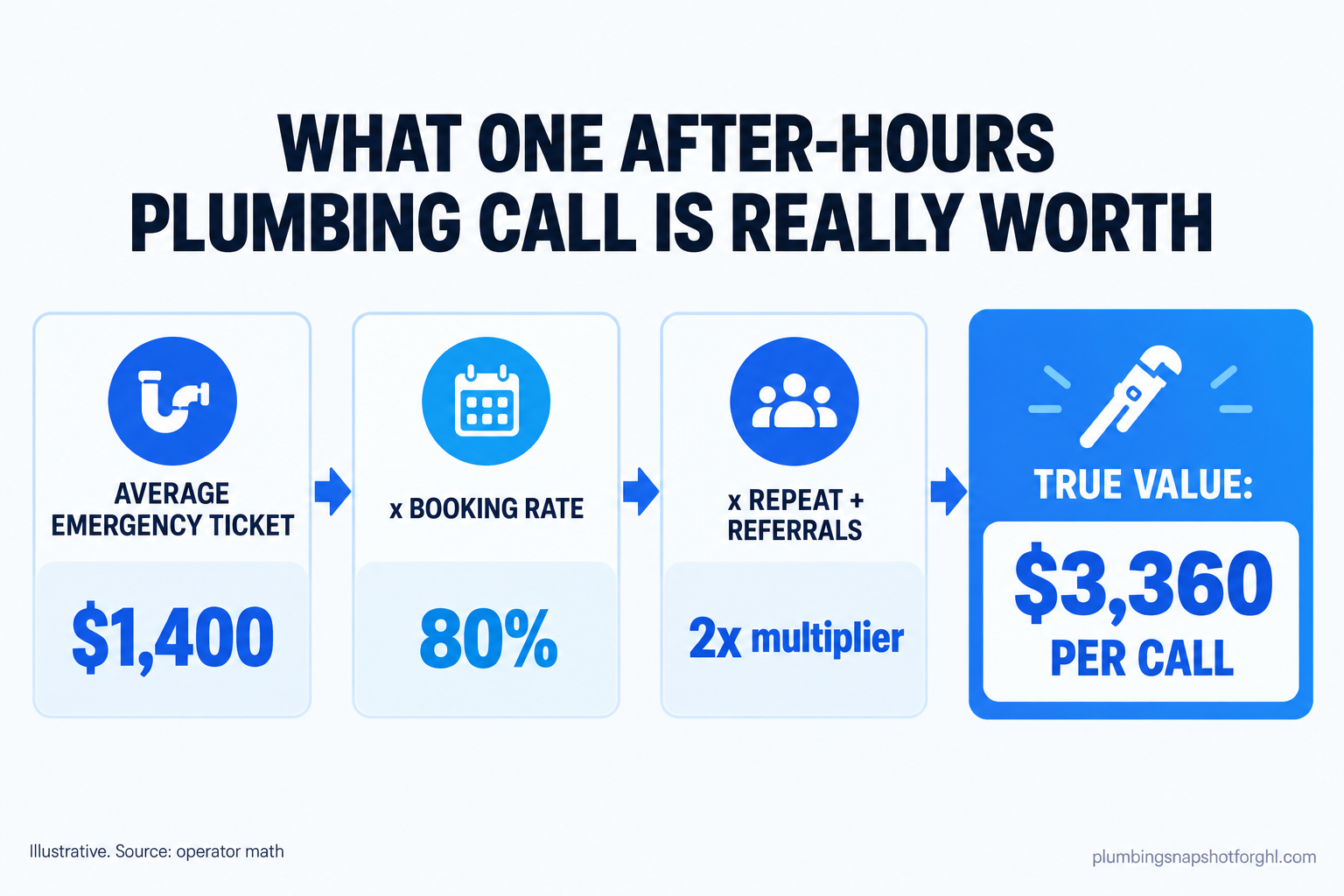
Run the formula with middle-of-the-road numbers for an independent shop: a $1,400 average emergency ticket, an 80% booking rate on calls you actually answer, and a 2x repeat-and-referral multiplier.
  $1,400  (average emergency ticket)
  x 0.80  (booking rate)
  = $1,120  first-job value per answered call

  $1,120 x (1 + 2)   [the 1 is the first job, the 2 is repeat + referrals]
  = $3,360  TRUE VALUE PER ANSWERED AFTER-HOURS CALL
Now compare that to how most shops treat the same call: as a $1,400 maybe, or worse, as an annoyance they would rather sleep through. The chart below shows the gap between the three ways an operator values an after-hours call. Only the third number is the real one.
The value of one answered after-hours call, built up from the first job to true lifetime value. Illustrative: $1,400 ticket x 80% booking x a 2x repeat-and-referral multiplier.
That $3,360 is what rings out to voicemail. Not $1,400. Hold that number, because it changes every decision about on-call pay, answering services, and automation that follows.
How many are you actually losing?
One call is a number. Your real problem is the monthly total. Here is the worksheet. Fill in your own figures and you will have a defensible annual loss in about ten minutes.
AFTER-HOURS MISSED-CALL LOSS WORKSHEET

STEP 1 - VALUE PER CALL
  Average emergency ticket .............. $__________  (A)
  x booking rate (0.70 to 0.90) ......... __________  (B)
  = first-job value ..................... $__________
  x (1 + multiplier)  [1 + 1.5 to 3] .... __________  (C)
  = VALUE PER ANSWERED CALL ............. $__________  (V)

STEP 2 - MISSED VOLUME
  After-hours + weekend calls / month ... __________
  x share that go unanswered (be honest)  __________
  = MISSED CALLS PER MONTH .............. __________  (M)

STEP 3 - THE LOSS
  V x M ................................. $______ /month
  x 12 ................................. $______ /year
Plug in the worked numbers above ($3,360 per call) and just three missed after-hours calls a month is $10,080 a month, over $120,000 a year. Miss one a week and you are near $175,000. Those are not jobs you lost at the quote. They are jobs that never reached you, from marketing you already paid for. The chart makes the slope obvious.
Annual revenue lost to missed after-hours calls, at $3,360 true value per call. Illustrative, using the worked example above.
Solo, 5-truck, and 15-truck: three worked answers
The formula is the same for everyone. The numbers, and the right fix, change with size.
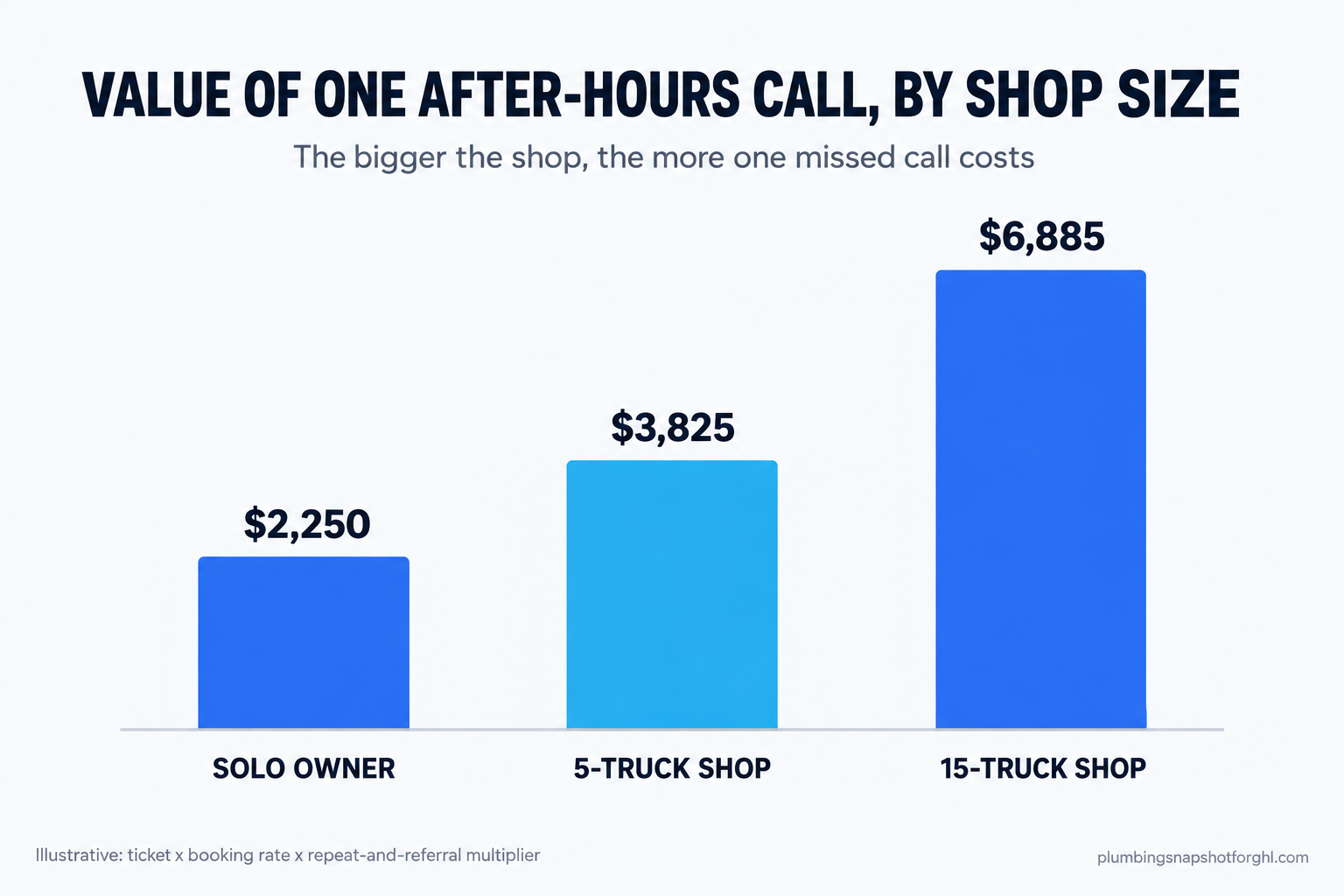
The solo owner-operator. Average emergency ticket around $1,200, books maybe 75% of answered calls, multiplier closer to 1.5x because there is less capacity to service repeat demand fast. Value per call: roughly $2,250. This owner cannot answer at 2am and work at 8am, so the realistic miss rate is high. For them, an instant text-back plus a simple on-call path is not a luxury, it is the difference between sleeping and losing $2,250 a night. Start cheap and automated.
The 5-truck shop. Ticket around $1,500, booking 85%, multiplier near 2x. Value per call: about $3,825. This shop generates enough after-hours volume that a formal on-call rotation pays for itself, and the math on on-call pay versus recovered jobs is lopsided in the jobs’ favor. The build is in on-call rotation and after-hours dispatch. The leak here is usually a tired tech ignoring the phone, not the absence of a system.
The 15-truck shop. Ticket around $1,800, booking 85%, multiplier 2.5x because capacity and brand turn more emergencies into long relationships. Value per call: roughly $6,885. At this size, a missed call is almost criminal, and the fix is a layered one: AI or live answering for triage, instant dispatch to the on-call tech, and automated follow-up. A full answering-service comparison for shops this size is in the plumbing answering service breakdown.
Notice the pattern. The bigger the shop, the more a single call is worth, and the less excusable it is to let one ring out. Size does not shrink the problem. It raises the stakes on every missed call.
Where the money leaks: six failure points
Knowing a call is worth $3,360 does nothing if it still rings out. Here is where after-hours revenue actually leaks, and what to do at each point.
1. The phone rings to voicemail. The single biggest leak. The fix is an instant automated text-back the moment a call is missed, so the caller gets a human-sounding reply in seconds instead of a beep. It holds their attention long enough to route them.
2. The on-call tech does not pick up. A rotation only works if the phone is answered. Build an escalation: if the on-call tech misses it, it rolls to a second tech, then to the owner. Pay on-call fairly so the phone is a responsibility, not a resented nuisance.
3. The caller reaches a stranger who just takes a message. Generic answering services often log a name and number and promise a callback, which for an emergency is barely better than voicemail. Whoever answers must triage: is this a true now emergency, or can it book for 8am? That decision has to happen on the first call.
4. The real emergency does not get dispatched fast. Triage without dispatch is a to-do list. A true emergency needs the on-call tech moving in minutes, with the address and problem already captured, not a callback an hour later.
5. The non-urgent call is lost by morning. Not every night call is a crisis. The slow-drip faucet can wait, but if you do not book it into the real calendar on the spot, it evaporates by morning. Capture and schedule everything, urgent or not.
6. The won job never turns into the next one. You saved them at 10pm and then went quiet. No review request, no maintenance-plan offer, no follow-up. The multiplier collapses to 1x and you leave the biggest money on the table. A same-day sequence fixes it.
Steal this: the after-hours message stack
Here is the actual copy to catch, triage, and keep an after-hours caller. Adapt the bracketed parts and the shop name, keep the structure.
Instant missed-call text-back (fires within seconds of a missed call):
This is [Shop Name] plumbing. Sorry we missed you. If this is a
water emergency (burst pipe, major leak, no water, sewage backup),
reply EMERGENCY and we'll get our on-call tech moving right now.
For anything else, reply with your address and the issue and we'll
book you first thing. - [Owner first name]
On-call tech dispatch alert (sent to the tech’s phone):
EMERGENCY DISPATCH
Name: [name]  Phone: [number]
Address: [address]
Issue: [problem]  Called: [time]
Reply ACCEPT to take it or PASS to roll to backup.
“Tech is on the way” text (sent to the customer once accepted):
Good news - [tech first name] is on the way and should reach you in
about [ETA]. He'll call from the truck if he needs gate or parking
details. Hang tight, help is coming. - [Shop Name]
Same-day review request (sent a few hours after the job closes):
Thanks for trusting [Shop Name] with your [job type] last night.
Glad we could get it handled fast. If [tech first name] took good
care of you, a quick review really helps a small local shop:
[review link]. Any issue at all, reply here and I'll make it right.
- [Owner first name]
Maintenance-plan follow-up (sent two to three days later):
Hope everything's holding up after the [job]. Most of our emergency
calls are things a yearly check-up catches early. Our [Plan Name]
is [price]/yr and includes [benefits] plus priority scheduling.
Want me to send the details? - [Shop Name]
That stack is the difference between a 1x call and a 2.5x call. Every piece can be automated so it fires on its own, which is the whole reason a built system beats willpower at 2am.
Keep it legal: consent and license rules
Two plain-English guardrails before you turn any of this on, because getting them wrong is expensive.
Texting rules (TCPA and A2P 10DLC). The missed-call reply and the follow-ups above are automated business texts, so they fall under the Telephone Consumer Protection Act and carrier registration rules. You need the right consent, clear opt-out language, and a registered A2P 10DLC campaign, which as of mid-2026 must include a published privacy policy and terms URL. A reply to a caller’s own inbound request sits on much safer ground than cold texting, but you still need the plumbing done right. The full checklist is in plumbing marketing compliance in 2026 and the deeper dive in TCPA for plumbers.
License in advertising. Several states require your contractor license number in your advertising. California requires it in every advertisement, and C-36 contractors must show the company name, address, and license number on both sides of every registered vehicle in letters at least 1.5 inches tall, with civil penalties from $100 to $5,000 (Contractors State License Board). Nevada likewise requires it in all advertising (Nevada State Contractors Board). Your website and any automated messaging that markets you count, so check your state before you scale this up.
Objections, answered straight
“I’d rather not be woken up at 2am for a $200 drain call.” That is exactly why triage matters. A proper system answers the real emergency and books the small stuff for morning, so you are only woken for the $3,000 jobs, not the $200 ones. The goal is not to answer everything yourself. It is to never lose the one that pays.
“Automated texts feel impersonal for an emergency.” A scared homeowner at 10pm does not want a poem. They want to know a human is coming. A fast, clear text that routes them to a real tech feels like the most responsive plumber in town, because it is. Silence feels impersonal. A beep feels impersonal. A reply in ten seconds feels like you cared.
“I already pay for an answering service.” Then measure it. How many of last month’s after-hours calls did it actually book into your calendar, versus just leave a message for? Many services take a message and stop, which for an emergency is close to voicemail with extra steps. If it is not triaging and booking, it is not protecting the $3,360.
“I’m a one-man shop. I can’t be on call 24/7.” You do not have to be. An instant text-back plus a simple escalation buys you sleep and still catches the job. The solo operator has the thinnest cushion and the most to lose from a single missed night call, so the cheap automated layer is the highest-return thing you can set up this week.
The 9:52pm call, revisited
So the water heater lets go and the homeowner starts dialing. This time your shop answers, or at least texts back in seconds, routes the real emergency to your on-call tech, books the job, and two days later offers the maintenance plan and asks for a review. That one call becomes a $1,400 job, a $200-a-year membership, and two referrals from the neighbor who heard how fast you showed up. The shops that lose at night are not slower plumbers. They are plumbers who never saw the call. Run the worksheet, find your number, and plug the leak. It is the cheapest money you will make all year.
What is an after-hours plumbing call actually worth?
More than the first job. Multiply your average emergency ticket by your booking rate to get first-job value, then multiply by one plus a repeat-and-referral multiplier of about 1.5 to 3x. For a typical shop that lands a single answered after-hours call somewhere between $2,000 and $6,000 of lifetime value, not the $1,400 the first invoice shows.
How do I calculate how much I'm losing to missed calls?
Use three steps: value per call (ticket x booking rate x one plus multiplier), missed calls per month (after-hours call volume x the honest share that go unanswered), then multiply the two and times twelve. Even three missed calls a month at $3,360 each is over $120,000 a year.
Do most people leave a voicemail if a plumber doesn't answer?
No. Roughly 69% of callers who reach voicemail hang up without leaving a message, and an emergency caller at night is even less patient. They dial the next shop on the list, so a missed after-hours call is close to a guaranteed lost customer rather than a maybe.
Is an instant text-back enough, or do I need live answering?
An instant text-back is the cheapest high-return fix and catches most of the leak, especially for a solo or small shop. Larger shops with higher call volume usually add live or AI answering for real triage and dispatch on top of it. The text-back is the floor, not the ceiling.
How do I keep automated after-hours texts legal?
Automated business texts fall under the TCPA and carrier A2P 10DLC registration rules. You need proper consent, clear opt-out language, and a registered campaign with a published privacy policy and terms URL as of mid-2026. Replying to a caller's own inbound request is far safer than cold outreach, but the setup still has to be done correctly.
What's the fastest way to stop losing after-hours calls this week?
Turn on an instant missed-call text-back and set a simple on-call escalation so a missed call rolls from the on-call tech to a backup to the owner. Those two changes catch the biggest leak for very little money, before you invest in full answering or dispatch automation.