
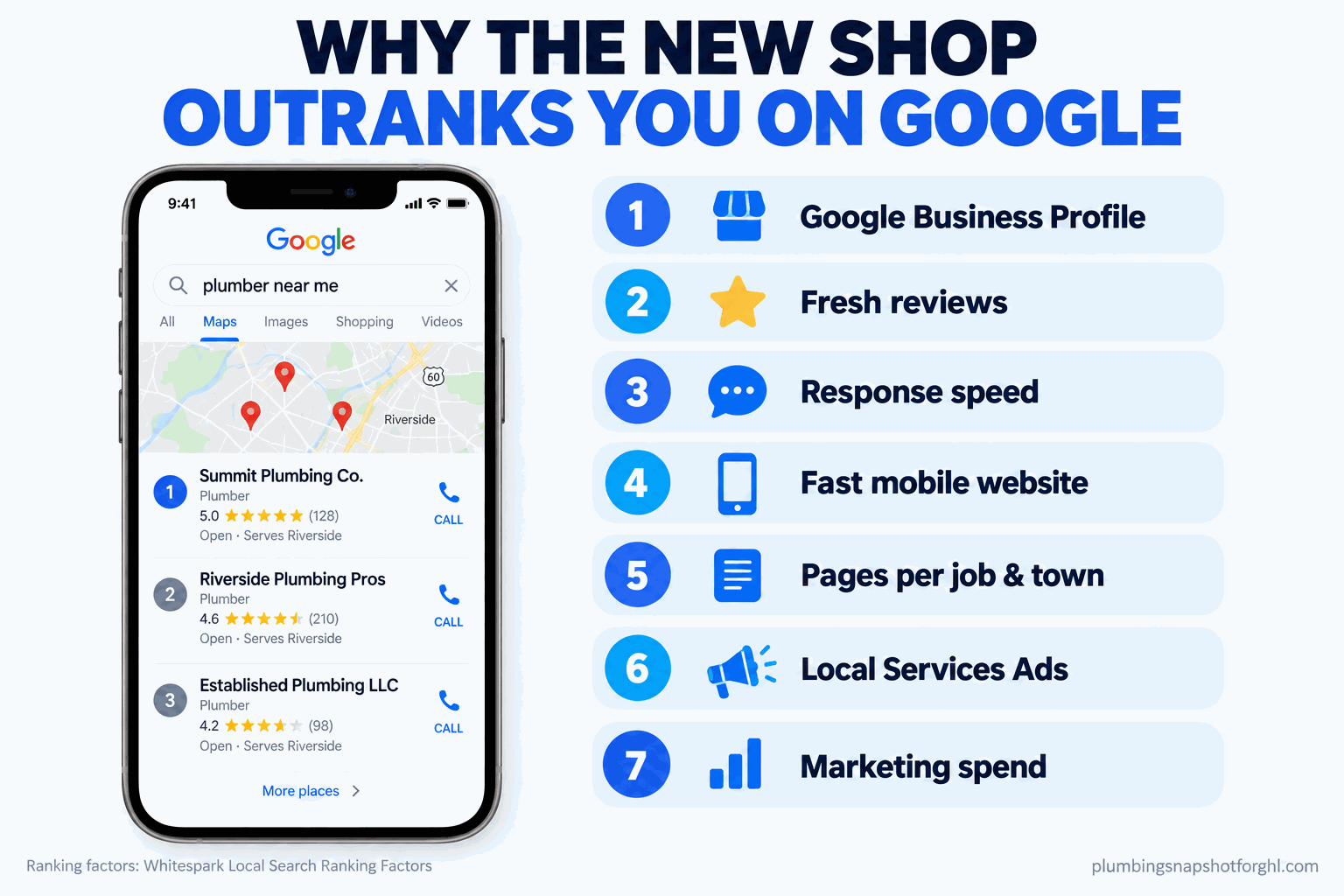
If a plumbing company that opened last year is sitting above you on Google and skimming the calls you used to get, it isn’t luck and it usually isn’t a bigger ad budget. Google ranks local plumbers on a short list of signals you can actually control: a complete and active Google Business Profile, fresh reviews, how fast you answer, a website that loads on a phone, real pages for the jobs and towns you serve, and whether you show up in the paid results above the map. The new shop is winning those signals while you coast on being the name in town for eleven years. Google doesn’t know you’re the name in town. It reads the signals. Here is exactly why the newcomer outranks you, what each gap costs in lost jobs, and the plain fix for every one.
In this guide
- The call you’re not getting anymore
- What being outranked actually costs you
- How Google actually decides who ranks
- Reason 1: Their Google Business Profile is alive, yours is a ghost
- Reason 2: They bank fresh reviews, your newest is from 2023
- Reason 3: They answer in seconds, you call back tomorrow
- Reason 4: Their website loads on a phone, yours crawls
- Reason 5: They have a page for every job and town, you have a brochure
- Reason 6: They’re above the map in Local Services Ads, you’re not in the auction
- Reason 7: They might be a private-equity roll-up, and you can still beat them
- Where to start by shop size
- Steal these: the three messages that move the signals
- Staying legal when you automate the fixes
- Objections
- Frequently asked questions
- About the author
The call you’re not getting anymore
It’s a Tuesday and you’re under a kitchen sink when the water heater call you would have booked two years ago never comes. It went to a shop you’ve barely heard of, one that opened fourteen months back and already sits in the top spot on Google Maps when a homeowner three blocks from your shop searches “plumber near me.” You’re the one who’s been fixing this town’s pipes for over a decade. You’re the one with the real trucks and the real license. And you’re the one on page two.
The honest answer is hard to hear and good news at the same time. Google is not rewarding the new shop for being better at plumbing. It’s rewarding them for being better at the handful of signals it actually reads, and every one of those signals is something you can fix without hiring an agency or burning your savings on ads. Seniority is invisible to a search engine. Signals are not. Let’s walk the seven places the newcomer is beating you, and close every one.
What being outranked actually costs you
More than a few jobs, because of where the leak sits in the funnel. A homeowner with water on the floor does not scroll. Google shows a Map Pack of three plumbers with stars and phone numbers, and the top three local results pull roughly 44% of all clicks on a local search (Backlinko). If you’re the fourth name down, you’re fighting for scraps on a screen the buyer has already left.
And this buyer moves fast. Google’s own data shows 76% of people who search for something nearby on a smartphone visit a related business within a day (Think with Google). This is decide-in-five-minutes traffic, not research traffic. The ranking isn’t a vanity contest. It’s the order in which emergency jobs get handed out.
The demand is there, which makes the loss sting. The Bureau of Labor Statistics counts about 510,600 plumbers and projects 7% growth from 2025 to 2035 (BLS). Homes keep flooding, too: water damage and freezing made up 27.6% of all homeowners insurance claims in 2022, averaging $13,954 per claim (Insurance Information Institute). The work is banging on the door. The newcomer is just the one Google puts in front of it.
How Google actually decides who ranks
Not on who’s been around longest, and not on who the locals know. The Map Pack is scored on a weighted mix of signals, and most of the weight sits in two buckets you control. Whitespark’s long-running Local Search Ranking Factors study puts your Google Business Profile at roughly 32% of what determines your position, review signals at about 16%, your website’s on-page content around 19%, links near 15%, and behavioral signals (clicks, calls, direction requests) at about 8% (Whitespark).
Estimated share of Google Map Pack ranking weight by factor. Source: Whitespark Local Search Ranking Factors.
Read that chart and the next seven sections write themselves. The newcomer is winning the two biggest levers, the Business Profile and the reviews, plus the website and speed signals underneath. None of it is out of your reach. Here’s each gap, what it costs, how it breaks, and the fix.
Reason 1: Their Google Business Profile is alive, yours is a ghost
Your Google Business Profile is the single biggest lever in local search, about a third of the whole ranking, and most established plumbers set theirs up years ago and never touched it again. The newcomer treats theirs like a storefront window: categories filled in, service area mapped, hours correct, photos added every week, questions answered, posts going up. Google reads that activity as “this business is open and serving customers right now,” and it ranks accordingly.
Photos alone move the needle. Google’s own profile data attributes roughly 42% more requests for directions and 35% more website click-throughs to listings with photos (via Sterling Sky). A profile with twelve photos from 2021 looks dead next to a shop posting a clean tankless install every Friday.
How it leaks: no primary category or the wrong one, a service area that doesn’t match where you actually drive, missing or stale hours, a handful of old photos, and zero posts or answered questions. Every blank field is a signal you handed the competitor.
The fix: claim the profile, complete every field to 100%, set the right primary category (“Plumber”) and relevant secondaries, map your real service area, and add photos on a schedule. The full walkthrough is in local SEO for plumbers, which is the pillar this whole article links up to.
Reason 2: They bank fresh reviews, your newest is from 2023
Reviews do two jobs at once, and the newcomer is winning both. They lift you into the Map Pack (about 16% of ranking weight, the second-biggest lever) and they win the click once you’re there (Whitespark). You can have forty five-star reviews and still lose, because the part that matters most is recency. 84% of consumers say reviews older than three months aren’t relevant to them (BrightLocal). A profile where the newest review is from last year reads as “this shop was good once.” A steady drip of fresh ones reads as “this shop is busy and trusted right now.”
The bar keeps rising, too. 68% of consumers now require at least a 4-star rating before they’ll even consider a business (BrightLocal), and a one-star increase in rating is associated with a 5% to 9% revenue increase for independent businesses (Michael Luca, Harvard Business School). Reviews aren’t a trophy shelf. They’re a ranking input and a revenue input.
Here’s the gap that kills established shops: willingness isn’t the problem. About 70% of customers leave a review when they’re simply asked (Search Engine Land). The newcomer asks every single customer automatically. You ask when someone remembers, which is almost never.
How it leaks: asking by hand, asking days late, asking by email nobody opens, and going quiet for months so your profile ages out of relevance.
The fix: automate a review request that fires the moment a job is marked complete, by text, with a one-tap link. The playbooks are double your Google reviews in 60 days and how to get more Google reviews on autopilot.
Reason 3: They answer in seconds, you call back tomorrow
Google watches behavior, and behavior is where the newcomer quietly pulls ahead. Calls, messages, and direction requests from your listing are behavioral signals (about 8% of ranking weight), and the shop that answers is the shop that earns them. But the bigger cost isn’t the ranking point. It’s the job.
A homeowner with an active leak calls two or three plumbers in a row and hires whoever picks up first. The research is brutal: contacting a lead within 5 minutes instead of 30 makes you about 21 times more likely to qualify it (MIT / InsideSales). Yet when Harvard Business Review audited over two thousand companies, the average first response took 42 hours, and 23% never responded at all (Harvard Business Review). The newcomer answers or texts back in seconds. You’re under a sink, and the call goes to voicemail, and the voicemail goes unreturned until the job is already booked somewhere else.
How it leaks: after-hours calls to voicemail, a second line that rings out while you’re on the first, form fills nobody sees until morning, and no instant reply when you physically can’t pick up.
The fix: an automatic text-back on every missed call within seconds, plus a 24/7 answer for the calls a human can’t take. The build is in missed-call text-back for plumbers and the after-hours AI receptionist playbook. Faster answers win more jobs and feed the exact behavioral signals Google is scoring.
Relative odds of qualifying a lead by response speed (5-minute reply set to a 21x baseline). Source: MIT / InsideSales Lead Response Management study.
Reason 4: Their website loads on a phone, yours crawls
Your website feeds two signals at once: it’s about 19% of ranking weight through its on-page content, and it’s where the click you fought for either converts or dies. The newcomer built on a modern, fast setup. Your site is a six-year-old template that opens slowly on a phone at the bottom of a basement stairwell, which is exactly where your buyer is standing.
Speed is not a nice-to-have. Google found that 53% of visits to a mobile site are abandoned if the page takes longer than 3 seconds to load (Google). Half your hard-won traffic is gone before it sees your phone number. On the money side, a site that loads in 1 second converts about 3 times better than one that loads in 5 seconds (Portent), and in Deloitte’s research a 0.1-second improvement lifted conversions 8.4% (Deloitte / web.dev). Google also uses Core Web Vitals in its ranking systems (Google Search Central), and only about 48% of mobile sites pass all three (HTTP Archive). Most of your competitors fail that test, which means passing it is still an edge.
How it leaks: a bloated page that takes five seconds on 4G, no mobile layout, images that aren’t compressed, and a phone number the homeowner has to pinch-zoom to tap.
The fix: a fast, mobile-first site that passes Core Web Vitals and puts the call button where a panicking homeowner’s thumb already is. The full teardown is in is a slow website costing you jobs, and you can get one built in a done-for-you plumbing website.
Reason 5: They have a page for every job and town, you have a brochure
On-page content is roughly 19% of the ranking weight, and this is where the newcomer out-works you quietly. Your site is five pages: home, about, services, a photo gallery, and a contact form. Theirs has a real page for every job they want more of and every town they drive to: a page on what causes a slab leak and what the repair involves, a page on tank versus tankless once you price the gas line, a page for each suburb in the service area. Google ranks the page that answers the search, and depth is what answers it.
This matters more every year because of how search is changing. AI Overviews now sit above the results for many informational queries and have been linked to roughly 34.5% lower click-through to the top organic result (Ahrefs). The content that still gets surfaced, and quoted by AI answer engines, is the genuinely useful, in-depth page, not the 400-word brochure with a town name dropped in twice.
How it leaks: one generic “services” page instead of a page per service, no town pages, thin copy that answers nothing, and no fresh content signaling the site is maintained.
The fix: build out a real page for each core job and each town you serve, written to actually answer the homeowner’s question. See how to get more plumbing leads for where this sits among your channels, and get a website for a build that ships researched service and town pages instead of filler.
Reason 6: They’re above the map in Local Services Ads, you’re not in the auction
Look at the top of a “plumber near me” result and you’ll often see Local Services Ads sitting above the Map Pack, each with a green “Google Guaranteed” badge. The newcomer is in that auction. You aren’t. Local Services Ads charge per lead rather than per click and put a verified badge next to your name, which is exactly the trust cue a nervous homeowner wants. Being outranked organically hurts more when you’re also absent from the paid slots above everything.
This isn’t a reason to abandon the organic work above, it’s an additional front. Local Services Ads reward the same things you should already be fixing: fast response, good reviews, and a verified profile. The shops that win there answer the phone, because Google reroutes a lead to a competitor when you don’t pick up.
How it leaks: you’ve never set up Local Services Ads, you’re not Google-verified, or you are running them but letting leads go to voicemail, which trains Google to send them elsewhere.
The fix: get verified, get in the auction, and make sure every lead gets answered fast so the pay-per-lead math works. The cost, setup, and ROI are broken down in Google Local Services Ads for plumbers.
Reason 7: They might be a private-equity roll-up, and you can still beat them
Sometimes the “new shop across town” isn’t a scrappy startup. It’s a private-equity-backed roll-up wearing a local name. Investors have poured billions into buying up residential plumbing and HVAC companies since 2022, consolidating independents under one brand with a central marketing budget most owner-operators can’t match (Marketplace). They outspend you on ads, they have staff whose only job is reviews and SEO, and they can lose money on marketing longer than you can.
That sounds like a reason to give up. It isn’t, because the two heaviest ranking levers can’t be fully bought. Proximity still matters: a homeowner searching from your side of town gets results weighted toward businesses near them, and a national roll-up’s call center isn’t three blocks away. Reviews and response speed are earned, not purchased, and a focused local shop that answers every call and banks a fresh review after every job can out-signal a bloated operation that treats each market as a line item. You will not win a spending war. You can win the signals war, because you care about this town and they care about a spreadsheet.
How it leaks: assuming you can’t compete, so you stop trying, which hands them the signals for free.
The fix: play to proximity, reviews, and speed, the three things a distant owner can’t fake. Then automate them so they happen on every job without you thinking about it. That’s the whole case for a system like the Plumbing Snapshot: it wires the signals to fire by default.
Where to start by shop size
The seven gaps are universal. Which one is costing you the most depends on your size. Run the diagnosis for yours before you spend a dime.
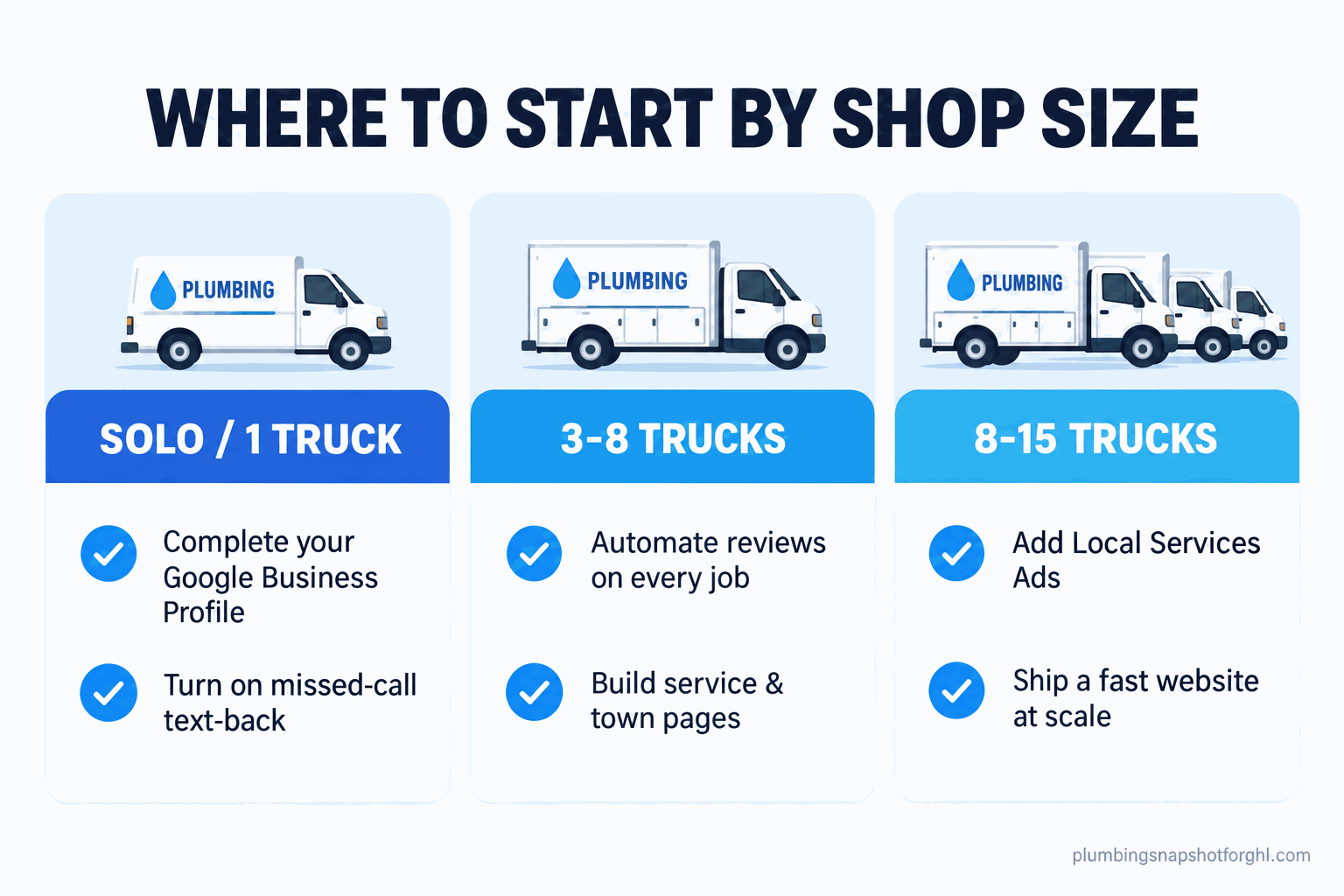
The solo operator (1 truck). Start with Reasons 1 and 3, the Google Business Profile and the missed-call text-back. You are the truck and the office, so you can’t answer while your hands are wet, and a dead profile plus unreturned calls is where you bleed. Both are free or nearly free, and both pay off the first week you catch a water heater you’d have slept through. Do nothing else until these two are handled.
The mid-size shop (3 to 8 trucks). Someone answers the phone now, so your gap moves to Reasons 2 and 5, reviews and website depth. Your competitors are banking fresh reviews every week and ranking pages you don’t have. Automate the review request on every job and build out a real page for each core service and each town. This is the size where “we’ve been here twenty years” quietly loses to a shop with a page for every suburb and a wall of this-month reviews.
The larger operation (8 to 15 trucks). You have the volume to compete on every front, so your gaps are Reasons 4 and 6, a fast website at scale and Local Services Ads. At your size a slow site is leaking paid traffic you’re already buying, and staying out of the Local Services auction cedes the slots above the map to the roll-up. Fix the site, get verified, and make sure the pay-per-lead leads actually get answered.
Steal these: the three messages that move the signals
Most of the fixes above run on a handful of short messages that have to fire every time. Here they are, ready to load into your system. Keep them plain, keep them human, and keep the opt-out on the automated ones.
Three messages, and they move four of the seven signals: the missed-call text-back wins the behavioral and speed signals, the review request fixes recency and rating, and the weekly profile post keeps your Business Profile reading as alive. The fixes aren’t complicated. They just have to happen on every job, which is exactly what a busy person on a truck can’t promise and a workflow can.
Staying legal when you automate the fixes
The moment you turn on automatic texts, missed-call replies, and review requests, you’re operating under TCPA and A2P 10DLC rules. This isn’t a reason to avoid automation. It’s a reason to do it right, and the basics are simple. Register your sending number with the carriers through A2P 10DLC or your texts get filtered before anyone reads them. Put an opt-out (“Reply STOP”) on automated messages and honor it instantly. Keep non-emergency texts inside legal hours. Replying to a homeowner who just called you is defensible because you have a clear business relationship. Blasting an old list without consent is not.
One more rule specific to reviews: never gate them. Asking only happy customers for a public review, or filtering out the unhappy ones before they reach Google, violates Google’s policies and can get your profile penalized. Ask everyone, the same way, every time. The full framework is in TCPA compliance for plumbing SMS.
Objections
“I’ve been here twenty years, I shouldn’t have to do any of this.” Fair, and Google doesn’t care. Seniority is invisible to a search engine, which reads signals, not history. The good news is the signals are cheaper to fix than twenty years of reputation were to build. You’re not starting over, you’re pointing the trust you already earned at the place buyers actually look.
“Isn’t this just SEO snake oil?” No. Every lever here is measurable and owned by you: profile completeness, review recency, response time, page speed, and whether you’re in the paid auction. You can check each one yourself this afternoon from your own phone. There’s no magic, only the choice of whether you fix the gaps by hand or have them automated.
“The new shop has way more money than me.” Maybe, and it matters less than you think, because the two biggest ranking levers can’t be bought. Proximity weights results toward the business near the searcher, and reviews and speed are earned on every job. A focused local shop that answers fast and asks every customer out-signals a cash-rich operation that treats your town as a line item. See how to get more plumbing leads for where to spend what you do have.
“I’m not technical, this sounds like a project.” The diagnosis is an afternoon, and the fixes are set up once, then they run. You approve the messages, connect your number, and the profile posts, review requests, and text-backs fire on their own. If you’d rather never touch it, hire a done-for-you GHL VA to own it, or have the Plumbing Snapshot installed in 24 hours.
Frequently asked questions
Why does a newer plumbing company outrank me on Google?
Because Google ranks local businesses on signals, not seniority. The heaviest are your Google Business Profile (about 32% of Map Pack ranking weight) and your reviews (about 16%), followed by your website's on-page content (about 19%), links, and behavioral signals like calls and direction requests (Whitespark Local Search Ranking Factors). A newer shop that keeps its profile active, banks fresh reviews, answers fast, and runs a fast, content-rich website sends stronger signals than an established shop coasting on reputation. Google can't see that you've been in town for years; it reads the signals, and the newcomer is winning them.
How much does my Google Business Profile matter for ranking?
A lot. Google Business Profile signals are roughly 32% of what determines your Map Pack position, the single largest factor (Whitespark). That covers your primary category, service area, hours, photos, posts, and ongoing activity. Listings with photos also get about 42% more direction requests and 35% more website clicks (via Sterling Sky). Most established plumbers set the profile up once and never touched it again, which is exactly the gap a newer, active competitor exploits.
Do reviews really affect where I rank, or just whether people trust me?
Both. Review signals are about 16% of Map Pack ranking weight, the second-biggest factor, and they also decide the click once you're in the pack (Whitespark). Recency is the part most shops miss: 84% of consumers say reviews older than three months aren't relevant (BrightLocal), so a wall of old reviews quietly loses to a competitor banking fresh ones every week. About 70% of customers leave a review when simply asked (Search Engine Land), so automating the ask on every completed job is the fastest fix.
How fast do I need to answer to compete?
Minutes, not hours. Contacting a lead within 5 minutes instead of 30 makes you about 21 times more likely to qualify it (MIT/InsideSales), yet the average business takes 42 hours to respond and 23% never respond at all (Harvard Business Review). A homeowner with an active leak calls two or three plumbers and hires whoever picks up first. An automatic missed-call text-back and a 24/7 answer close that gap and feed the behavioral signals Google scores.
Can I beat a private-equity-backed plumbing roll-up?
On ad spend, no. On signals, yes. Private equity has poured billions into buying up residential plumbing and HVAC companies since 2022 and funds them with central marketing budgets (Marketplace). But proximity weights results toward the business nearest the searcher, and reviews and response speed are earned on every job, not bought. A focused local shop that answers every call and asks every customer for a review can out-signal a distant operation that treats your town as a spreadsheet line.
How long until fixing these things changes my ranking?
Some signals move in days, others in weeks. A completed Google Business Profile, fresh photos, and a steady stream of new reviews can lift your Map Pack position within a few weeks. Website speed and new service and town pages take a little longer for Google to re-crawl and weigh, usually several weeks to a couple of months. The behavioral and review signals are the fastest wins, which is why solo and small shops should start there.
Related posts
- Local SEO for Plumbers: Rank in the Google Map Pack (2026): the full step-by-step pillar this guide links up to.
- How Los Angeles Plumbers Get More Google Reviews on Autopilot: the automated review system behind Reason 2.
- Double Your Google Reviews in 60 Days: the exact review cadence and scripts.
- Is a Slow Website Costing You Jobs? Page Speed & the 2026 Fix: the detail behind Reason 4.
- Missed-Call Text-Back for Plumbers (2026): win the speed signal from Reason 3.
- Google Local Services Ads for Plumbers (2026): get into the paid slots above the map.
Sources
- Whitespark: Local Search Ranking Factors
- Backlinko: Local SEO Statistics
- Think with Google: Mobile location searches to store-visit data
- BrightLocal: Local Consumer Review Survey
- Search Engine Land: 70% of consumers will leave a review when asked
- Michael Luca, Harvard Business School: Reviews, Reputation, and Revenue
- Sterling Sky: Interpreting Google Business Profile performance
- Google: The need for mobile speed
- Portent: Site speed is hurting everyone’s revenue
- Deloitte “Milliseconds Make Millions” (via web.dev)
- Google Search Central: Core Web Vitals
- HTTP Archive: 2024 Web Almanac, Performance
- Ahrefs: AI Overviews reduce clicks
- MIT / InsideSales: Lead Response Management study
- Harvard Business Review: The Short Life of Online Sales Leads
- Marketplace: Private equity is buying up skilled-trades businesses
- BLS: Plumbers, Pipefitters, and Steamfitters (Occupational Outlook Handbook)
- Insurance Information Institute: Homeowners and renters insurance facts + statistics
About the author
Hector Salinas is GHL Automation Lead at Plumbing Snapshot for GHL, based in Phoenix, AZ. He spent nine years dispatching for a 12-truck plumbing operation before he ever touched a CRM, and he learned the hard way how a single missed call turns into a lost five-figure job. He maps the call flows, review requests, and after-hours answering that decide whether a shop shows up and gets chosen, and he writes the way he’d brief a new service manager: plainly, with the revenue math attached.
Tired of watching a newer shop take your calls? Get a fast plumbing website, install the Plumbing Snapshot, or talk to a real person.