
A truck pulled into your market last spring with a name you did not recognize, a fresh wrap, and billboards up within a month. By summer that name owned the top ad slots on every plumbing search in your county. You found out later it was two shops you knew, bought and rebranded by a private-equity group three states away, now one 90-truck operation with a call center and an ad budget you cannot touch.
You are a licensed plumber who started this solo out of the back of a truck. You do good work, your regulars love you, and you just watched a spreadsheet with a logo move into town and start eating your calls. That fear is not paranoia. The roll-up is real, well funded, and after the same homeowners you serve.
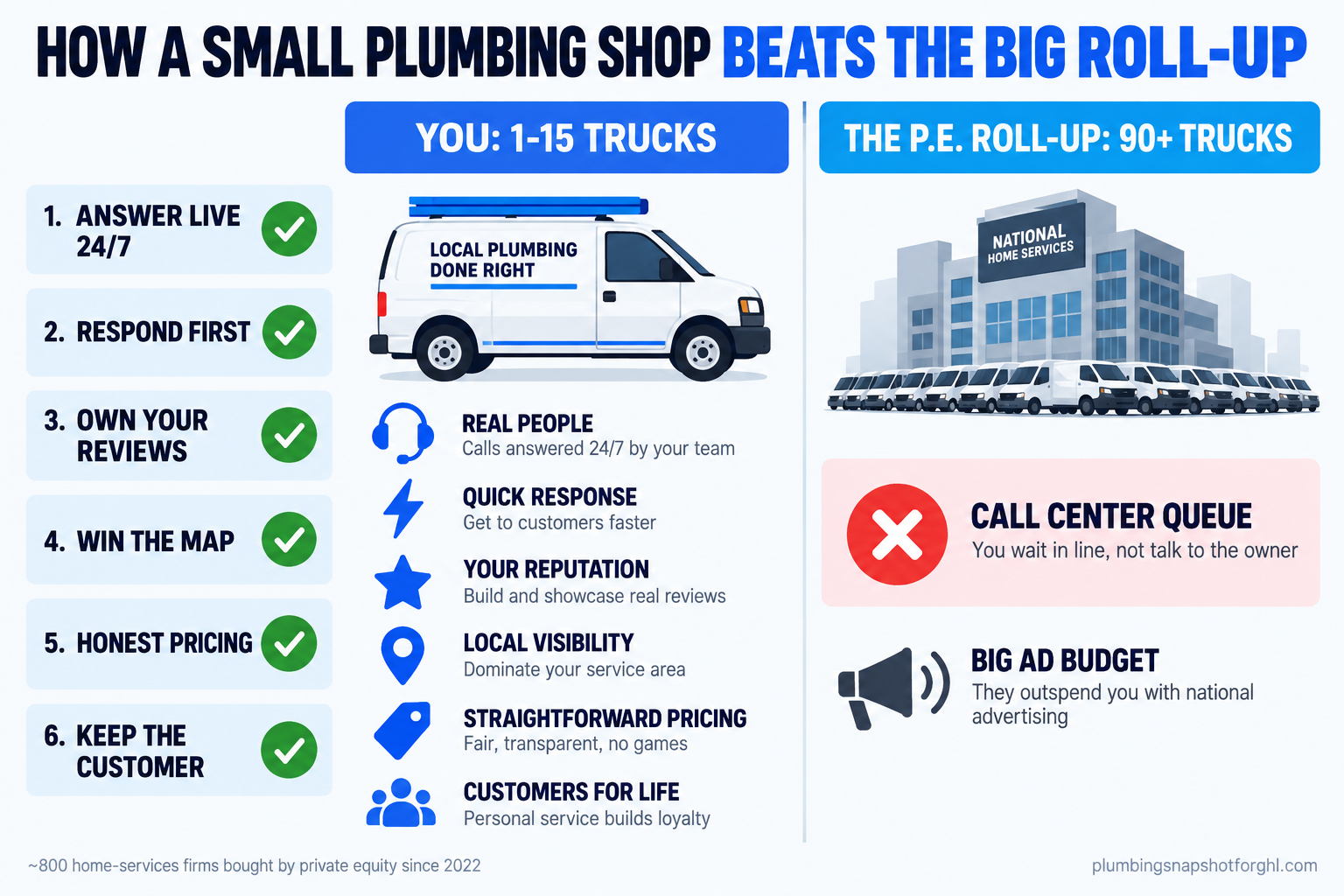
Here is the part nobody tells you: scale is a weakness as often as a strength, and almost every edge a 1-to-15-truck shop has over a roll-up is free or close to it. You will not out-spend them, and you do not have to. You beat them on what their size makes slow: answering live, responding first, owning your local reputation, and keeping the customers they treat as line items. This is the full playbook, six edges in order, with the copy and the math behind each one.
In this guide
- What is actually happening to your market
- Why big does not mean better at the one thing that counts
- The six edges a small shop beats a roll-up with
- Steal this: the exact texts and scripts
- How to prioritize by shop size
- Objections, answered
- Frequently asked questions
- About the author
What is actually happening to your market
For years, local plumbing was too fragmented for Wall Street to bother with. That changed once private-equity firms realized home services throw off steady cash and can be bought cheap and bolted together.
By some industry counts, private equity has acquired roughly 800 HVAC, plumbing, and electrical companies since 2022, and now sits behind about half of all HVAC-services deals (HVAC PE roll-up tracker). The biggest platform, Apex Service Partners, has reportedly scaled past $1.3 billion in annual revenue across more than 100 brands, closing around 60 acquisitions in 2025 alone (Hardwire News). Wrench Group, Sila Services, and ARS run the same play: buy a solid local shop, bolt on smaller shops cheaper, keep the familiar names on the trucks, and run marketing and dispatch centrally (roll-up economics).
That is why you often cannot tell. The roll-up keeps the old name, so the homeowner still thinks they are calling the local family shop. Behind the wrap, calls route to a regional call center, pricing comes from a spreadsheet built to hit a margin target, and the owner you used to see at the supply house is gone.
None of this means you lose. It means the game changed, and the winning edges are not the roll-up’s strengths.
Why big does not mean better at the one thing that counts
Here is what scale buys a roll-up: more trucks and more ad spend. Here is what it costs them: speed, local trust, and the owner who picks up at 2 AM because it is his name on the truck.
A homeowner with water coming through the kitchen ceiling is not comparison shopping. They want someone to answer, sound like they know the job, and get there. The shop that does that wins, and company size has nothing to do with it. The call center the roll-up routes to is slower and more scripted than you picking up your own phone.
The money side explains why they are so aggressive. A licensed plumber earns a median wage of about $63,800 a year, and the trade is tight, with roughly 42,000 openings a year through 2035 (U.S. Bureau of Labor Statistics). Labor is the roll-up’s biggest cost; they cannot conjure licensed plumbers any faster than you, so they lean on marketing to keep every truck full. Starve their trucks of calls in your zip codes and the economics they promised investors stop working.
The jobs at stake are big. Water damage and freezing makes up about 27.6% of all homeowners insurance claims and averages $13,954 per claim (Insurance Information Institute). Every burst pipe and failed water heater is a four-figure job that goes to whoever the panicked homeowner reaches first. That is the call you are fighting over, and it is winnable.
The six edges a small shop beats a roll-up with
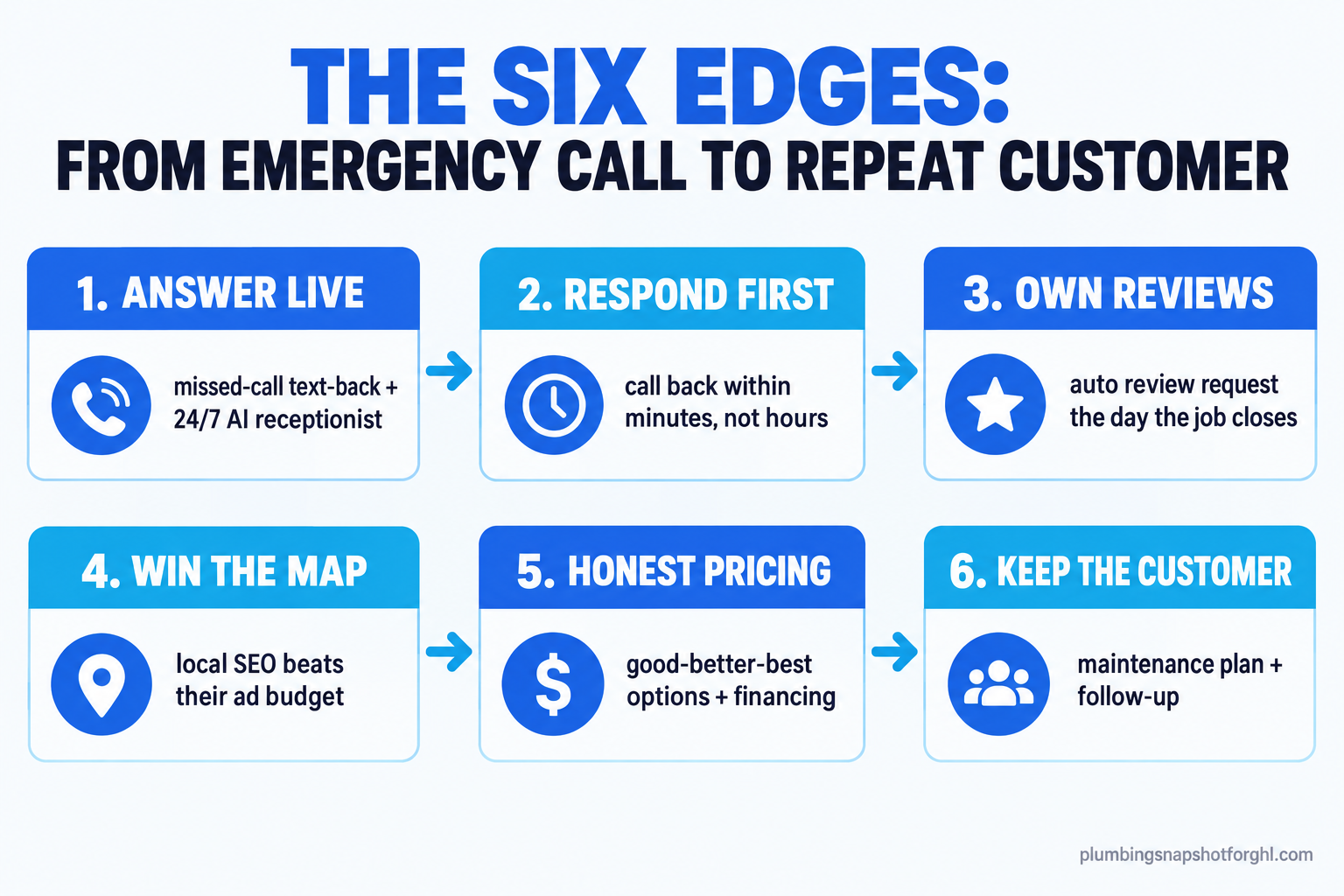
On every job, from emergency to paid invoice, there are six points where a small shop can beat a roll-up outright. Fix them in order.
Edge 1: Answer live, 24/7, when their call center cannot
The roll-up routes after-hours calls to an answering service that takes a message and promises a callback. You can text back in seconds. That gap is where emergency jobs are won.
How it breaks for you: you are a plumber, not a receptionist. You miss the 7:40 AM call because you are under a sink and the 11 PM call because you are asleep. Those go to voicemail, the homeowner dials the next name, and you never knew the phone rang.
What plugs it: a missed-call text-back that fires the instant a call goes unanswered, plus a 24/7 AI receptionist that answers in your shop’s voice and captures the emergency. That is the premise of an after-hours answering system: the homeowner gets a live-feeling response at 2 AM from a one-truck shop, exactly what the 90-truck roll-up cannot deliver from its call center. A missed-call text-back alone recovers jobs you are losing right now.
Edge 2: Respond first, because the first callback usually wins
Speed is the single most beatable thing about a roll-up. Their lead goes into a queue; yours goes straight to you. The shop that calls back first, while the homeowner is still holding the phone, usually takes the job.
How it breaks for you: a web form submits at 2 PM and you see it at 6 PM between jobs. By then the homeowner has called two other shops and booked one.
What plugs it: automated speed-to-lead so every form, chat, and missed call triggers an instant text and a task to call back within minutes. You do not need a dispatcher; you need a system that never sits on a lead. When you respond in minutes and the roll-up’s call center responds the next business day, you win the ones they paid to generate.
Edge 3: Own your local reviews, the trust money cannot buy fast
A roll-up can buy trucks tomorrow. It cannot buy ten years of five-star reviews from real neighbors. Reputation is the one asset that compounds for the shop that has been there, and it is the first thing a homeowner checks.
How it breaks for you: you do great work and never ask for the review. Your 200 happy customers stay silent while one angry one posts a one-star, so your rating does not reflect reality. The rebranded shop, meanwhile, inherited the reviews of whatever company it bought.
What plugs it: an automatic review request sent the same day every job closes, routing happy customers to Google and unhappy ones back to you privately first. That is how you build a review pipeline that reflects your real work.
Where consumers read local business reviews, by platform. Google dominates, so your Google Business Profile is the battleground. Source: BrightLocal Local Consumer Review Survey 2025.
Edge 4: Win the map, not the ad auction
You will lose the paid-ad auction. The roll-up has deeper pockets and will outbid you on “plumber near me” all day, so do not fight there. Fight for the organic map pack and the local results beneath the ads, where budget matters far less than relevance, reviews, and proximity.
How it breaks for you: a thin Google Business Profile, no local landing pages, a slow website, and no fresh reviews. The algorithm has nothing to rank you on, so the better-optimized competitor shows above you.
What plugs it: a real local SEO foundation, a fully built Google Business Profile with photos and service areas, and steady reviews feeding both. This is exactly how a newer competitor outranks an established shop. A well-run small shop can sit above the roll-up in the map pack for free, right under the ads it paid a fortune for.
Edge 5: Price with honest options, not a margin-target spreadsheet
Roll-ups are under pressure to hit investor margin targets, and that shows up in the price. Plenty of homeowners have noticed their “local” plumber got pricier after the quiet buyout. Your edge is honest, transparent pricing with real choices.
How it breaks for you: no flat-rate price book, so every quote is made up on the spot, your techs lowball out of nervousness, and the customer cannot tell if your number is fair. Inconsistent pricing reads as untrustworthy even when you are the honest one.
What plugs it: a good-better-best price book your techs read from, photos on every quote, and a financing line on anything over about $1,500. “The repipe is $6,400, or about $142 a month” is a different conversation than a bare number, and you present it without the margin padding a PE spreadsheet demands.
Edge 6: Keep the customer so they never shop the roll-up again
The roll-up treats customers as acquisition targets. You can treat them as a relationship, and that is where you quietly win the long game. A customer on a maintenance plan with you never types “plumber near me” and never sees the roll-up’s ads.
How it breaks for you: you fix the emergency, do great work, and never follow up. Two years later the same customer has forgotten your name and lands on the big guy’s ad.
What plugs it: a recurring maintenance plan plus a light retention sequence between jobs. This is the maintenance-plan flywheel: it turns one emergency into a decade of predictable work that is immune to the roll-up’s ad budget. Every customer you keep is one they cannot buy.
Steal this: the exact texts and scripts
Here is the copy that runs the first three edges, the ones that win the emergency call. Load it and change the shop name. You must have consent to text and honor opt-outs, which is standard TCPA-compliant setup, but done right these read as good service.
That last message does double duty: it builds your Google reviews and routes any unhappy customer back to you privately instead of to a public one-star. Send it automatically the same day the job closes.
How to prioritize by shop size
The six edges are the same at every size. Which one is bleeding you most, and what to fix first, depends on your setup.
Solo owner-operator (you are the tech). You lose the most to missed calls, because you cannot answer while your hands are wet. Fix Edge 1 first, then Edge 3, the automatic review request, because your reputation is your entire marketing department and costs nothing to build. Ignore the ad auction for now. You win on answering and trust.
The 3-truck shop. Now the leak is speed and consistency: leads come in faster than you can route them, and your pricing is three different stories depending on which tech shows up. Fix Edge 2 (speed-to-lead) and Edge 5 (a shared price book). This is where owners shop field-service software and find the big platforms built for operations three times their size.
The 10-to-15-truck shop. You are the roll-up’s actual acquisition target, so fight it on its own terrain: the map and the margin. Fix Edge 4 (local SEO so you out-rank them organically) and Edge 6 (maintenance plans so revenue is locked in and immune to their ad spend). At this size a single point of retention across the fleet is real money, and it makes your shop worth more if you ever do choose to sell on your terms.
Objections, answered
“I can’t out-spend a private-equity company, so what’s the point?” That is the point. You win by taking the calls their size makes them slow at, not by matching their budget. A roll-up’s call center cannot answer like the owner, call back in five minutes, or buy your decade of local reviews. Those edges are cheap and beat budget at the moment the homeowner chooses.
“Aren’t the big guys just better and cheaper because of scale?” Rarely cheaper. Roll-ups carry investor margin targets, and that pressure usually pushes prices and sales tactics up, not down. A call center and a rotating crew is not better service than the owner who stands behind his own name. Scale helps procurement and ad spend, not the homeowner with water on the floor.
“I already pay for ServiceTitan or Housecall Pro. Isn’t this covered?” Partly, and that is the trap. Those platforms can hold a price book and send a text, but the systems that win the emergency call, the 24/7 answer, the instant text-back, the speed-to-lead routing, the review pipeline, still have to be built and run. ServiceTitan will not even publish a price and has stated it is not optimized for shops with three or fewer technicians. Housecall Pro’s useful MAX tier runs about $329 a month (Housecall Pro pricing) and Jobber stacks paid add-ons on top (Jobber pricing). Owning the software is not owning the system that beats the roll-up.
“Do I need to be technical to run any of this?” No. In a done-for-you setup the text-back, after-hours capture, speed-to-lead routing, and review requests are already built and connected. You approve the copy and the prices; the automation handles the rest. If you can answer a text and approve an estimate, you can run the system that beats a company a hundred times your size.
Frequently asked questions
How do small plumbing companies compete with big private-equity-backed ones?
Not on ad budget, which you will lose, but on the edges scale makes slow: answering live 24/7, calling back within minutes, owning your local Google reviews, ranking in the map pack organically, pricing honestly, and keeping customers on maintenance plans. A roll-up's call center cannot match an owner who answers his own phone or buy years of real local reviews overnight.
Is private equity really buying up plumbing companies?
Yes. By industry tracker estimates, private equity has acquired roughly 800 HVAC, plumbing, and electrical companies since 2022, usually keeping the original local names on the trucks while running marketing and dispatch centrally. The 'new' competitor in your town is often a rebranded shop you already knew.
Why does speed matter so much against a bigger competitor?
An emergency caller books whoever responds first, and a roll-up routes leads into a call-center queue while yours go straight to you. A missed-call text-back that fires in seconds and a callback within minutes beat a next-business-day response every time. Speed is the most beatable thing about a large competitor.
Should I bother with Google Ads if the big company outbids me?
Spend your energy on the organic map pack and local SEO first, where reviews, relevance, and proximity matter more than budget, so you rank right under the ads a roll-up paid a fortune for. Add paid ads only once your Google Business Profile, reviews, and speed-to-lead are solid.
Will customers really pick a one-truck shop over a big company?
Often, yes, especially in an emergency. Homeowners trust local reviews and a human who answers, and many have noticed their 'local' plumber got pricier after a quiet buyout. A strong review profile, a live answer, and honest pricing beat an unfamiliar call center when someone has water on the floor.
The roll-up is betting you will fight it on its turf, out-spending on ads until you burn out. Do the opposite. Answer the calls it is too big to catch, keep the customers it treats as line items, and let it pay full price for leads that call you back first. Want the numbers before you build? See what plumbing software actually costs in 2026 and our pricing.
About the author
Yvonne Castellanos runs partner success at Plumbing Snapshot, where she has onboarded contractors from solo owner-operators to regional outfits. Her focus is the boring money that beats scale: review pipelines, maintenance-plan flywheels, and the retention automations that keep a plumbing brand booked between emergencies and out of reach of a bigger competitor’s ad budget.