

It is a Tuesday in March. You just turned down a water-heater job and a drain call in the same afternoon, not because the work was bad, but because you have no body to send. Your two best techs are booked three days out. You posted a “now hiring” ad two weeks ago, got eleven applicants, three with a license, one who answered your callback. He agreed to come in Thursday at 9. He never showed.
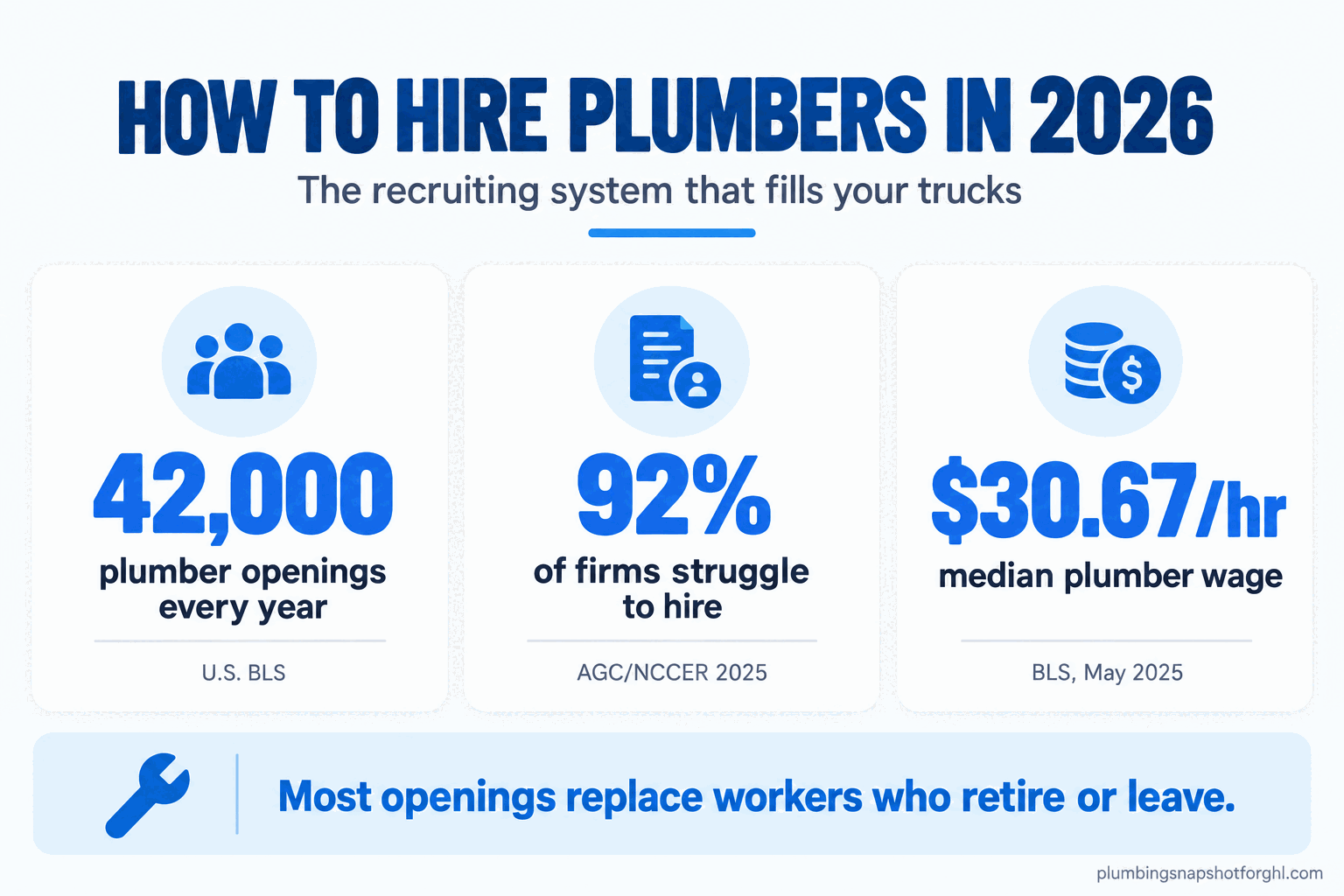
Hiring plumbers in 2026 is not a posting problem, it is a response-and-process problem: the shops that fill trucks fastest treat recruiting exactly like lead generation, answering every applicant in minutes, screening hard and early, and keeping a steady pipeline running even when every seat is full. The trade adds roughly 42,000 openings a year, and most of those are replacements for people who retire or leave, not new growth (U.S. Bureau of Labor Statistics). Meanwhile 92% of construction firms report difficulty hiring (2025 AGC / NCCER Workforce Survey). This is the full system that gets a qualified tech in your truck, the messages to send, and how it changes by shop size.
In this guide
- Why hiring plumbers is so hard right now
- What an empty truck actually costs you
- The 7-stage plumber hiring system
- Steal this: the exact job post, texts and scripts
- How hiring changes by shop size
- Keeping the techs you hire
- Common objections, answered
- Frequently asked questions
Why hiring plumbers is so hard right now
The shortage is real and the numbers are blunt. The Bureau of Labor Statistics counts about 510,600 plumbers, pipefitters and steamfitters in 2025, with employment projected to grow 7% through 2035, faster than the average job (BLS). That growth plus retirements works out to roughly 42,000 openings a year, but only about 34,500 of the decade’s openings are net new jobs. The rest is churn, so even in a flat market the trade keeps hiring just to stand still.
Now layer on how hard it is to find someone good. In the 2025 AGC / NCCER Workforce Survey of nearly 1,400 firms, 92% reported trouble hiring, and 57% said applicants were not qualified, lacking the skills or the license (AGC / NCCER). The one that stings most for a small shop: 48% said new hires failed to show up or quit quickly, and 45% said shortages were already causing project delays.
Read those two facts together. There are not enough licensed plumbers to go around, and even the ones you reach often ghost you. That is not bad luck. It is what happens when a scarce worker gets to choose and most shops give them a slow, clumsy reason to pick a competitor.
What an empty truck actually costs you
Owners treat an open seat like money saved. It is the opposite: a parked truck is your most expensive asset sitting idle while the phone rings. A working truck books four jobs a day at a few hundred dollars each, plus a water heater or repipe a couple of times a week. That is real revenue a second truck would earn and does not. The calls do not wait for you to staff up. They go to whoever can send someone, and once a homeowner likes a plumber, you lost their next job and their referrals too.
The 7-stage plumber hiring system
Filling a truck is not one post. It is a pipeline, the same shape as the one you use to turn a lead into a booked job. Here is each stage, how to set it up, and the way it breaks.
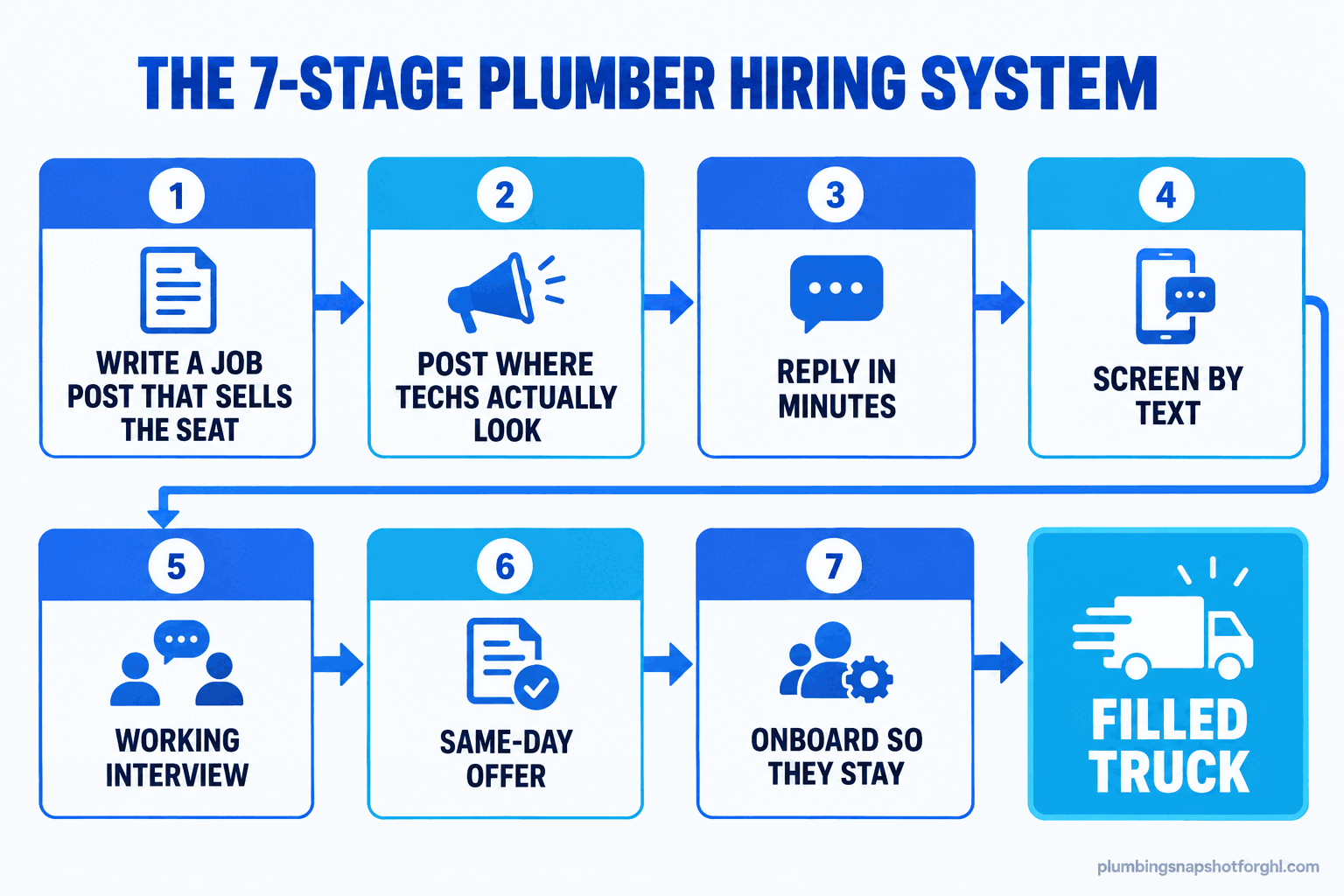
Stage 1: Write a job post that sells the seat
How to set it up. A good plumber is choosing between shops, so sell your shop, do not just list demands. Lead with a real pay range (not “competitive”), the truck, the schedule, and whether on-call is paid. Say what you do not do: no pressuring customers, home most nights, weekends rotated fairly.
How it breaks. A wall of “must have” demands with no pay number. Qualified techs scroll past it. If your post reads like a parole condition, the only people who apply are the ones no one else will take.
Stage 2: Post everywhere a tech actually looks
How to set it up. Indeed and Facebook job groups are table stakes. Then go where owners do not bother: the union hall, supply house counters, the community college trade program, and your own customers and crew (a referral bonus is the cheapest hire you will make). Post it on your website and Google Business Profile too.
How it breaks. One ad on one site, then waiting. The best techs are already working, and you reach them through people, not job boards.
Stage 3: Reply to every applicant in minutes
How to set it up. Treat an application exactly like a lead. The first shop to respond usually gets the interview, because a good tech applied to several at once. An automated text that fires the second an application lands buys you that first-contact spot even when you are under a sink. It is the same speed-to-lead principle that wins customers, pointed at hiring, with the same missed-call text-back logic.
How it breaks. You see the application Thursday and call back Monday. By then he started elsewhere. A 48-hour reply is a no in a market this tight.
Stage 4: Screen by text before you spend time
How to set it up. Before anyone books an interview, send three or four questions that filter fast: Do you hold a license, and in what state? Years in residential service? Own hand tools and a clean driving record? Can you start in two weeks? One morning of unqualified walk-ins costs more than the hire.
How it breaks. You skip screening to “just get people in,” then burn a day of billable time confirming that 57% of them lack the skill or the license (AGC / NCCER).
Stage 5: A working interview, not just a chat
How to set it up. Talk is cheap and plumbers are doers. After a short sit-down, put a real task in front of them: size a job from a photo, walk a water-heater swap, or ride along on one call. You learn more in twenty minutes of work than an hour of questions, and you see how they treat the homeowner.
How it breaks. Hiring on a handshake and a good story. The ones who interview great and cannot run a call are the hires that wash out fast.
Stage 6: Make the offer same day
How to set it up. If the working interview goes well, offer on the spot or by end of day, in writing, with pay, schedule, on-call terms, and benefits spelled out. A good tech has other shops circling, and the owner who hesitates a week loses them to the one who said yes Friday.
How it breaks. Slow-playing the offer to shave $2 an hour, and losing the only qualified person who answered all month.
Stage 7: Onboard so they stay
How to set it up. Day one, the truck is stocked, the uniform fits, and someone walks them through how you quote, close out a job, and treat a customer. A 30-day check-in catches small frustrations before they become a notice.
How it breaks. You hand them keys and a work order and disappear. They feel like a warm body, not a hire, and leave the first time a competitor waves a bigger number.
Steal this: the exact job post, texts and scripts
You do not need a recruiter, just copy that works. Swap in your details and use these today.
A note on the texting: message only applicants who gave you their number by applying, and keep an opt-out on file. The TCPA rules that govern customer texting are a good habit here too. Have the automation send a polite “we went another direction” text to the people you pass on. It keeps your name clean in a trade where everyone talks.
How hiring changes by shop size
The pipeline is the same. What you can offer, and what you should hunt for, is not.
The solo owner adding the first tech (1 truck to 2)
This is the scariest hire, because payroll comes out of your pocket before the second truck is fully booked. Do not over-hire: a strong apprentice or a journeyman who is good with customers beats a master plumber you cannot keep busy. Your edge over the big shop is that you will actually mentor this person, so sell that. Automate the instant reply so you are not choosing between answering applicants and finishing the job in front of you.
The 3-truck shop (filling seats and planning ahead)
At three trucks you hire on a rhythm, not in a panic. Keep the pipeline warm even when you are full, because someone is always six weeks from quitting. Start a crew referral bonus, run a ride-along as standard, and start growing an apprentice into a journeyman. Your pay has to be honest against your true billable rate, or you train people and lose them to the shop that pays $3 more.
The 8-plus-truck shop (building a bench)
Now hiring is a department, even if the department is you and an office manager with a good system. You are competing with private-equity-backed roll-ups that have recruiters and ad budgets. You will not out-spend them, so out-respond and out-culture them. An automated pipeline that replies in seconds, a real apprenticeship track, and a reputation as the shop techs want to work for beats a faceless roll-up most of the time. Track hiring like you track jobs: applicants in, reply time, how many start, how many last 90 days, all KPIs worth watching.
Keeping the techs you hire
Every hire you keep is one you do not have to make again. The shops with the worst hiring problem usually have the worst turnover, running the same stage 1 over and over.
The levers are simple. Pay fairly and review it on a schedule, so a good tech never has to leave to get a raise. Keep trucks clean and stocked, because nothing burns out a plumber faster than fighting their own equipment all day. Set clear expectations and do not ask them to pressure-sell, which loses the honest ones fast (there is a better way to lift tickets, a system around the tech, not a quota). And build a path to journeyman and beyond.
Grow your own, too. A registered apprenticeship lets you bring on someone with no experience, pay them while they learn over a 4 to 5 year program of paid on-the-job training plus classroom hours, and shape them into the plumber your shop needs (BLS). Find or sponsor a program through apprenticeship.gov or your state board. It is slower than hiring a journeyman, but it is the one channel the roll-ups cannot corner, and the tech you trained tends to stay.
Common objections, answered
“I can’t afford to pay what they’re asking.” Then you cannot afford the open seat either, and that one costs more. Price your jobs off your real billable rate so a fair wage is built into every ticket. If the math does not work at market pay, the problem is your pricing, not the wage. Apprentices also start lower and climb as they learn (BLS).
“Every tech I interview ghosts me or quits in a month.” You are not alone, 48% of firms report exactly that (AGC / NCCER). It traces to two things: slow response and weak onboarding. Fix stages 3 and 7 and the ghosting drops.
“I don’t have time to recruit, I’m running jobs all day.” That is the reason to automate the front of the pipeline. The instant reply, screening questions, interview reminders, and reject notices run without you. You step in only for the working interview and the offer.
“Can’t I just use a staffing agency?” For a one-off gap, fine. But agency fees are steep, the placement may not stick, and you are renting a fix for a problem you will have again next quarter. Your own pipeline is cheaper after the first hire.
Frequently asked questions
How do I hire a plumber for my business when no one qualified applies?
Widen where you post and speed up how you respond. Go past Indeed to your supply house counter, local trade programs, your union hall, and referrals from your crew and customers. Then reply to every applicant within minutes, because a qualified tech is applying to several shops at once and the first owner to answer usually gets the interview. In the 2025 AGC/NCCER survey, 57% of firms said applicants were not qualified, so screen by text before you book any interview.
How much do I have to pay to hire a plumber in 2026?
The U.S. median wage for plumbers, pipefitters and steamfitters is $30.67 an hour, or $63,800 a year as of May 2025 (BLS), and good residential techs in busy markets often run higher. Price your jobs off your true billable rate so a competitive wage is built into every ticket. If you cannot pay market rate, your pricing is the problem.
Should I hire a licensed journeyman or an apprentice?
Both, for different reasons. A licensed journeyman produces revenue on day one but costs more and is harder to find. An apprentice costs less, is paid while they learn over a 4 to 5 year program, and is the cheapest long-term way to fill a truck because you train them to your standard and they tend to stay. Most growing shops run a mix.
Why do my new plumbing hires quit so fast?
Usually onboarding and pay, not the person. Nationally, 48% of firms report new hires no-showing or quitting quickly (AGC/NCCER). Techs leave when the truck is a mess, expectations are unclear, they are pushed to pressure-sell, or they see no path to a raise. A stocked truck, clear expectations, fair pay, and a 30-day check-in fix most early quits.
Is it legal to text job applicants from my business number?
Yes, when they gave you the number by applying and you keep an opt-out available. Applicant texting is on safer footing than cold marketing, but the same consent and opt-out habits that govern customer texting under the TCPA are worth following. Keep records of who opted in and honor any STOP request.
How fast should I respond to a plumber who applies?
Within minutes, ideally with an automated first reply in under a minute. The same speed-to-lead math that wins customers applies to hiring: the first shop to make real contact usually gets the candidate. A 48-hour callback in this market is effectively a no, because the good techs have already lined up interviews elsewhere. To find apprentices to grow yourself, start at apprenticeship.gov and your state plumbing board.
About the author
Hector Salinas is GHL Automation Lead at Plumbing Snapshot. He spent nine years dispatching for a 12-truck plumbing operation before building GoHighLevel systems full time, so he has watched owners lose jobs to an empty seat as often as to a missed call. He writes the way he would brief a new service manager: plainly, with the revenue math attached.