

It is a Sunday night and your best service plumber texts you. “Hey, I’m giving my two weeks. Got an offer I can’t turn down.” You call him back. He is polite, a little embarrassed, and already gone in his head. The roll-up that bought the big shop two towns over offered him four dollars an hour more, a sign-on bonus, and a truck that does not smell like 2015.
You spent two years making that guy good. Monday morning you are short a truck and about to spend months and real money getting back to where you were Friday.
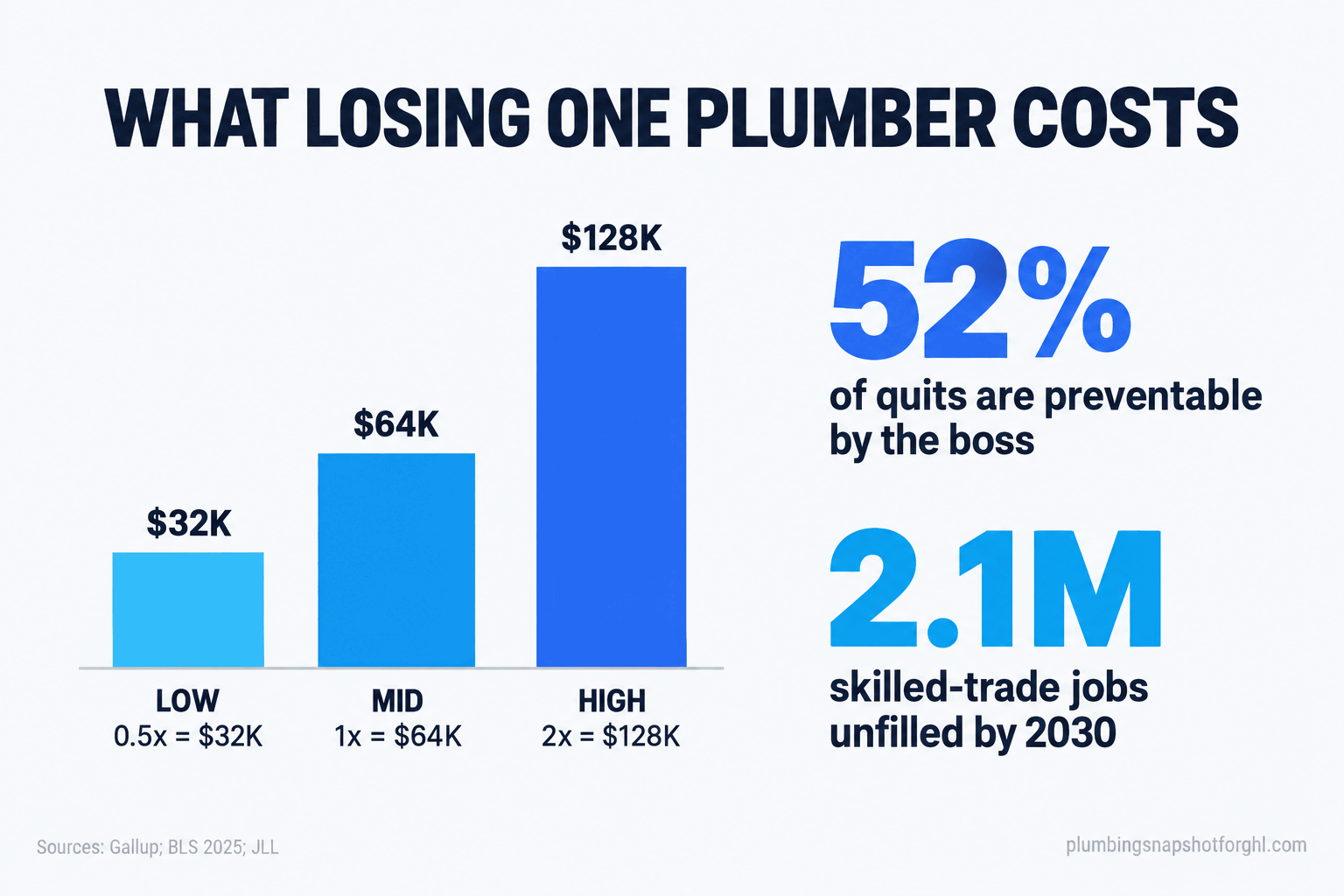
Here is the thing nobody tells you: most of the time, that plumber was not bought away. He was pushed out long before the offer came, by pay he could not make sense of, days that fell apart by 10 AM, and a boss who never once asked what would keep him. Gallup found that 52% of people who quit say their manager or company could have done something to stop them (Gallup). This is the system that does that something, before the Sunday-night text.
In this guide
- What losing one good plumber actually costs you
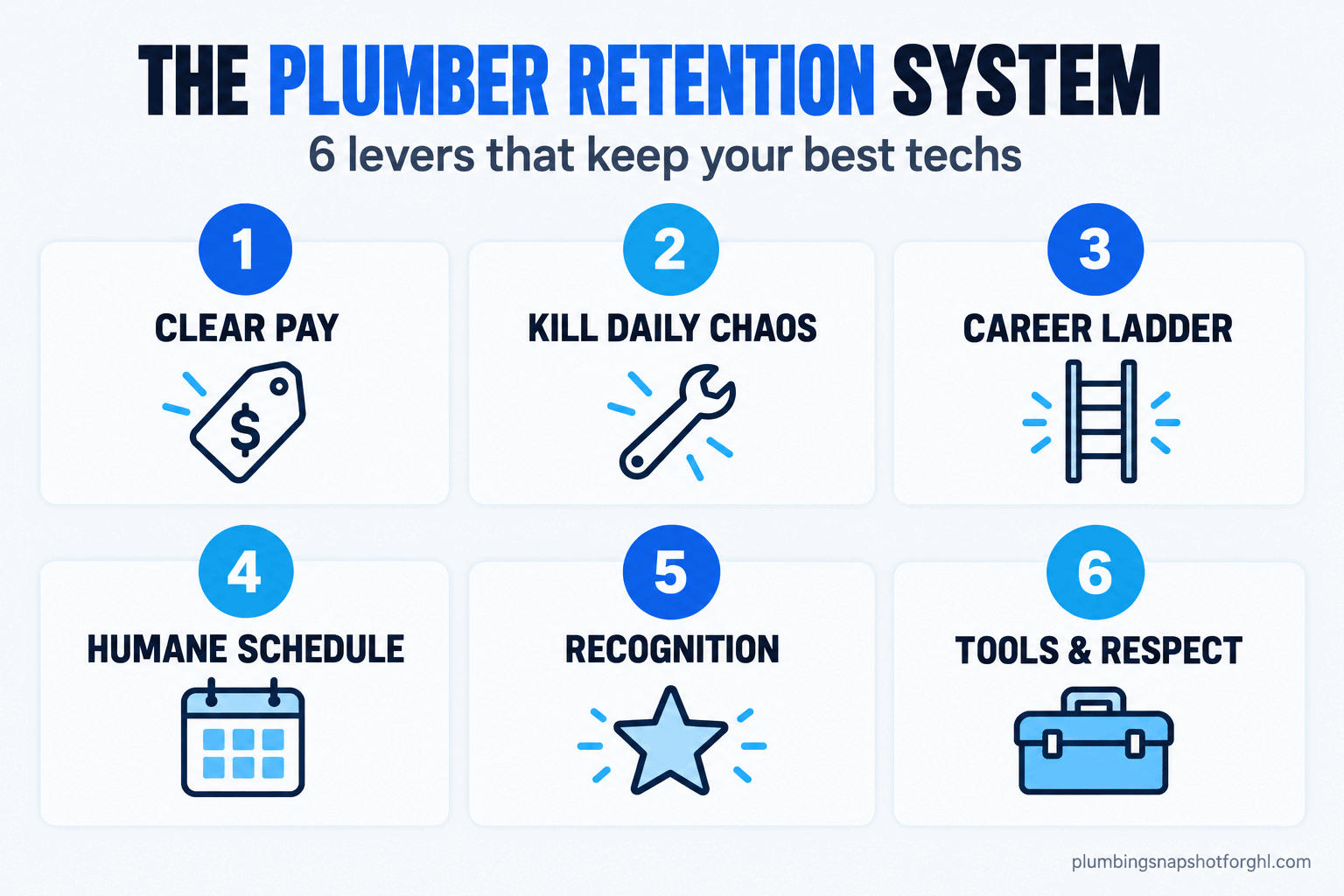
- The six levers that keep a plumber
- Steal this: the scripts and the raise math
- What retention looks like for a solo, a 5-truck, and a 12-truck shop
- You versus the private-equity roll-up
- Objections, answered straight
- Frequently asked questions
- About the author
What losing one good plumber actually costs you
Start with the number. Gallup puts the cost of replacing one employee at one-half to two times their annual salary, and calls that conservative (Gallup). The median plumber earns $63,800 a year as of May 2025 (BLS). Run the math and losing one plumber costs you somewhere between $32,000 and $128,000.
That is not a made-up HR figure. It is the stuff you can feel: recruiting ads, a sign-on bonus, weeks of ride-alongs before the new hire is billable, and the overtime your crew eats to cover the hole. Then the costlier soft stuff: the accounts that followed your old tech out the door, and the rest of the crew watching a good guy leave and updating their own resumes.
Cost to replace one plumber: Gallup’s one-half to two times range applied to the $63,800 median salary. Sources: Gallup, BLS, May 2025.
The part that should scare you more: you cannot hire your way out of this anymore. The trades are staring at 2.1 million unfilled jobs by 2030, and last year about 600,000 skilled-trade jobs were posted while only 150,000 new workers came in through apprenticeships (Fortune / JLL). Plumbing is projected to grow 7% through 2035 (BLS). Demand up, labor pool down. The guy you already trained is the most valuable asset on your books.
The six levers that keep a plumber
Every owner assumes the plumber left for a bigger check. More often the check was just the excuse, because he was already pushed out by confusing pay, days that fell apart by 10 AM, no path forward, a schedule that owned his life, or feeling nobody heard him. Retention is not a vibe. It is six concrete levers, each with a failure mode you can spot. Pull the ones leaking in your shop.
Lever 1: Pay that is clear, not just competitive
Competitive matters. Clear matters more. Publish a simple pay ladder, apprentice to journeyman to lead tech, with the hourly band for each and the two or three things it takes to move up. The BLS median is $63,800, with experienced service plumbers well above that (BLS), and your techs can look that up in thirty seconds. Add performance pay they can control: a spiff on membership plans sold, a bonus on reviews earned, a cut of their own booked revenue over a threshold. If you are not sure you can fund raises, start with your true billable-hour rate before you decide it is impossible.
How this breaks: secret pay. Raises handed out quietly to whoever complains loudest teach everyone else that the way to a raise is to threaten to quit.
Lever 2: Kill the daily chaos
This is the lever owners skip, and the one that burns out good techs fastest. A plumber did not get into this trade to sit in traffic, call the office four times for an address, or show up with the wrong parts. Every hour of that is an hour he thinks about the shop two towns over.
Tighten it. Stage parts the night before, stop the double-booking, and get the customer’s history, gate code, and photos to the tech before he rolls, not after he is parked out front. A real dispatching and scheduling system cuts windshield time and the 10 AM blowup, and a fair on-call rotation stops resentment growing after hours. The admin mess is its own quiet quit: missed calls, manual reminders, and reviews chased by hand all roll downhill onto techs as rushed jobs and angry customers. That is the difference between a plumber who finishes the day tired and one who finishes it done.
How this breaks: you buy software and change nothing. A dispatch board nobody updates is just prettier chaos.
Lever 3: A real career ladder
A plumber with nowhere to go starts looking for somewhere to go. Build the rungs: apprentice to journeyman to lead to service manager, each with the skills and hours it takes. Pay for license renewals and sponsor the apprenticeship hours. The Department of Labor’s registered apprenticeship programs are built for this and cost less than you think (apprenticeship.gov). Growing your own licensed plumber is cheaper than poaching one, and ties straight into how you hire plumbers.
How this breaks: a ladder with no rungs. Telling a tech “there’s room to grow here” and then promoting nobody for three years is worse than saying nothing. If you name a path, somebody has to actually walk it.
Lever 4: A schedule that does not own their life
On-call is where good plumbers quietly burn out. One week on, one week off is survivable. Every other night with your phone on the nightstand is not. Pay for on-call time, rotate it fairly, and protect real days off. The Department of Labor has clear rules on when on-call time is paid, and getting it wrong is a morale and a legal problem (DOL). The real fix is a system that captures the 2 AM call without waking the guy who is not on.
How this breaks: the hero trap. You lean on your one reliable plumber for every emergency because he always says yes, right up until the Sunday-night text. The most dependable tech is usually the one closest to the edge.
Lever 5: Recognition and actually being heard
This one is free and most owners skip it. Run a stay interview twice a year with every tech you want to keep. Not a performance review: an honest talk about what is working, what grinds on them, and what would keep them two more years. Then fix one thing they name. That loop, ask and act, is what separates a shop people stay at from one they tolerate. Catch people doing it right, too: a shout-out at the Monday huddle when a tech earns a five-star review by name is the opposite of the invisibility that pushes people out.
How this breaks: you ask and do nothing. A stay interview where the plumber airs a real problem and watches it get ignored is worse than never asking. Only run the conversation if you intend to act on it.
Lever 6: The right tools, trucks, and respect
Plumbers notice what you equip them with. A truck that runs, stocked inventory, a camera and locator that work, quoting on a tablet instead of a paper pad. Cheap tools tell a tech his time is cheap. Respect is the quiet version of the same thing: back your plumber in front of a difficult customer, and do not blow up over one honest mistake.
How this breaks: nickel-and-diming the truck. Making a tech fight for a $200 tool while the owner drives a new dually tells your crew exactly where they rank.
Steal this: the scripts and the raise math
Here is the actual language, ready to use this week.
The stay interview (twice a year, 20 minutes):
“I’m not reviewing you today. I want to keep you here for a long time, so I need the honest version. What’s the best part of working here right now? What’s the thing that makes you think about leaving, even a little? And what would it take to have you here in two years? Nothing’s off the table.”
Then shut up and write it down. The goal is the thing he would never bring up on his own, while it is still small enough to fix.
The raise conversation (make the money make sense):
“Here’s how pay works here. You’re a journeyman at $X. To move to lead tech, I need you running jobs clean, closing above Y%, and mentoring the apprentice. Hit that for two quarters and you’re at $Z. That’s the ladder, and here it is in writing.”
The exit save (when the resignation text lands):
“Before anything’s final, give me one honest conversation, no pressure. I’d rather fix what’s pushing you out than match a number and lose you in six months anyway. Can you tell me the real reason, and what the other offer actually is? If I can’t compete, I’ll shake your hand and mean it.”
You will save more than you think. The counter-offer math usually favors staying calm: matching a $5,000 raise beats a $35,000-plus replacement cost. Just make the counter once, only for someone worth keeping, and alongside fixing what pushed him to look. A raise that buys silence on a real problem buys you six months, not a career.
What retention looks like for a solo, a 5-truck, and a 12-truck shop
The levers are the same. Which one leaks worst changes completely with your size.
Solo owner with one helper. You are the culture, the schedule, and the ladder all at once, and if he walks you are back to running every call yourself. Levers 4 and 5 are your weak points: you lean on him for every after-hours call and never ask how he is doing because you are both slammed. Protect his time off like a customer appointment, do an honest stay interview once a quarter, and put his pay path in writing.
Five-truck shop. This is where chaos (Lever 2) does the most damage. You have enough volume that a sloppy dispatch day burns real hours, enough techs that resentment spreads, and pay that drifts secret-and-reactive fast. Publish the ladder, systematize the day, and rotate on-call on a real calendar. One bad month of scheduling here can cost you two techs, not one.
Twelve-truck shop. Now it is Levers 3 and 6. Your best plumbers are good enough to run their own trucks and bored enough to think about it, and the roll-ups target this size hardest because your trained journeymen are who they want. Fund the career path, equip the trucks like you mean it, and make sure your best people know the next rung is real and close. Losing three plumbers a year to preventable turnover is a quarter-million-dollar line item hiding in plain sight.
You versus the private-equity roll-up
The private-equity-backed shop buying up your town has more cash, better trucks, and a recruiter whose job is calling your plumbers. You will not win on raw pay. You win on everything else, because a roll-up is bad at exactly the things a small shop is good at.
| Your shop | PE-backed roll-up | |
|---|---|---|
| Pay | Competitive, if you price right | Usually higher, with a sign-on bonus |
| Who the plumber reports to | You, by name | A rotating regional manager |
| Decisions | Made on the truck, fast | Made at corporate, slow |
| Recognition | Personal, same day | A dashboard metric |
| Career path | You can build it around the person | A rigid template |
| Culture | Trade talk, has your back | Corporate, KPI pressure |
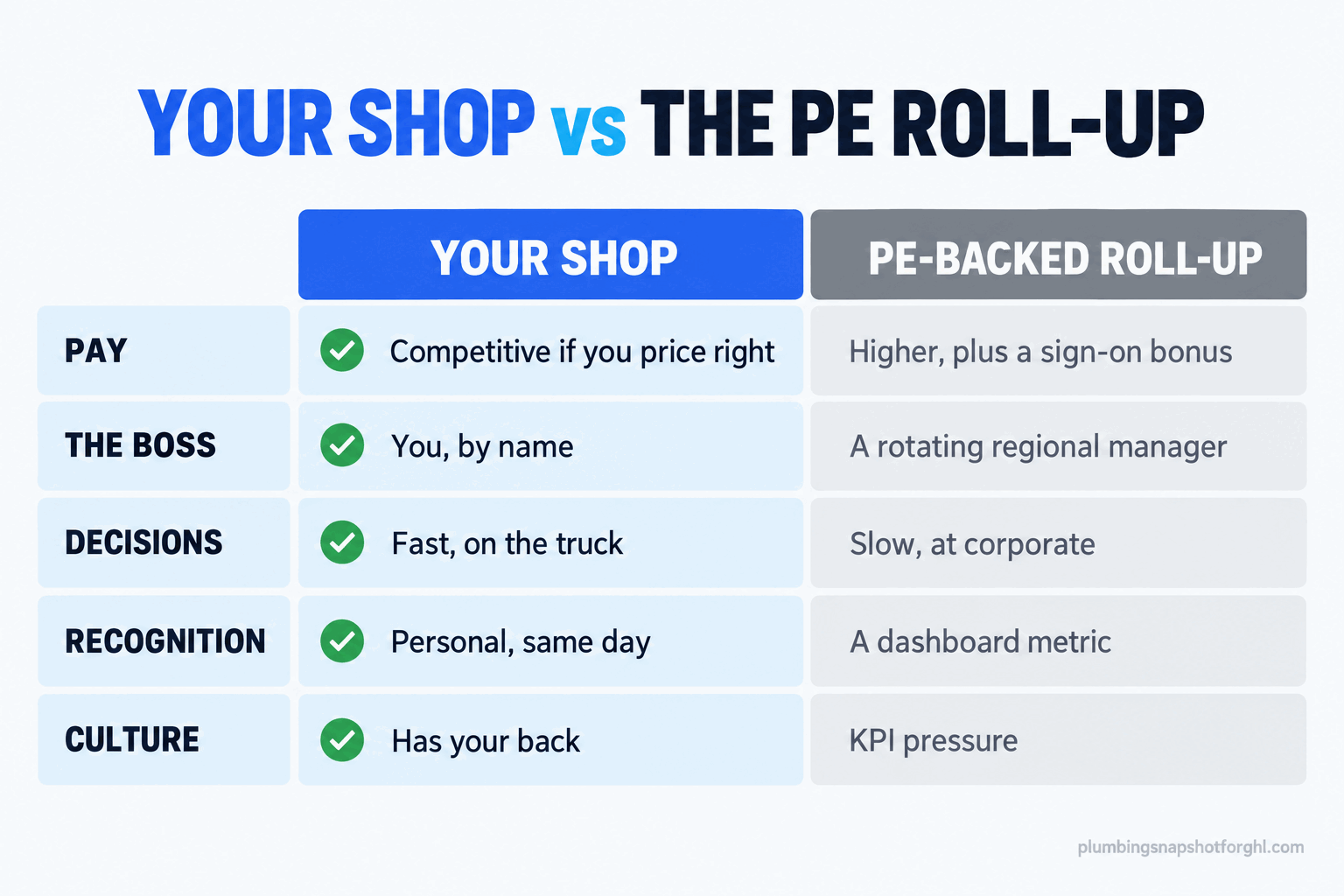
A plumber who feels seen, paid fairly, and set up to have a good day turns down a few dollars an hour to stay somewhere he is a name, not a number. The roll-up cannot copy that, but only if you actually pull the six levers. For the bigger fight over customers, see how to compete with big plumbing companies.
Objections, answered straight
“I can’t afford to pay more right now.” Then you have a pricing problem, not a payroll problem. Replacing one tech runs $32,000 to $128,000 (Gallup, BLS). A $4,000 raise is cheap next to that, and half the levers here cost nothing but attention.
“They’ll leave eventually anyway.” Some will. The goal is keeping your best people two or three years longer and sending the leavers out as fans. One who stays an extra two years and refers a buddy on the way out is a different story than one who quits raw at 18 months and badmouths you.
“The roll-ups will always outbid me.” On the number, often yes. On the job, no. More than half of quits are preventable by the employer (Gallup), so most of what keeps a plumber is not the top-line wage. You cannot win a bidding war, but you can be the place a four-dollar raise is not worth leaving.
“I don’t have time for stay interviews.” Twenty minutes, twice a year, per tech, against the weeks you lose rehiring. It is the one retention move a recruiter calling your crew cannot do for you.
“My techs seem fine.” They did for that guy too, right up until the Sunday-night text. “Fine” is what you see from the outside while someone quietly decides. A stay interview surfaces the problem while it is still a complaint, not a resignation.
The Sunday-night text, rewritten
Rewind two years on that plumber giving his two weeks. He knew how to make more and what the next rung was. His days ran clean because the office took the chaos off his truck. His on-call was fair and paid. Twice a year you asked him, straight, what would keep him, and fixed the thing he named. When the roll-up called with four dollars an hour, he thought about it for a night and told them no, because the money was close and the place was better.
That is not luck. That is six levers, pulled on purpose, before the offer came. You will still lose a plumber now and then, but far fewer, and you stop paying the $32,000-and-up tax on the ones you could have kept. In a trade this short on people, the shop that keeps its crew is the one still standing in five years.
How much does it cost to replace a plumber?
Roughly one-half to two times their annual salary, per Gallup, which calls that conservative. On the $63,800 median plumber salary from BLS, that is about $32,000 to $128,000. It covers recruiting, sign-on costs, weeks of ramp-up before the new hire is billable, overtime, and the accounts and morale that follow a good tech out the door.
Why do good plumbers quit?
Rarely for pay alone. Gallup found 52% of people who quit say their manager or company could have prevented it. The common drivers are pay they cannot make sense of, chaotic days, no career path, an on-call schedule that owns their life, and feeling invisible. A bigger offer is usually the excuse, not the cause.
How do I keep my plumbers from leaving for a bigger competitor?
You will not win a straight bidding war with a private-equity roll-up, and you do not have to. Pull the six levers: clear pay, less daily chaos, a real career ladder, a humane and paid on-call schedule, stay interviews you act on, and good tools. A plumber paid fairly who has good days turns down a few dollars an hour to stay somewhere he is a name, not a number.
What is a stay interview and how often should I do one?
A short, honest conversation, about 20 minutes, twice a year, with every tech you want to keep. It is not a performance review. You ask what is working, what makes them think about leaving, and what would keep them two more years, then fix at least one thing they name. Only run it if you intend to act.
Can automation really help me keep plumbers?
Indirectly, yes. A lot of tech burnout comes from the office being a mess: missed calls, manual reminders, double-booked days, reviews chased by hand. That chaos rolls downhill onto techs as rushed jobs and angry customers. Automating the office noise with a system like GoHighLevel gives plumbers cleaner jobs and fewer bad days, one of the six retention levers.
Is the plumber shortage really that bad?
Yes. The skilled trades could leave 2.1 million jobs unfilled by 2030, with roughly 600,000 skilled-trade jobs posted last year against only 150,000 new apprentices, per a JLL report cited by Fortune. Plumbing is projected to grow 7% through 2035, per BLS. Keeping the plumbers you already trained is the single best move you can make.
About the author
Hector Salinas spent nine years dispatching for a 12-truck plumbing operation in Phoenix before he ever touched a CRM. He has watched good plumbers walk over things a twenty-minute conversation would have fixed, and he builds the on-call rotations, dispatch flows, and office automations in the Plumbing Snapshot that take the daily chaos off a crew. He writes the way he would brief a new service manager: plainly, with the revenue math attached.