

It is Thursday. You sold a 50-gallon gas water heater swap on Tuesday, the homeowner is thrilled, and the unit is sitting in your shop. Then your office tells you the city needs a permit before you can touch it, the portal is backed up, and the earliest inspection slot is nine days out. The customer, who still has hot water today, starts to wonder why nothing is happening. By the weekend she has called two more shops “just to compare.” You already won the job. Now you are at risk of losing it to a wait you never explained.
Here is the part most owners miss: the permit and the inspection are not the government slowing you down. They are a stage of the job you already sold, and the money leaks when you treat them as an afterthought instead of a scheduled, communicated step. A permit pulled late, an inspection failed on a detail, or a customer left in silence for a week turns a booked repipe into a refund and a bad review. This is the system that keeps that from happening, from the moment you quote to the moment the inspector signs off and you get paid.
In this guide
- What a permit delay actually costs you
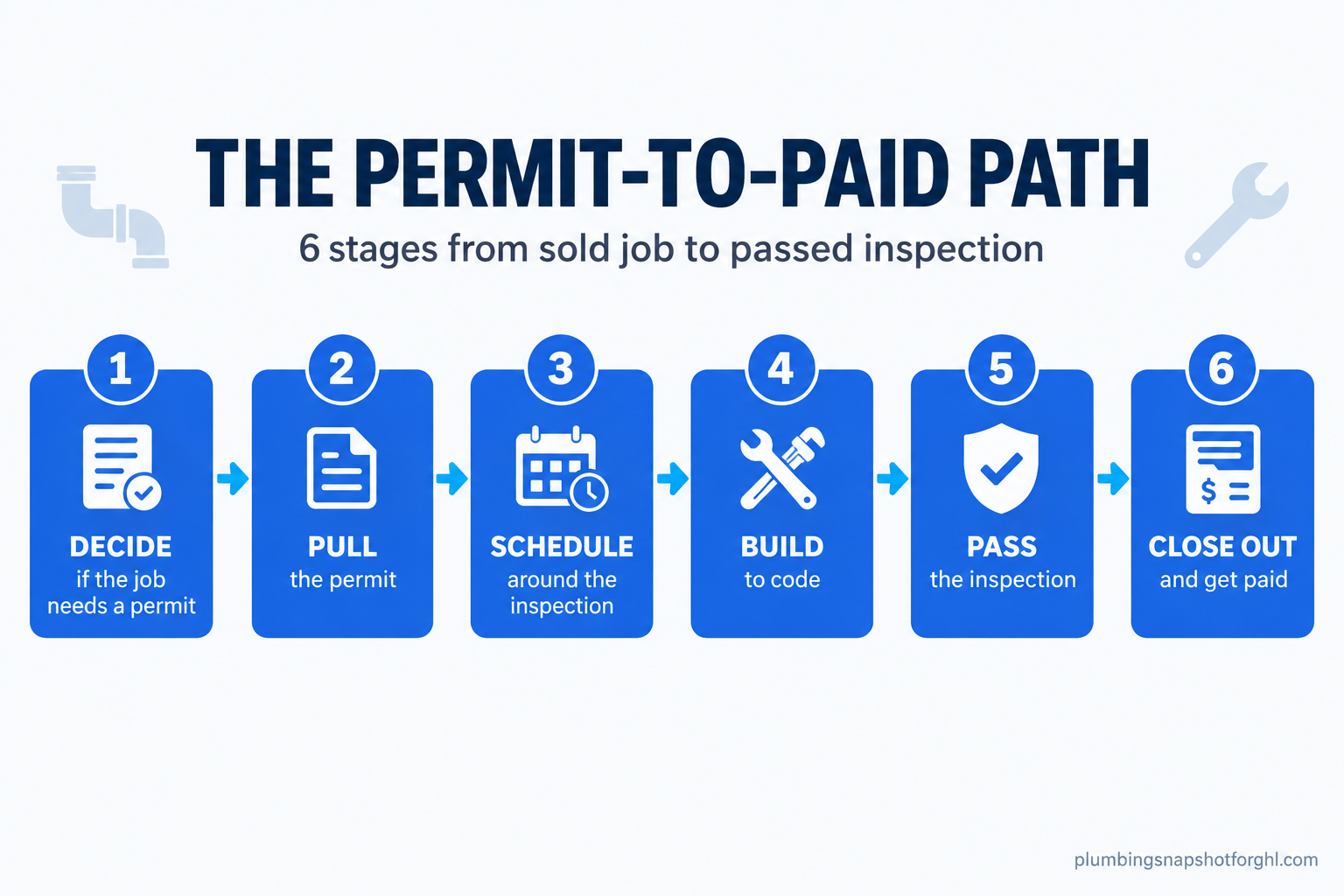
- The permit-to-paid path: six stages
- Steal this: the customer-update copy
- How this works for a solo, a 5-truck, and a 12-truck shop
- Which plumbing jobs usually need a permit
- Objections, answered straight
- Frequently asked questions
- About the author
What a permit delay actually costs you
Start with the number you already know: the job. A water heater runs four figures and a whole-home repipe runs five. The cost of a permit delay is not the permit fee. It is the odds that a customer who already said yes walks while she waits.
That risk is highest on exactly the jobs that need permits. Water damage and freezing claims average about $15,400 each, and about one in 60 insured homes files a property-damage claim from water damage or freezing each year (Insurance Information Institute). The homeowner feels the stakes on those jobs, and a silent week makes her nervous enough to call the shop down the road.
Water damage and freezing as a share of homeowners insurance losses, by year. These are the big jobs that need permits, and the ones a nervous customer cancels. Source: Insurance Information Institute.
Now the other direction, skipping the permit to move fast. That is the shortcut that costs the most. If work done without a permit later fails, an insurer can call you negligent and deny the homeowner’s claim, raise the premium, or cancel the policy outright (The Ascent). When the house sells, an official can refuse the certificate of occupancy, and an appraiser may ignore the improvement entirely. Your name is on that job, and the permit is what protects you, the customer, and your license.
Underneath it is a labor reality: plumbing is projected to grow 7% through 2035 (BLS), so your truck is scarce, and a tech idled by a permit nobody pulled is the most expensive downtime there is.
The permit-to-paid path: six stages
Permits feel like red tape because most shops bolt them on after the sale instead of building them into the job. Run them as six stages, each owned by someone, and the “delay” mostly disappears.
Stage 1: Decide if the job needs a permit, before you quote
The worst time to find out a job needs a permit is after you have quoted it without one. Decide at the estimate. The code leaves the exempt list to your local AHJ, but as a working rule, anything that alters the water supply, drain and vent, or gas line, or swaps a fixture like a water heater, is usually permit-required, even a like-for-like replacement (code reference). A cartridge or a flapper is not.
How this breaks: you quote a flat price, then discover the permit fee and inspection trip are not in it, so you either eat the cost or go back looking disorganized. Build the permit cost and the extra day into the quote, and your flat-rate price book should have the permit line in it already.
Stage 2: Pull the permit, and know who pulls it
As the licensed contractor, you pull the permit, not the homeowner. A homeowner “owner-builder” permit shifts liability onto them and is a red flag on a real job. Register your license with the jurisdictions you work in before you need to, so pulling a permit is a ten-minute portal task, not a first-time scramble. Many AHJs offer a same-day or over-the-counter permit for simple swaps, which turns a feared delay into a formality.
How this breaks: you treat every jurisdiction as a one-off, so the first water heater in a new town takes three days because nobody registered the license or learned the portal. Do that setup once per market and it never costs you again.
Stage 3: Schedule the work around the inspection, not the other way
This is the stage that actually kills jobs. The inspection is not something that happens after the work, it is something you schedule into the work, so find out your AHJ’s inspection lead time and book the slot as you book the job. If the rough-in needs to be seen before you close a wall, that inspection is a hard gate, and your dispatching and scheduling system has to treat it like a customer appointment.
How this breaks: you finish the install, then call for an inspection and learn it is nine days out with the customer standing there. Or you close the wall before the rough-in and the inspector makes you open it back up. Both are schedule failures, not permit failures. Book the inspection the day you sell the job.
Stage 4: Do the work to code the first time
The inspection only goes smoothly if the work is clean. The checkpoints on everyday jobs are predictable: on a water heater, the inspector looks at the T&P valve and discharge pipe, the gas shutoff and leak test, the venting and combustion air, seismic strapping where required, and the electrical disconnect on electric units (code reference). On a repipe, it is support spacing, materials, and pressure test. Train your techs to the inspector’s checklist, not just to “it holds water.”
How this breaks: every tech does it his own way, so the pass rate is a coin flip. Standardize the code details into your job templates, the same discipline that makes a price book your techs actually follow work.
Stage 5: Pass the inspection
Many jurisdictions use a single final inspection for a simple swap, and separate rough-in and final inspections for bigger work (code reference). Have the tech or a point person meet the inspector, permit and paperwork in hand. A clean job site and a plumber who knows the code get a faster read than a mess and a shrug. If something is flagged, fix it fast and book the re-inspection the same day.
How this breaks: a failed inspection with nobody driving the fix. The correction note sits in a truck for a week and the open permit turns into a problem. Assign one person to own every correction until the permit is closed.
Stage 6: Close out the permit and get paid
The job is not done when the water is hot. It is done when the permit is closed and the final inspection has signed off. An open permit left dangling comes back to bite the homeowner at resale (The Ascent), with your name on it. Confirm the close-out, send the customer the signed-off record, then collect the balance. For jobs where payment still drags, tighten up how you get paid faster.
How this breaks: you get paid on install and forget the close-out. Months later the homeowner cannot sell, calls you angry, and you drive back out for free. Tie final payment to a closed permit and close it as part of the job, every time.
Steal this: the customer-update copy
The silent week is what loses the job, so the fix is cheap: tell the customer what is happening before she wonders. Here is the language, ready to send and set to go out automatically. Keep every text consent-based with an opt-out, the same TCPA rules that apply to all your messaging.
When the job is sold and a permit is needed:
“Thanks for choosing us for your water heater, [Name]. Quick heads-up: your city requires a permit and a final inspection, which protects you and keeps it on record for resale. We’re pulling the permit now and we’ll text your install date as soon as it clears. Nothing needed on your end.”
When the install is booked around the inspection:
“Good news [Name], your permit is cleared. Install is set for [date] and your city inspection for [date/window]. One visit to install, one quick inspector visit to sign off. We’ll remind you the day before each.”
The day before the inspection:
“Reminder: your plumbing inspection is tomorrow between [window]. The inspector just needs access to [location]. Takes about 15 minutes. Reply here with any questions.”
When the inspection passes:
“Passed, [Name]. Your [job] is fully inspected and the permit is closed out. We’ll email the signed-off record, hang onto it for resale. If we earned it, a quick review means the world: [link]”
When the inspection flags a correction (do not go silent):
“Quick update, [Name]: the inspector asked for one small correction, which is normal. We’re handling it at no extra cost and we’ve already booked the re-inspection for [date]. Nothing changes on your end, we’ll confirm the moment it’s signed off.”
The failed-inspection text matters most: a correction is routine, but a week of silence after one reads like something went wrong. For jobs that still go quiet, a real estimate follow-up cadence catches the ones slipping away.
How this works for a solo, a 5-truck, and a 12-truck shop
The six stages are the same. What breaks changes with your size.
Solo owner with one helper. You are the estimator, the permit-puller, and the inspection point person at once, so stages 2 and 6 are your weak spots: the permit does not get pulled until you have a free hour, and the close-out slips because you got paid and moved on. Register your license in your top jurisdictions up front, refuse to mark a job “done” until the permit reads closed, and automate the customer texts so the follow-through does not live only in your head.
Five-truck shop. Now stage 3, scheduling, does the most damage. One botched inspection date cascades into a week of shuffled jobs and idle trucks, so a dispatcher who treats the inspection slot as a hard appointment pays for himself. Put the permit status and inspection date on the same board as the job, so nobody closes a wall early.
Twelve-truck shop. At this size it is stage 4, consistency, and stage 6, close-out at scale. Twelve techs mean twelve ways to set a T&P valve unless you standardize the code details into the job template. Track first-time pass rate per tech, close every permit as a gate on final billing, and assign one office person to own open permits. A handful of forgotten open permits across a busy year is a resale and reputation liability hiding in your back office.
Which plumbing jobs usually need a permit
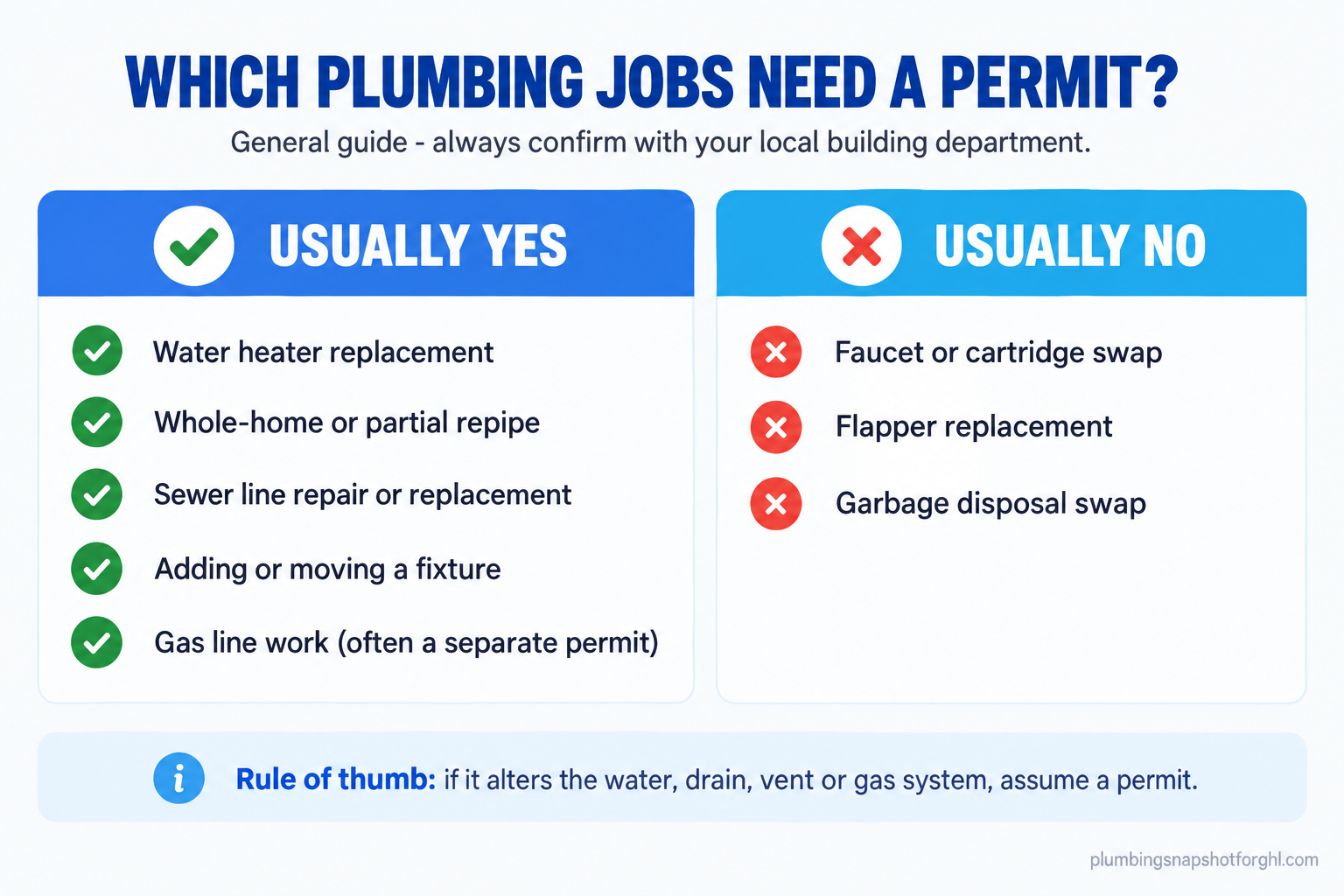
Rules are local, so confirm with your building department. As a general guide across IPC and UPC jurisdictions:
| Job | Usually needs a permit? | Why |
|---|---|---|
| Water heater replacement (tank or tankless) | Yes, in most jurisdictions | Gas, water, venting, and electrical connections (code reference) |
| Whole-home or partial repipe | Yes | Alters the water supply system |
| Sewer line repair or replacement | Yes | Alters the drain, waste, and vent system |
| Adding or moving a fixture (toilet, sink, tub) | Usually | New supply and drain connections |
| Gas line work | Yes, often a separate gas permit | Life-safety; frequently its own inspection |
| Faucet, cartridge, flapper, or garbage disposal swap | Usually not | Like-for-like, no system alteration |
The pattern is simple: if the job changes the water, drain, vent, or gas system, assume a permit until your AHJ says otherwise. A two-minute call to the building department beats a red-tag later. On the biggest of these jobs, make sure your techs are actually closing them.
Objections, answered straight
“Pulling permits slows me down and I’ll lose the job to a faster shop.” The permit is rarely the delay. The silence is. A shop that pulls the permit and texts a clear timeline looks more professional than one that shows up unpermitted, and the faster shop skipping the permit is handing their customer a denied insurance claim and a resale headache (The Ascent).
“The inspector in my town is impossible.” Some are tough. The answer is doing the work to the checklist so there is nothing to flag, and meeting the inspector in person with the permit posted. You cannot change the inspector, but you can remove every reason for him to fail you.
“I’m a one-man shop, I do not have time for all this.” Most of this is setup you do once: register your license, build the one-page permit list, and automate the five customer texts. After that, each job is a portal login and a scheduled inspection, against the day lost to a reopened wall or a drive back to close a forgotten permit.
“I already got paid, why chase the close-out?” Because the open permit has your name on it, and it surfaces at the worst time, when the homeowner is trying to sell and the city flags it (The Ascent). Closing it is ten minutes now or a free truck roll later. Tie final payment to a closed permit and the problem disappears.
The Thursday job, finished right
Rewind to that gas water heater. This time you flagged the permit at the estimate and built it into the price. Your office pulled it Tuesday because your license was already registered in that city, and booked the inspection the same day. The customer got a text that evening explaining the permit and the timeline. You installed Wednesday, the inspector signed off Thursday on a clean job, and she got the record by email with a review request attached. She never had a silent day to wonder, so she never called another shop.
That is the whole difference. The job that survives is the one where the permit and inspection were a planned, communicated stage instead of a surprise. The shop that runs permits as a system keeps the jobs it already sold.
Frequently asked questions
Do I need a permit to replace a water heater?
In most U.S. jurisdictions, yes, even for a like-for-like swap, because the job involves gas, water, venting, or electrical connections that most jurisdictions treat as permit-required. The code leaves the exact list to your local authority having jurisdiction, and many building departments offer a same-day or over-the-counter permit for simple swaps. Always confirm locally.
Who pulls the permit, me or the homeowner?
As the licensed contractor doing the work, you pull the permit. A homeowner owner-builder permit shifts liability onto the customer and is a red flag on a professional job. Register your license with the jurisdictions you work in ahead of time so pulling a permit is a quick portal task.
How long does a plumbing permit and inspection take?
It varies by your authority having jurisdiction. Some offer same-day permits and next-day inspections; others run a week or more on the inspection queue. The key move is to find your local lead time and book the inspection slot the day you sell the job, so the wait is scheduled and communicated, not a surprise at the end.
What happens if I do plumbing work without a permit?
It is the expensive shortcut. If unpermitted work later fails, an insurer can deem you negligent and deny the claim, raise the premium, or cancel the policy. At resale, an official can refuse the certificate of occupancy and an appraiser may ignore the improvement. The missing permit has the contractor's name on it, so the risk lands on you.
Why do inspections fail, and how do I pass the first time?
On everyday jobs the checkpoints are predictable: on a water heater, the T&P valve and discharge, gas shutoff and leak test, venting and combustion air, seismic strapping, and the electrical disconnect. On a repipe, support spacing, materials, and the pressure test. Train techs to the inspector's checklist and meet the inspector with the permit posted and a clean job site.
How do I keep a customer from canceling while we wait on a permit?
Communicate before they wonder. Send an automatic text when the job is sold explaining the permit and timeline, another when the install and inspection are booked, a reminder the day before, and a message the moment it passes. If the inspection flags a correction, say it is routine and give a re-inspection date. The silent week loses the job, not the permit.
About the author
Hector Salinas spent nine years dispatching for a 12-truck plumbing operation in Phoenix before he ever touched a CRM. He has watched sold jobs die in the gap between the handshake and the inspection, and he builds the scheduling, dispatch, and customer-update automations in the Plumbing Snapshot that keep a booked job booked. He writes the way he would brief a new service manager: plainly, with the revenue math attached.