

It is 6:50 on a January morning and a homeowner calls, no hot water. Your tech rolls out, relights the pilot, it holds. He charges a $140 service call and leaves, proud he saved the customer money. The heater is 13 years old, rusting at the base, sitting in a garage under a finished bedroom.
That tank is going to fail, and when it lets go at 2 AM, the homeowner calls whoever answers. The $2,400 replacement, the drywall repair, and the next ten years of that customer’s plumbing book with another shop. Your guy did nothing wrong as a plumber. He left a job on the truck as a salesman and never saw it happen.
The fix is not a pushier crew. It is a system that turns a no-hot-water call into an honest repair-or-replace decision, every time, with the math and the photos to back it up. This guide walks that system from the first ring to the review request, with the scripts to steal and where each stage breaks.
In this guide
- What the replacement you skip is really worth
- Repair or replace: the call you make before you quote
- Tank or tankless: what to actually recommend
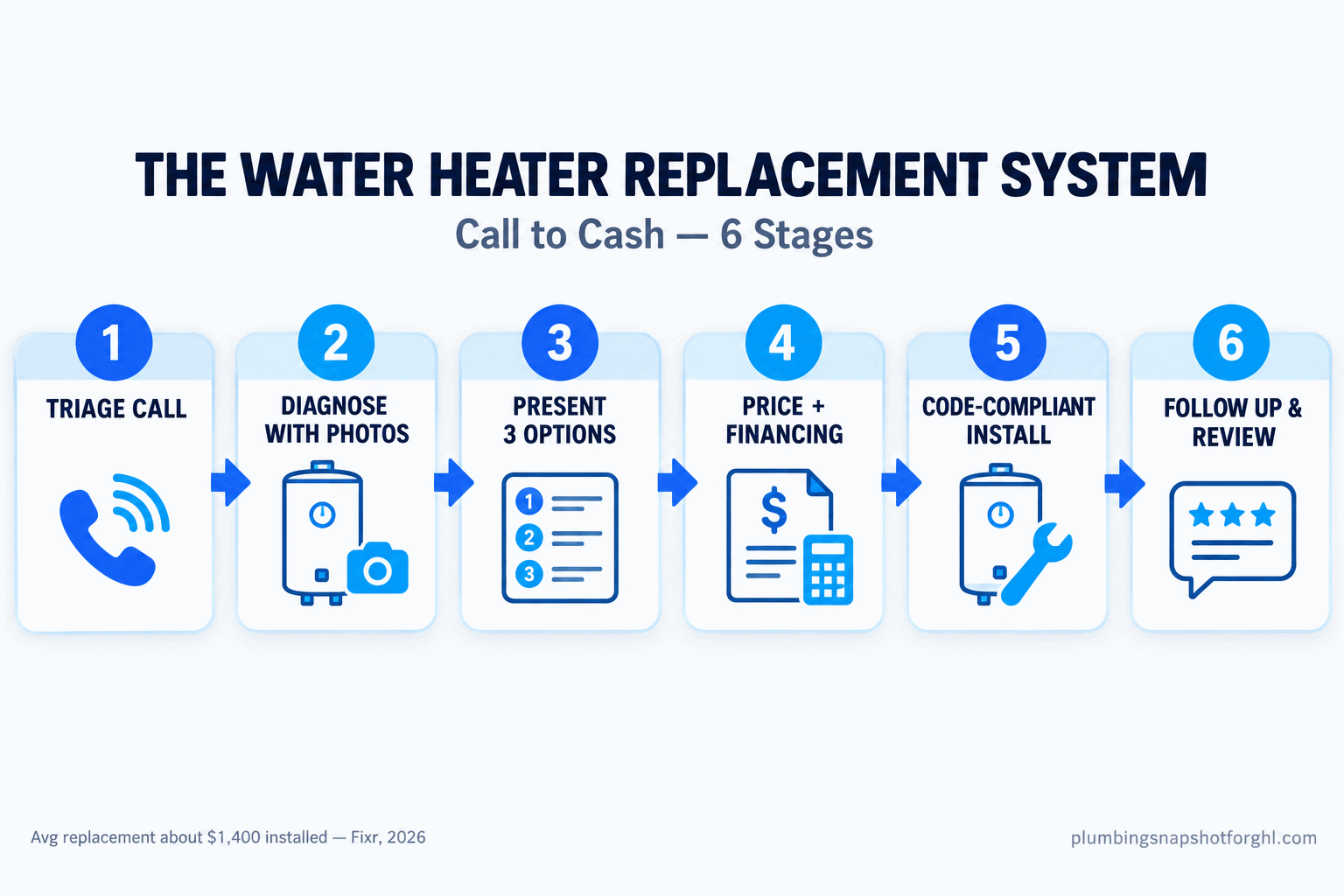
- The water heater system, call to cash
- Steal this: the scripts and texts
- What this looks like for a solo, a 5-truck, and a 15-truck shop
- Staying legal: the code and the texting
- Objections, answered straight
- Frequently asked questions
- About the author
What the replacement you skip is really worth
Start with the number. A full water heater replacement runs about $900 to $3,000 installed, averaging near $1,400, and tankless or heat-pump upgrades push past $4,000 (Fixr, 2026). Compare that to the $140 service call your tech wrote this morning. That gap is the difference between a shop that grows and one that just stays busy.
Then the failure cost. Water damage and freezing is one of the most common and expensive homeowner claims there is, averaging roughly $15,400, and about one in 60 insured homes files one a year (Insurance Information Institute). A tank that lets go over a finished floor is exactly that claim. Framing a replacement is not upselling, it is being the plumber who warned them first.
The leak shows in your own numbers. A shop running 20 no-hot-water calls a month that replaces on two books maybe $5,000. Lift that to six and the same calls produce closer to $13,000. That is why a weak close shows up as a phone that rings all day without the money following.
Repair or replace: the call you make before you quote
Most techs decide repair-versus-replace by instinct, and instinct leans cheap because the cheap answer feels honest and dodges the money talk. Replace it with three checks the tech runs in the first five minutes. None need a sales bone in his body.
Check the age. The label or serial gives the year. A storage tank lasts about 10 to 15 years, a tankless unit more than 20 (DOE). Past ten years on a tank, replacement is on the table by default. Under six, you are usually fixing it.
Check the type of failure. A bad thermocouple, a dead element, or a tripped high-limit on a younger tank is a repair. A tank leaking from the body, rusting at the base, or dropping rusty hot water is done, because the steel shell has gone and no part fixes that. A leaking tank is not a repair, it is a countdown.
Check the code triggers. An old install never brought up to code turns a “simple swap” into a real job with real value: a missing expansion tank on a closed system, wrong venting, no drip pan, or a unit not strapped in an earthquake state. The tech should spot these during diagnosis so they are part of the honest quote, not a surprise you eat later.
Tank or tankless: what to actually recommend
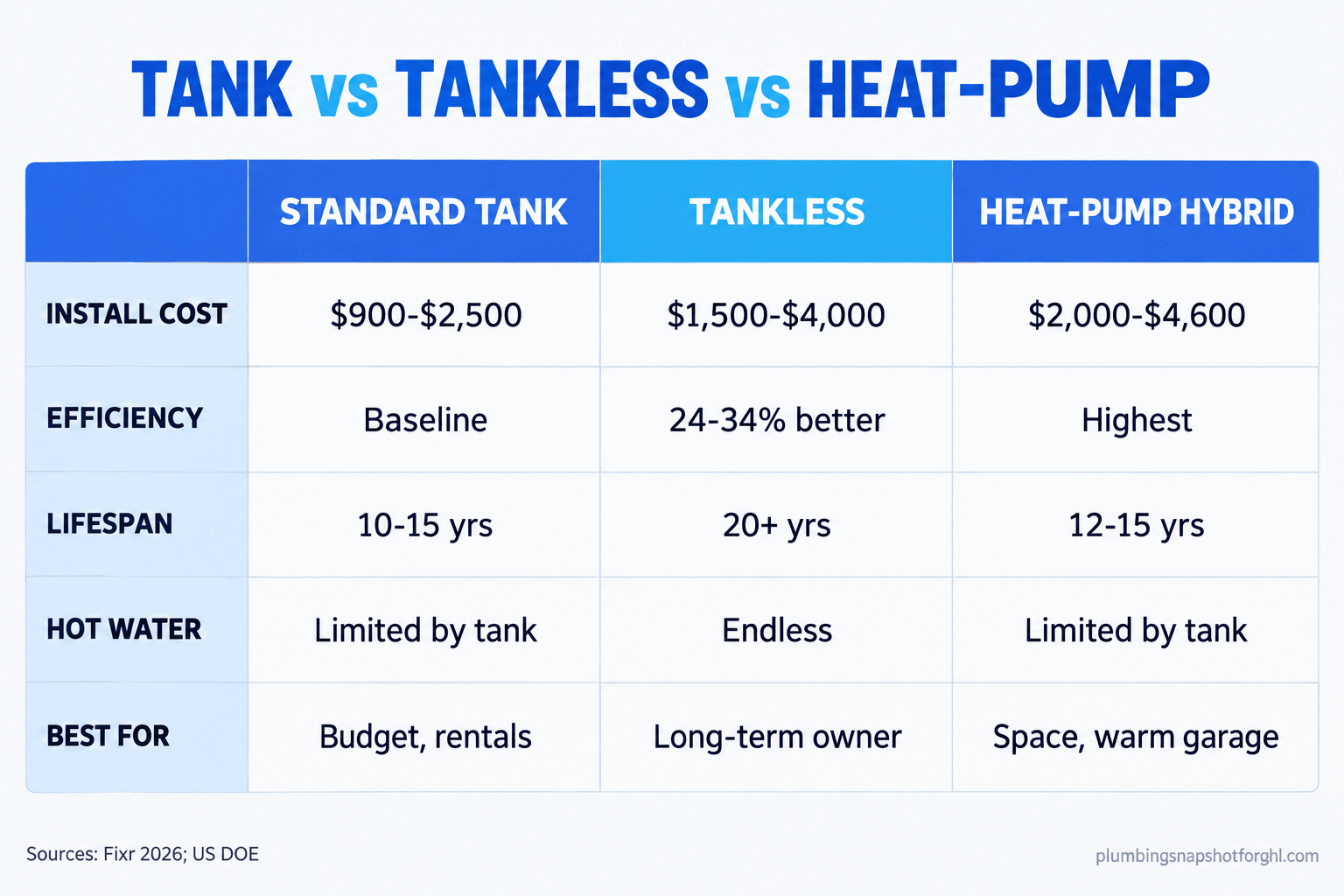
Once it is a replacement, the customer’s real question is “what do I put in.” Tankless costs more up front and sometimes needs a bigger gas line or venting, but it runs 24% to 34% more efficient and lasts past 20 years versus 10 to 15 for a tank (DOE).
Typical installed cost by unit type, midpoint of 2026 ranges. Source: Fixr, 2026.
Give three paths and let the homeowner pick:
| Standard tank | Tankless | Heat-pump hybrid | |
|---|---|---|---|
| Install cost (typical) | $900–$2,500 | $1,500–$4,000 | $2,000–$4,600 |
| Efficiency vs old tank | Baseline | 24%–34% better | Highest |
| Lifespan | 10–15 yrs | 20+ yrs | 12–15 yrs |
| Hot water | Limited by tank size | Endless | Limited by tank size |
| Best for | Budget, rentals, tight venting | Long-term owner, high use | Space + warm garage, efficiency |
How this stage breaks: the tech pitches tankless to a customer who cannot afford it and loses the job, or defaults every house to the cheapest tank so the homeowner who would have upgraded never gets the choice. The fix is a standing rule: present all three, every replacement, and let the customer choose. Close rate climbs because nobody feels sold to.
The water heater system, call to cash
The rules only pay off if the same path runs on every call. Here is the six-stage system, with the failure mode for each, because that is where the money leaks.
Stage 1: The triage call
Whoever answers the phone runs three questions: how old is the unit, water on the floor, gas or electric. Those answers decide which tech to send, whether to put a tank on the truck, and whether it is an emergency. A call sent to voicemail gets none of it, which is why instant text-back earns the first dollar.
How it breaks: whoever answers books “a plumber” with no notes, the tech shows up blind with no unit, and a same-day replacement becomes a second trip the customer may not wait for.
Stage 2: The in-home diagnosis, with photos
The tech runs the three checks and, the part most shops skip, photographs the evidence: the rust at the base, the corroded fitting, the water stain on the floor. Photos do the selling the tech does not want to do, because the customer sees the problem instead of taking a stranger’s word for it. Same reason photo-backed quotes convert.
How it breaks: the tech diagnoses out loud, gives a verbal number, and leaves. Nothing written, nothing shown, and the customer “thinks about it” with no evidence in hand.
Stage 3: Present the options
The tech presents the three paths as a written good-better-best, built from a flat-rate price book so the number is not invented at the kitchen table, each with a photo. Most homeowners pick the middle.
How it breaks: the tech offers one number. One number is a yes-or-no, and a stressed homeowner says “let me think about it.” Three options turns the question from whether to which.
Stage 4: Price it right, and offer the payment
A replacement over about $1,500 is a payment conversation. “It’s $2,600, or about $92 a month” turns an impossible number into a manageable one, and shops that present financing on big jobs close replacements a flat price would have lost. Quote the code work as line items in the same estimate.
How it breaks: the tech drops a big number with no payment option. The job was affordable at $92 a month and died at $2,600.
Stage 5: The code-compliant install
Do it right the first time: expansion tank on a closed system, correct venting, pan and drain, seismic strapping in earthquake states, a properly piped T&P discharge, and the permit pulled (details in the code section). That code work is real revenue, because it is real work the customer pays for.
How it breaks: the shop skips the expansion tank and permit to “keep it cheap,” then eats a callback, a failed inspection, or a warranty fight when the relief valve weeps.
Stage 6: Follow up, review, and attach the plan
If the customer did not buy today, the estimate goes into an automatic follow-up cadence instead of a glovebox. The day the job closes, send the review request and offer a maintenance plan so you are the shop that comes back to flush the tank, turning one replacement into a repeat customer on a membership.
How it breaks: no follow-up on the unsold estimate, no review ask, no plan, so a hard-won customer disappears and the next emergency goes to whoever answers.
Steal this: the scripts and texts
Copy these and hand them to your crew. They are not hard-sell lines, they just give the customer more to work with.
That review request does double duty: it feeds your review pipeline and routes an unhappy customer back to you privately instead of to a public one-star. Automate all of these so the tech does not have to send them by hand.
What this looks like for a solo, a 5-truck, and a 15-truck shop
The system is the same at every size. The stage that leaks most, and what you fix first, is not.
Solo owner-operator. You are probably underselling because you hate the money talk and you are wiped by 4 PM. Your highest-value fix is the follow-up automation and a price book, so estimates do not die in the glovebox and you stop lowballing to dodge the conversation. Carry a tank in the cold months so “today” is a real answer.
The 5-truck shop. The problem is consistency. One tech quotes the swap three ways, your best guy replaces on four of ten calls and your newest on one, and you cannot see which estimates sit unsold. Fix it with a shared good-better-best price book and a central follow-up system. This is the size where owners start shopping field service software and find the big platforms built for much larger operations.
The 10-to-15-truck shop. The money is in the numbers you cannot see from the truck: replacement rate by tech, average ticket on heater calls, open estimates, follow-up across hundreds of quotes a month. One point of replacement-rate improvement across a fleet this size is real money. The failure here is not a shy tech, it is a pipeline nobody measures.
Staying legal: the code and the texting
Two kinds of rules touch this job, and the extra install work is real value you should quote.
The install code. Common triggers: a thermal expansion tank is required once the house is a closed system, meaning there is a check valve, pressure-reducing valve, or backflow preventer (IPC 607.3). In earthquake states like California the heater must be strapped, typically two straps, one in the top third and one in the bottom third (CPC 507.2). The T&P discharge has to be piped right, a drip pan and drain go where a leak could do damage, venting has to match the unit, and the permit gets pulled. Sections and strap counts vary by your city’s adopted edition, so confirm with your building department.
The texting rules. Every follow-up and review text above needs the customer’s consent and an opt-out, under TCPA and the 2026 A2P 10DLC rules. The consent language to copy lives in our plumbing marketing compliance guide.
Objections, answered straight
“I don’t want my guys pushing replacements on people who just need a repair.” None of this is pushing. The rule recommends a repair when a repair is honest, a sound tank under six years with a bad part. You are not inventing work, you are making sure a 13-year-old leaking tank gets called what it is, with a photo.
“Tankless is too expensive, my customers won’t go for it.” Some will not, which is why you present three options. But plenty pay for endless hot water and a 20-year unit when you show the efficiency and offer a monthly payment. They never get the chance when the tech only quotes the tank.
“I already pay for ServiceTitan or Housecall Pro. Isn’t this built in?” Partly, and that is the trap. Those platforms hold a price book and send a text, but the system itself, the triage questions, the photo-quote flow, the three-option script, the follow-up cadence, the review and plan attach, you build and keep running. See what plumbing software costs first.
“Do I need to be technical to run this?” No. In a done-for-you setup the triage flow, the texts, the follow-up timing, the financing, and the review request are already built. You approve the copy and prices, your techs snap the photos, the automation does the rest.
Frequently asked questions
When should a water heater be replaced instead of repaired?
Replace a storage tank past about 10 to 15 years when it is leaking from the body, rusting at the base, or dropping rusty hot water, because the steel shell is failing and no part fixes that. Repair a sound tank under about six years with a part failure like a thermocouple, element, or thermostat. The DOE puts storage tank life near 10 to 15 years and tankless past 20.
How much does it cost to replace a water heater in 2026?
About $900 to $3,000 installed, with the overall average near $1,400, per Fixr's 2026 data. A standard tank is roughly $600 to $2,500, a tankless unit $1,000 to $4,000, and a heat-pump hybrid $1,200 to $4,600. Gas-line, venting, and electrical work on the house move the number.
Is a tankless water heater worth the extra cost?
For a long-term owner, often yes. It costs more up front and sometimes needs a bigger gas line or venting, but runs 24% to 34% more efficient and lasts past 20 years versus 10 to 15 for a tank (DOE). For a rental, a tight budget, or a closet that cannot vent one, a standard tank is the honest call. Present both.
Does a water heater replacement need an expansion tank?
If the house is a closed system, which it is once there is a check valve, pressure-reducing valve, or backflow preventer, most codes require a thermal expansion tank (IPC 607.3). Without it, pressure has nowhere to go and the T&P valve weeps. It is real work to quote, not skip.
How do I get customers to say yes to a bigger water heater job?
Show, do not tell. Photograph the rust and the failure, present a written good-better-best with three options, and offer a monthly payment on anything over about $1,500. 'It's $2,600, or about $92 a month' closes jobs a flat number loses. Then follow up automatically for two weeks.
Do I need consent to text water heater estimate follow-ups?
Yes. Any follow-up text needs the customer's prior consent and an easy opt-out under the TCPA, plus A2P 10DLC campaign registration for business texting in 2026. Collect consent at booking, honor STOP, and keep the records. Our compliance guide has the consent language to copy.
A no-hot-water call is the highest-value work your phone rings for, and most shops hand it back as a $140 repair. Build the system, triage to follow-up, and the calls you already pay for start turning into the jobs they were worth.
About the author
Hector Salinas is GHL Automation Lead at Plumbing Snapshot, based in Phoenix, AZ. He spent nine years dispatching for a 12-truck plumbing operation before building GoHighLevel systems full time, and he has watched more good plumbers hand back a replacement at the garage door than lose one on the job. He writes the way he would brief a service manager: plainly, with the revenue math attached.