
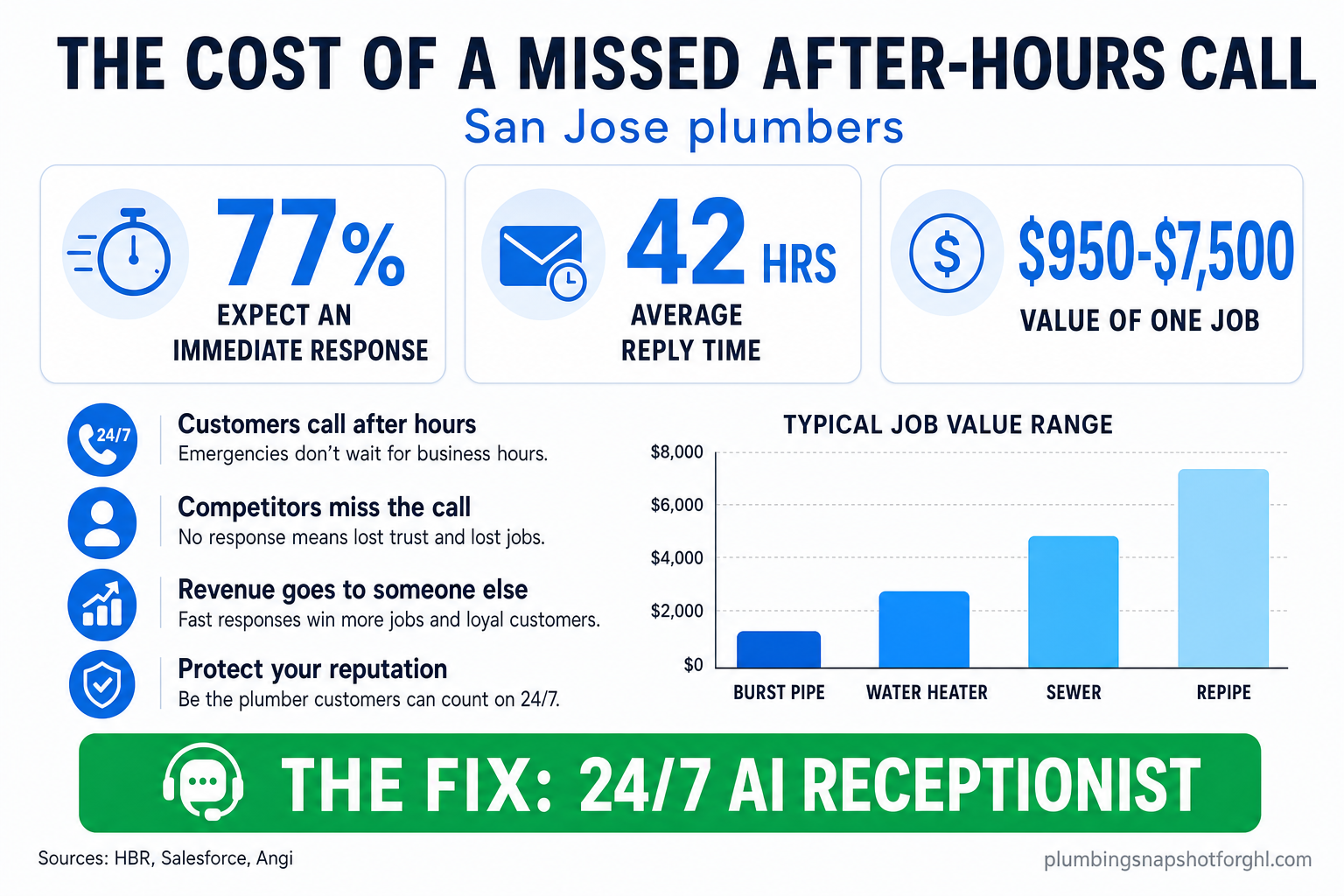
For a San Jose plumbing shop, a missed after-hours call is rarely a small loss. The homeowner staring at a spreading puddle at 11 p.m. does not leave a voicemail and wait — they hit “back” and dial the next result. With the average firm taking about 42 hours to respond to an inbound lead (Harvard Business Review) and 77% of customers expecting to reach someone immediately (Salesforce, 2024), the shop that answers first usually wins the job — and in San Jose that job is often a $1,300 water heater or a $7,500 repipe. This is the math on what those calls cost, and the 24/7 AI receptionist that keeps them from leaking to the competition.
In this guide
- The short answer: what does a missed after-hours call cost?
- Why San Jose plumbers lose the after-hours job
- The speed-to-lead math nobody wants to see
- What one San Jose after-hours call is actually worth
- Voicemail and callback services don’t fix this
- How a 24/7 AI receptionist plugs the leak
- The San Jose numbers: why this market rewards answering
- Frequently asked questions
- About the author
- Related reading
The short answer: what does a missed after-hours call cost?
A missed after-hours call costs a San Jose plumber the full value of the job — because that homeowner is already dialing the next shop. The behavior is well documented: a phone call is the number-one way consumers reach a local business (BrightLocal, 2025), and buyers now expect an instant answer, with 77% saying they expect to interact with someone immediately when they contact a company (Salesforce, 2024).
Think about the moment. It’s a weeknight. A supply line lets go under a San Jose kitchen sink and water is running across the floor. The homeowner is not comparing five-star reviews — they’re panicking, and they’re on a phone. They tap the first plumber, and if it rings out to voicemail, they don’t leave a message and settle in for the night. They tap the next one. The job — and every future job from that household — goes to whoever picked up.
That’s the real cost, and it isn’t hypothetical. It’s the difference between a booked emergency ticket and a competitor’s truck in your customer’s driveway an hour later.
I dispatched for a 12-truck shop before I ever touched a CRM. The jobs that hurt weren’t the ones we quoted and lost — they were the 1 a.m. calls nobody ever saw. You can’t win work you don’t know rang. Answering is the cheapest marketing a plumber will ever buy.
Why San Jose plumbers lose the after-hours job
San Jose plumbers lose after-hours jobs for one structural reason: emergencies happen when the office is closed, and a closed office sends the caller to voicemail. Burst pipes, failed water heaters, and backed-up mains don’t keep business hours — they hit at night, on weekends, and during holidays, exactly when a typical shop has nobody on the phones.
That timing collides with buyer psychology. Nobody wants to explain a flooding bathroom to a recording. And the data on how businesses actually handle inbound leads is bleak: an audit of 2,241 U.S. companies found the average responder took about 42 hours to reply, and nearly a quarter never replied at all (Harvard Business Review). For an emergency trade, 42 hours isn’t slow — it’s invisible. The customer’s problem is solved by someone else long before a Monday-morning callback.
Here’s how that HBR audit broke down — and why “we’ll call them back tomorrow” is a losing strategy:
How fast 2,241 U.S. firms responded to an inbound web lead. Only 37% replied within an hour; 23% never replied. Source: Harvard Business Review, “The Short Life of Online Sales Leads.”
The plumbers stuck in the bottom three bars aren’t lazy — they’re asleep, on a job, or out with family. The problem isn’t effort. It’s that a human can’t answer every call at every hour, and voicemail is where after-hours leads go to die.
The speed-to-lead math nobody wants to see
Speed to lead is the single biggest lever an emergency plumber has, and the numbers are stark: contacting a lead within 5 minutes instead of 30 makes you roughly 100× more likely to reach that person and 21× more likely to qualify the job (MIT / InsideSales, Oldroyd study). Wait an hour past the first hour and you’re already ~7× less likely to qualify the lead than a shop that answered fast (Harvard Business Review).
Put those together and the strategy writes itself. Homeowners expect an instant answer; almost no plumbing shop delivers one after hours; and the reward for being the exception is enormous. You don’t need a bigger ad budget to win the 11 p.m. water-heater job — you need to be the phone that gets answered. Every dollar you spend on Google Ads or local SEO to make that phone ring is wasted the moment it rings out to voicemail.
This is why speed-to-lead beats almost every other marketing investment for a service trade. It’s not about reaching more people — it’s about not fumbling the ones already trying to hand you money.
What one San Jose after-hours call is actually worth
In San Jose, a single after-hours emergency call is typically worth four to five figures — which is what makes missing one so expensive. These aren’t $89 service calls. The city’s housing stock is older (median year built around 1976, per Census ACS data), and aging homes generate exactly the high-ticket emergency work that comes in after dark.
Here’s what national 2026 pricing data puts on those jobs:
Typical U.S. job values (midpoints of common ranges), 2026. Sources: Angi water-heater and repipe cost guides; HomeGuide plumbing estimates.
Now run the leak math. Say your shop misses just three after-hours emergency calls a week — a conservative number for a busy San Jose market. At an average recovered ticket of even $1,000, that’s $3,000 a week, or about $156,000 a year in work walking straight to the next plumber on the map. And that figure ignores the lifetime value: the emergency customer who becomes a maintenance-plan member and a source of referrals for years.
Our field observation: the after-hours calls a shop never sees are almost always its highest-value calls. Nobody has a slab leak or a dead water heater at a convenient 2 p.m. on a Tuesday — the expensive, urgent problems cluster at night, precisely when the phone isn’t staffed.
Against numbers like these, the cost of never missing another call is trivial. That’s the whole case for automating the answer.
Voicemail and callback services don’t fix this
Voicemail and traditional answering services don’t solve the after-hours problem — they just document it more politely. Voicemail asks a panicking homeowner to leave a message and wait, which they won’t. A live human answering service can take a message and maybe page you, but it doesn’t know your service area, your pricing rules, or your on-call rotation, and it can’t book the job into your calendar.
Here’s the honest comparison for a San Jose shop:
After-hours options: voicemail / answering service vs. a 24/7 AI receptionist
| Plan | Voicemail or basic answering service | 24/7 AI receptionist (Plumbing Snapshot) recommended |
|---|---|---|
| Price | $0–$300+ / mo | Included in the snapshot |
| Feature 1 | Caller must leave a message and wait | Answers instantly, every hour, every call |
| Feature 2 | No booking — just a note for the morning | Qualifies the emergency and its urgency |
| Feature 3 | Doesn't know your service area or pricing | Books the slot into your live calendar |
| Feature 4 | Can't dispatch your on-call tech | Texts your on-call tech the address + problem |
| Feature 5 | Response measured in hours, not seconds | Trained on your services, area, and rules |
| Feature 6 | Emergency leads still leak to competitors | Turns 2 a.m. panic into a booked ticket |
| Why this loses jobs | See the AI receptionist |
The gap isn’t subtle. One option records the fact that you lost a job; the other books it while your competitor’s phone rings out.
How a 24/7 AI receptionist plugs the leak
A 24/7 AI receptionist plugs the after-hours leak by doing in seconds what a human can’t do at 2 a.m.: answer, qualify, book, and dispatch — automatically. Because it responds instantly every time, it lands in the 5-minute window where you’re ~100× more likely to reach the lead (MIT / InsideSales) — a window a sleeping shop can never hit.
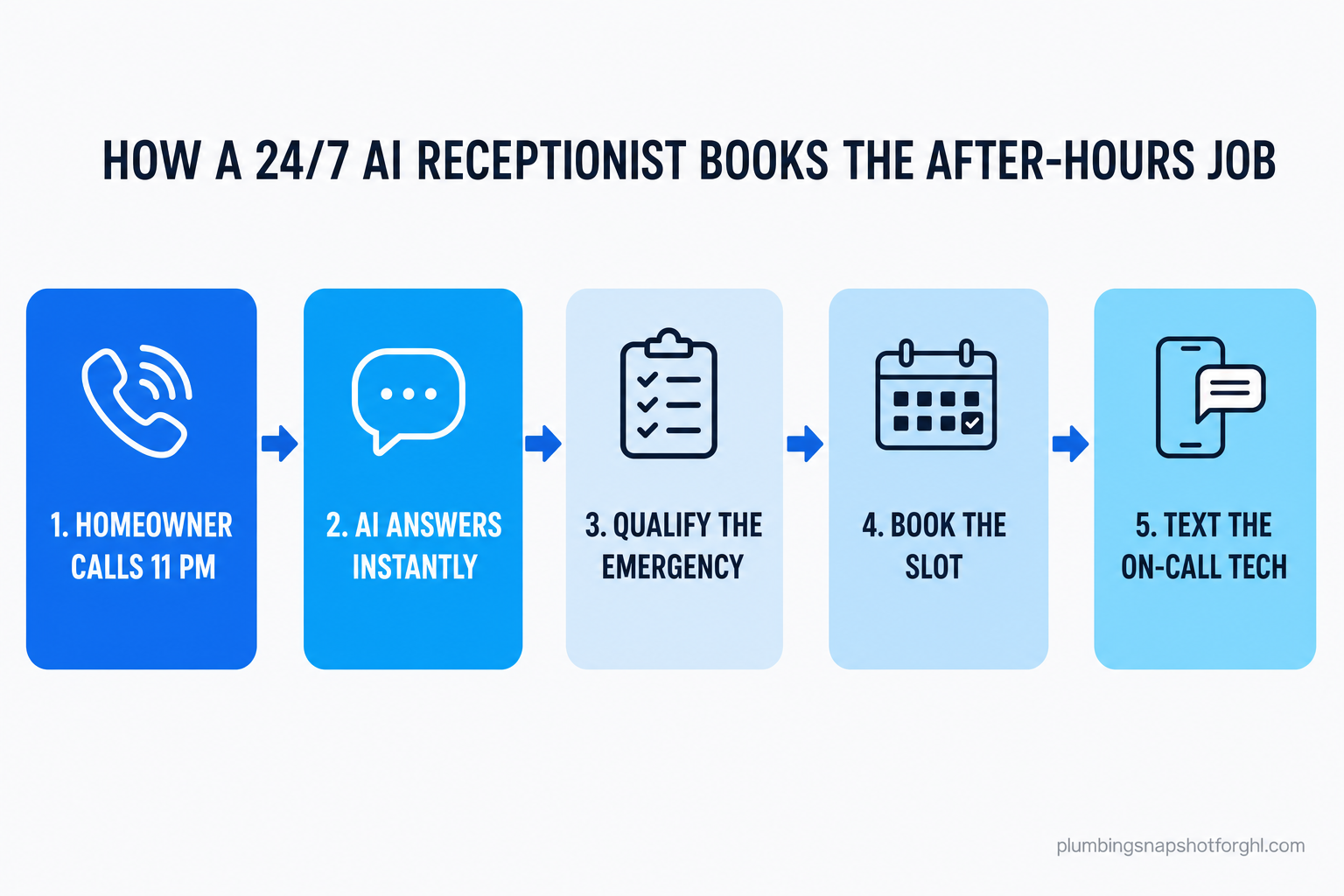
Here’s what it does on a real after-hours call, start to finish:
- Answers on the first ring, 24/7. No voicemail, no hold music — a natural conversation the moment the phone rings.
- Qualifies the problem and urgency. It asks the right questions (“Is water actively leaking? Can you shut off the main?”), figures out whether it’s a same-night emergency or a next-day booking, and captures the address and callback number.
- Books the job into your calendar. Routine work gets a real appointment slot on the spot — no phone tag, no morning callback.
- Dispatches your on-call tech. For a genuine emergency, it texts the on-call plumber the address and the problem so a truck can roll tonight.
- Stays compliant. When it captures a number for follow-up texts, it collects proper opt-in consent — the TCPA basics every plumbing shop has to respect.
This isn’t a robotic phone tree. It’s the after-hours answer that turns a missed call into a booked ticket — and it pairs with missed-call text-back so even a call that somehow slips through gets an instant text before the homeowner dials anyone else.
The San Jose numbers: why this market rewards answering
San Jose is one of the best markets in the country to fix your after-hours answering, because the ticket sizes are high and the homes are old enough to keep generating emergencies. The city has roughly 990,000 residents, a 55.8% homeownership rate, and a median home value of about $1.23 million — more than triple the national figure (U.S. Census / Data USA).
Two things follow from that. First, the housing stock is aging (median year built ~1976), and older homes mean more failed water heaters, corroded supply lines, and tired sewer laterals — the exact high-value, time-sensitive work that comes in after hours. Second, high home values and incomes mean homeowners who will pay for a fast, professional response rather than wait. In a market like this, the constraint on your growth usually isn’t demand — it’s whether you’re there to catch it when it calls.
A shop that answers every call in a city of a million people, with five- and six-figure homes full of 50-year-old plumbing, is playing on easy mode. The only question is whether your phone is the one that gets answered at 11 p.m. — or the one that rings out while the next shop books your customer. If you want that answering built for you, our team can set up the whole system, or you can start with the done-for-you Plumbing Snapshot.
Frequently asked questions
How much does a missed after-hours call really cost a San Jose plumber?
Effectively the full value of the job, because the caller dials the next shop rather than leave a voicemail. San Jose emergency tickets are large — a water heater replacement runs about $850–$1,750 and a whole-house repipe averages around $7,500 (Angi, 2026). Missing just three such calls a week can mean six figures a year in lost work.
What is a 24/7 AI receptionist for a plumbing business?
It's an AI system that answers your phone at any hour, holds a natural conversation with the caller, qualifies the plumbing problem and its urgency, books routine jobs into your calendar, and texts your on-call tech for emergencies. Unlike voicemail or a generic answering service, it's trained on your services, service area, and pricing rules, and it responds in seconds — the window where you're about 100× more likely to reach the lead (MIT/InsideSales).
Why not just use voicemail or a callback service after hours?
Because homeowners with an active leak won't wait. A phone call is the #1 way consumers contact a local business (BrightLocal, 2025), and 77% expect an immediate response (Salesforce, 2024). Voicemail documents the lost lead; a live answering service can take a message but can't book the job or dispatch your tech. Only instant answering-and-booking captures the emergency.
Will an AI receptionist actually book jobs while I sleep?
That's the point. Because emergencies cluster at night and on weekends, a large share of high-value plumbing work comes in outside business hours. The AI engages instantly at any hour, qualifies the problem, and either books a slot or texts your on-call tech with the address and details — so a 2 a.m. burst pipe becomes a scheduled ticket instead of a voicemail nobody hears until Monday.
Do San Jose plumbers specifically benefit from this?
Strongly. San Jose has about 990,000 residents, a 55.8% homeownership rate, and a median home value near $1.23M in older housing built around 1976 (U.S. Census / Data USA). Older, high-value homes generate steady high-ticket emergency work, and affluent homeowners pay for a fast response — so answering every after-hours call has an outsized payoff here.
Is AI phone and text follow-up compliant with texting laws?
It can and must be. When the system captures a phone number to follow up by text, it needs clear opt-in consent, an identified sender, and an easy opt-out — the TCPA basics that apply to any plumbing SMS. Our snapshot builds that consent step into the flow. See our TCPA guide for plumbers for the specifics.
About the author
Hector Salinas is the GHL Automation Lead for Plumbing Snapshot for GHL, based in Phoenix, AZ. He spent nine years dispatching for a 12-truck plumbing operation before he ever touched a CRM, where he learned firsthand how a single missed after-hours call turns into a lost five-figure job. He now maps every call flow, on-call rotation, and emergency-dispatch sequence in the Plumbing Snapshot, and writes the way he’d brief a new service manager — plainly, with the revenue math attached.
Related reading
- The After-Hours AI Receptionist Playbook — the full build for answering the emergency calls your team can’t get to.
- Missed-Call Text-Back for Plumbers — the instant text that catches any call that slips through.
- Do You Need a Plumbing Answering Service? — where human services help and where they fall short.
- AI Receptionist for NYC Plumbers — the same fix, sized for another high-value market.
- Online Booking for Plumbers — the self-scheduling flow your receptionist books into.
- Local SEO for Plumbers — get the right San Jose homeowners calling in the first place.