
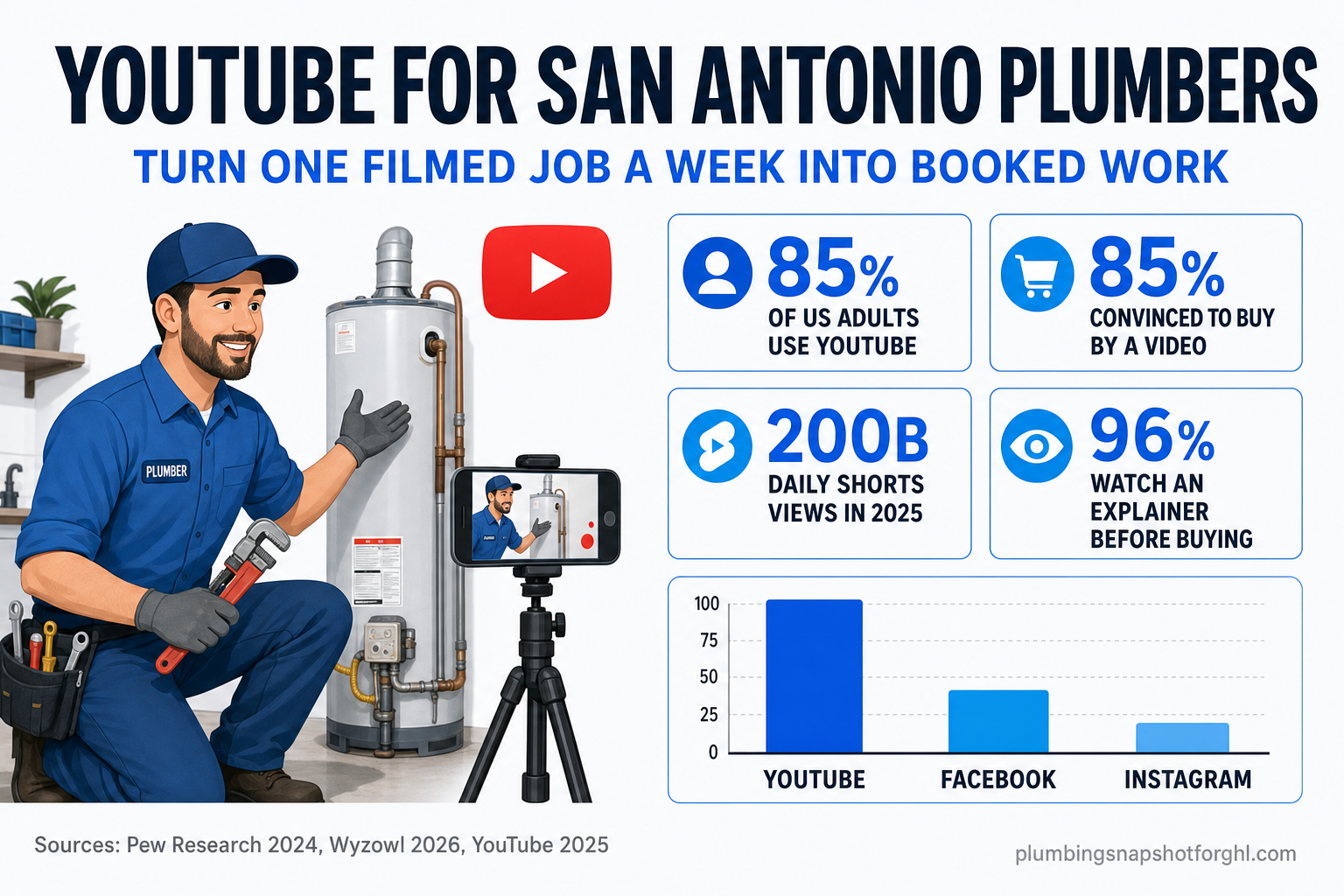
Here’s the fastest way to say it: YouTube is a search engine, and most San Antonio plumbers have handed that search engine to their competitors. When a homeowner in Alamo Heights or Stone Oak types “why is my water heater leaking” or “how much to replace a water heater in San Antonio,” a video answer is waiting — it’s just not yours. YouTube reaches 85% of U.S. adults, more than any other platform, and 85% of consumers say a video has convinced them to buy (Pew Research, 2024; Wyzowl, 2026). This guide is a plain, 6-step playbook to turn one filmed repair a week into found, searchable, job-booking video — without becoming a video editor.
In this guide
- Why YouTube matters for San Antonio plumbers
- Step 1: Film the jobs that are worth money
- Step 2: Cut one job into two videos
- Step 3: Optimize every video for search
- Step 4: Publish and embed everywhere
- Step 5: Capture the lead the video created
- Step 6: Measure booked jobs, not views
- The catch: this is a second full-time job
- Frequently asked questions
- About the author
- Related reading
Why YouTube matters for San Antonio plumbers
Because your future customers are already on it, and they’re using it to decide who to trust. YouTube reaches 85% of U.S. adults — more than Facebook (70%) or Instagram (50%) — making it the single widest-reach platform in the country (Pew Research, 2024). Its advertising alone reaches an estimated 2.53 billion people worldwide (DataReportal, 2025). This isn’t a niche channel for teenagers; it’s where adult homeowners go to answer a question.
And plumbing is a question-driven, trust-driven purchase. A homeowner staring at a rusty water heater doesn’t want a billboard — they want to see the job done. 85% of consumers say watching a video convinced them to buy, and 96% have watched an explainer video to learn about a product or service before spending money (Wyzowl, 2026). A three-minute clip of you diagnosing a slab leak does more to earn a $6,000 repipe than any ad ever will.
The reach story got dramatically better with Shorts. YouTube’s short-form feed went from 70 billion daily views in March 2024 to 200 billion by mid-2025 — roughly a 186% jump in a year (YouTube via TheWrap, 2025; YouTube via TechTimes, 2024). That’s a firehose of free reach pointed at exactly the homeowners you want — people scrolling San Antonio, not people who already follow you.
YouTube Shorts average daily views, in billions. Source: YouTube announcements via TheWrap, 2025.
Plumbers tell me YouTube is for influencers, not trades. It’s the opposite. A homeowner searching “water heater making noise” wants a real plumber showing a real fix — not a creator. That search is a warm lead raising their hand, and right now a plumber three cities away is answering it instead of you.
Step 1: Film the jobs that are worth money
Don’t film everything — film the high-ticket, high-search work. Your phone camera is the only gear you need, but your time is the constraint, so aim it at the jobs that both pay well and get searched. For a San Antonio plumbing shop, that short list is clear:
- Water heater replacement (tank and tankless) — high ticket, constant search demand.
- Slab leak detection and repair — common in Texas foundations, high anxiety, high value.
- Drain cleaning and hydro-jetting — visual, satisfying, endlessly searchable.
- Sewer line camera inspections and trenchless repair — big-ticket and mysterious to homeowners.
- Repipes and whole-home shutoff/valve work — the five-figure jobs.
Shoot in short, honest clips: the diagnosis, the problem up close, the fix, and the clean result. You don’t need a script — narrate it like you’d explain it to the homeowner standing next to you. One filmed job a week is enough to build a library that works for years.
Step 2: Cut one job into two videos
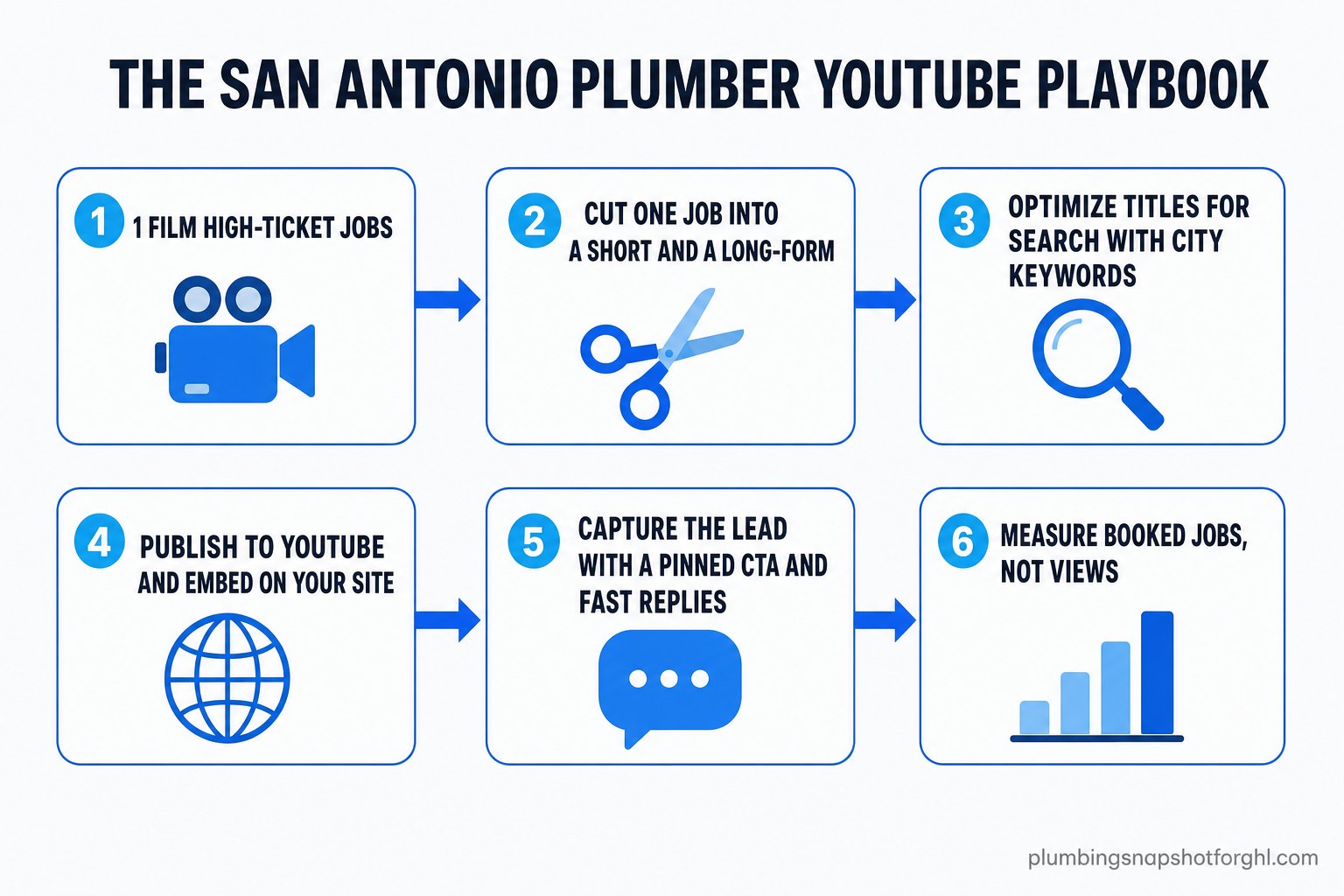
One filmed job becomes two assets: a Short that gets discovered, and a long-form video that gets searched. They do different jobs, and you need both.
- The Short (30–60 seconds, vertical). The hook. A tight cut of the most satisfying moment — the hydro-jet breaking through, the corroded tank hauled out, the leak found under the slab. Shorts are your reach engine, tapping into that 200-billion-daily-view feed to put you in front of homeowners who’ve never heard of you.
- The long-form video (3–6 minutes, horizontal). The searchable asset. “How We Replaced a 12-Year-Old Water Heater in San Antonio” or “3 Signs Your Slab Is Leaking.” This is what ranks when someone actively searches the problem, and it’s what you embed on your website.
The Short earns the attention; the long-form earns the trust and the search ranking. Film once, publish twice. If you already run short-form on Instagram or TikTok, this is the same muscle — see our short-form video playbook for the format details that make a plumbing clip travel.
The Short and the long-form aren’t two pieces of content — they’re the same job, cut for two different moments. The Short catches the scroller who didn’t know they needed you. The long-form catches the searcher who already does. Skip either one and you’re leaving half the market on the table.
Step 3: Optimize every video for search
This is the step that separates YouTube-as-marketing from YouTube-as-a-shoebox-of-clips. YouTube is the second-most-visited site in the world and functions as a search engine — so treat every upload like a page you want to rank. That means:
- Keyword-first titles with the city. “Water Heater Replacement in San Antonio, TX — What It Really Costs” beats “Another day on the job.” Put the service and the location where people can read it.
- A real description. Two or three sentences describing the job, the neighborhood or ZIP if relevant, and your service area. Add your phone number and a booking link in the first line.
- Chapters and captions. Timestamps help both viewers and YouTube understand the video. Captions make it accessible and searchable.
- Consistent tags and a playlist per service — “Water Heaters,” “Drain & Sewer,” “Leak Detection” — so YouTube learns what your channel is about.
Do this and your videos start showing up in two places at once: inside YouTube search, and inside Google. Video results surface in roughly half of all Google searches (Semrush, 2025), so an optimized plumbing video can rank on the results page a homeowner already lands on. This is the same local-intent game as your website — if you haven’t nailed that yet, start with our local SEO guide for plumbers.
Step 4: Publish and embed everywhere
A video that lives only on YouTube is working at 20% of its capacity. Once it’s up, put it to work everywhere a homeowner might meet your brand:
- Repurpose the Short across your channels — Instagram Reels, TikTok, Facebook, Google Business Profile. Same clip, sized per platform. This is where a multi-channel content engine earns its keep.
- Embed the long-form video on the matching service page of your website. A water-heater video on your water-heater page keeps visitors watching longer and gives Google a richer, more trustworthy page to rank.
- Add relevant videos to your Google Business Profile so they show up in the map pack and on your local listing.
- Drop them into estimate follow-ups and email — “Here’s a video of the exact repair we quoted.” It closes hesitant homeowners.
One filmed job, optimized once, now shows up on YouTube search, Google search, your website, your social feeds, and your local listing. That’s the compounding leverage video has over a static photo post.
Step 5: Capture the lead the video created
Views don’t pay — booked calls do, and the gap between them is response speed. A homeowner who watches your slab-leak video and comments “do you service Boerne?” is a lead with their hand up. If nobody answers for two days, that job books with someone else. Speed is the whole game: 78% of customers buy from the business that responds first, and replying within five minutes makes a lead 21× more likely to convert (Lead Response Management Study, MIT).
So build the capture in:
- Pin a comment and put a CTA in the description — “Book a visit: [link]” and your phone number — on every single video.
- Answer every comment and DM fast, on-brand, and push to book. On emergency work, the fastest reply wins the call.
- Route it to a real calendar. The homeowner should be able to book without a phone-tag loop.
This is exactly where most shops leak the reach they earned. An AI website chat widget and Instagram & Facebook DM automation answer in seconds and book straight onto your calendar, so the intent your videos create doesn’t cool off overnight.
Step 6: Measure booked jobs, not views
Treat YouTube as a lead channel, not a popularity contest. A video with 40,000 views and no booking mechanism is a billboard nobody can act on. The number that matters is jobs booked, so track the full path:
- Which videos and searches send people to your booking page.
- Calls and form fills tagged to “found us on YouTube.”
- Booked jobs and revenue from video, reviewed monthly.
When you know that your water-heater video books three calls a month, you know exactly which job to film next. That’s the difference between “we tried YouTube once” and a channel that quietly books work every week. If you’re still building the lead fundamentals underneath all this, our guide on how to get more plumbing leads is the place to start.
Share of U.S. adults who use each platform. Source: Pew Research Center, 2024.
The catch: this is a second full-time job
Most San Antonio plumbers don’t have a YouTube problem — they have a time problem. The strategy above is simple. The workload is not. Filming one job is easy. Editing it, cutting a Short and a long-form, writing keyworded titles and descriptions, adding captions and chapters, uploading, repurposing across nine channels, embedding on your site, and then answering every comment and DM within minutes — that’s a part-time job you don’t have while you’re under a sink in Stone Oak.
That’s why plumbing shops start a channel strong and go dark by video four. The platform rewards consistency, and consistency is exactly what a two-truck operation can’t sustain by hand.
This is the specific gap a done-for-you plumbing social media service closes. Instead of you becoming a video editor, a real content engine ships the work every week:
- Short-form video, carousels, and posts every week, published five days a week across all 9 channels — including YouTube — one brand voice, sized correctly for each.
- AI comment, DM, and web-chat agents that answer “do you service my area?” in seconds and book the job onto your calendar 24/7.
- A monthly report on reach, engagement, and the number that matters — leads and jobs booked.
Because you get dozens of shots at a breakout clip instead of one, the odds of a video genuinely taking off and flooding your phone go way up. In the trades, that happens — and it only takes one.
The plumbers who own San Antonio’s search results in 2026 won’t be the biggest shops — they’ll be the ones whose face a homeowner already recognizes from a video before the emergency ever hits.
Frequently asked questions
YouTube for San Antonio plumbers — FAQ
Does YouTube actually get plumbers jobs, or just views?
It books jobs when you build in the capture. YouTube reaches 85% of U.S. adults and 85% of consumers say a video convinced them to buy (Pew, 2024; Wyzowl, 2026). The jobs come from pairing that reach with a booking CTA and fast replies — video earns the attention, speed-to-lead closes it.
Should San Antonio plumbers post Shorts or long-form videos?
Both, from the same filmed job. Shorts are the discovery engine — YouTube Shorts hit 200 billion daily views in 2025 (YouTube via TheWrap) — so they reach homeowners who don't know you. Long-form videos are the searchable, embeddable assets that rank when someone actively searches a problem like 'water heater replacement San Antonio.'
How do I get my plumbing videos to show up in search?
Optimize each one: a keyword-first title with the service and city, a real description with your service area and a booking link, captions, chapters, and a playlist per service. Video results appear in roughly half of Google searches (Semrush, 2025), so an optimized video can rank in both YouTube and Google.
What should a San Antonio plumber film?
The high-ticket, high-search work: water heater replacements, slab leak repairs, drain cleaning and hydro-jetting, sewer camera inspections, and repipes. Show the diagnosis, the problem, the fix, and the clean result. One filmed job a week is enough to build a library that keeps working for years.
I don't have time to shoot and edit video. What are my options?
That's the real bottleneck for most shops, not ideas. A done-for-you social media service handles the editing, captions, keyworded titles, publishing across all 9 channels including YouTube, and runs AI agents that answer comments and DMs — so you stay on the tools while the content ships. Plans start at $397/mo.
About the author
Yvonne Castellanos runs partner success for agencies that resell the Plumbing Snapshot for GHL to local shops, and she has onboarded contractors from solo owner-operators to regional outfits. Her focus is the boring money: review pipelines, retention automations, and the social and content systems that keep a plumbing brand booked between emergencies. She writes case-grounded playbooks for operators who want the marketing done for them.