

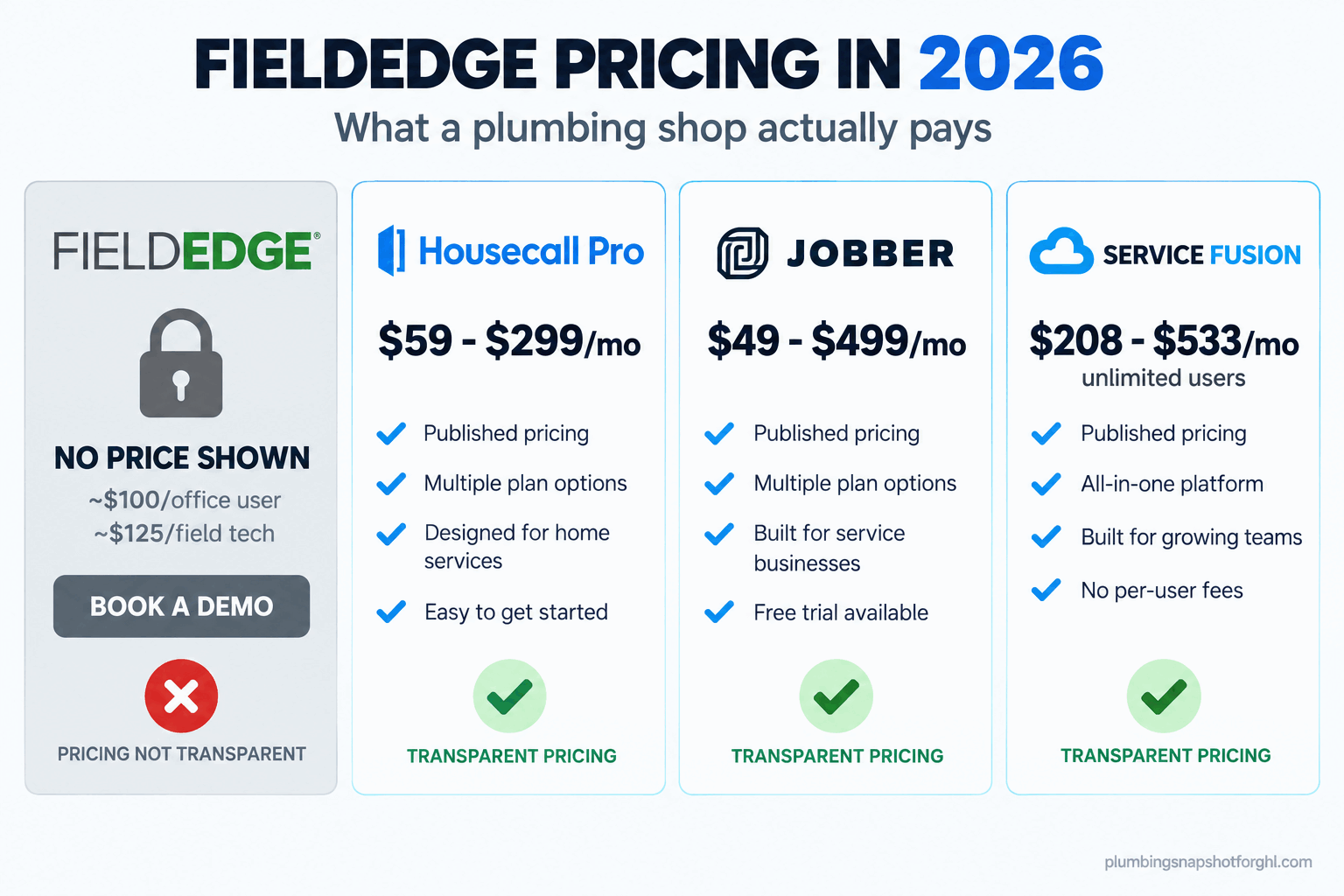
FieldEdge does not print a price anywhere on its site. Every plan ends at “Book a demo,” so here is the real number from reviewer reports: roughly $100 a month per office user and $125 a month per field technician, with no free trial, a mandatory five-week onboarding, and a one-time setup fee that runs $500 to $2,000 (ITQlick puts onboarding as high as $10,000). A real three-truck shop with a dispatcher lands near $475 a month in seats alone, and once you add GPS and review tools the Year 1 bill clears $11,000. Three competitors, Housecall Pro, Jobber, and Service Fusion, still publish every number, and for a small plumbing shop they are usually cheaper. This is the full teardown: the per-seat math, the costs that never make it into the quote, what three shop sizes actually pay, and the one email that forces a real number out of any rep.
In this guide
- The quote that was never on the page
- What hiding the price actually costs you
- What does FieldEdge actually cost in 2026?
- The costs that never make it into the quote
- What FieldEdge costs at three shop sizes
- The alternatives that still publish a price
- How a software switch actually goes wrong
- Staying legal when you automate the phone and the texts
- Steal this: the email that forces a real quote
- Objections
- Frequently asked questions
- About the author
The quote that was never on the page
It is a Tuesday night. The trucks are back, the invoices are half-done, and you sit down to price the field service software a supply-house rep keeps mentioning. You open the FieldEdge site, look for pricing, and there is nothing to look at. Three plan names, a wall of feature checkmarks, and the same button under each: “Book a demo.” No number, not even a “starting at.”
So you fill out the form and now you own a calendar invite for a 45-minute call and a rep who texts you until you take it. By the end of that call you still will not have a clean price. You will have a “package built for your shop,” which is sales talk for a number shaped to whatever you let slip about your revenue.
FieldEdge has been around for decades and it is a capable platform, especially for HVAC shops that live on service agreements. That is not the problem. The problem is you cannot budget against a price you are not allowed to see. So let us put the number back on the page.
What hiding the price actually costs you
The Bureau of Labor Statistics puts the plumbing median wage at $63,800 a year, or $30.67 an hour, as of May 2025, with employment of 510,600, projected growth of 7% through 2035, “much faster than the average for all occupations,” and about 42,000 openings a year (BLS Occupational Outlook Handbook). Your margin is made on how cleanly you run the back office, and software should protect it, not quietly eat it.
The demo wall works against you in one way. When you cannot see a price, you cannot compare on price, so the conversation moves to features, where the rep has the advantage. The vendors that print the number hand that lever back.
What does FieldEdge actually cost in 2026?
The caveat goes on the front: every figure here is a reviewer estimate from 2026 research, not a FieldEdge quote, because the pricing page lists no dollar amounts and review sites confirm it is quote-only (SelectHub, Capterra). The reported picture is consistent.
- FieldEdge uses per-user pricing, split by role. Office users (dispatchers, managers, CSRs) run about $100 a month each, field technicians about $125 a month each (Toricent Labs), with reviewers putting the overall range near $100 to $200 per user (ITQlick).
- The tiers (Select, Premier, Elite) mostly change features, not the per-seat rate. The lever that moves your bill is headcount, not which plan you pick (Toricent Labs).
- There is no free trial, so you cannot test it with your own data before you commit (Toricent Labs).
The seat math is simple. One dispatcher and three field techs is $100 plus three times $125, or $475 a month, before a setup fee or a single add-on. That is already more than most small plumbing shops expect.
The costs that never make it into the quote
The per-seat number is the part reps eventually say out loud. The rest of the bill is where shops get surprised.
The setup fee. A one-time implementation fee, reported at $500 to $2,000, with ITQlick’s estimate running far higher at $2,000 to $10,000 (Toricent Labs, ITQlick). Get it in writing; it is the most variable line in the quote.
The five-week onboarding. A mandatory onboarding of about five weeks covering migration, configuration, and training (Toricent Labs). That is five weeks before the tool pulls its weight, which matters if you switch mid-season.
GPS tracking. A third-party add-on, commonly FleetSharp, at roughly $25 per vehicle per month (Toricent Labs). Five trucks is another $125 a month.
Review tools. No strong native review engine, so shops bolt on Podium or similar at $249 a month and up, more than an entire Housecall Pro plan (Toricent Labs).
The annual contract. Reviewers report annual plans do not refund early cancellation and that shops get caught by auto-renewal (Toricent Labs). Read the term and the renewal clause before you sign.
For a five-technician shop with one dispatcher, the subscription alone is five techs at $125 plus one office seat at $100, or $725 a month. With a midpoint setup fee and GPS on five trucks, the real Year 1 cost looks like this:
Estimated FieldEdge Year 1 cost, 5-technician shop with 1 dispatcher (reviewer estimates). Setup shown at the $1,250 midpoint of the reported $500 to $2,000 range. Source: Toricent Labs.
That is roughly $11,450 in Year 1 before SMS credits, card fees, or the review add-on, which tracks with the $11,900 to $13,400 range one teardown ran for a similar setup.
What FieldEdge costs at three shop sizes
Per-user pricing changes character with your truck count, so run it three ways, using the reported seat rates as a planning range.
Solo or two-truck owner-operator. You are dispatcher and tech, so you pay for at least two seats, often three with an office helper. Call it $225 to $350 a month in seats, plus setup and GPS. For one or two trucks that is a steep entry, and exactly where the published-price tools (Housecall Pro at $59, Jobber at $49) pull furthest ahead.
Growing shop, five techs. The fair fight for FieldEdge. One dispatcher and five techs is about $725 a month in seats, roughly $8,700 a year before setup and GPS. The dispatch board, service agreements, and QuickBooks tie-in start to earn their keep here. Hold it against Service Fusion’s flat unlimited-user price first, because the gap is wide.
Multi-truck, ten to fifteen techs. Now per-seat bites. Three office users and ten field techs is $1,550 a month in seats alone (Toricent Labs), near $18,600 a year before a single add-on. Every hire raises your bill, the trap of per-seat pricing, which we broke down in per-tech versus unlimited-user plumbing software pricing.
The alternatives that still publish a price
No guessing with these three. Every number is on their pages, no form required, and the full all-vendor breakdown lives in what plumbing software actually costs in 2026.
| Software | Published entry price | Top published tier | User model | Shows price without a demo? |
|---|---|---|---|---|
| FieldEdge | Not published (est. $100/office, $125/tech) | Custom (Elite) | Per user + setup fee | No |
| Housecall Pro | $59/mo (Basic, annual) | $299/mo (Max, up to 8) | Per plan + $35/extra user | Yes |
| Jobber | $49/mo (Core, 1 user) | $499/mo (Plus, 15 users) | Per plan + $29/extra user | Yes |
| Service Fusion | $208/mo (Starter, annual) | $533/mo (Pro, annual) | Unlimited users | Yes |
| ServiceTitan | Not published (est. $245 to $500/tech) | Custom | Per technician | No |
Sources: Housecall Pro, Jobber, Service Fusion. FieldEdge estimate via Toricent Labs. ServiceTitan estimate via G2. FieldEdge and ServiceTitan do not publish base rates.
Housecall Pro ($59 to $299 a month, extra seats $35, Essentials at $149 for five users) is the friendliest entry for a solo or two-truck shop and undercuts a FieldEdge seat count by a wide margin (Housecall Pro). We put it head to head with Jobber in Housecall Pro vs Jobber for plumbers.
Jobber ($49 to $499, extra seats $29) sells its AI Receptionist, Marketing Suite, and Pipeline as add-ons at $29, $99, and $49, so price it the way you price FieldEdge: base plan plus the pieces you use (Jobber).
Service Fusion ($208 to $533 a month billed annually) is built for the shop that plans to grow, because every tier carries unlimited users with no contract (Service Fusion). A fifteen-truck shop pays what a three-truck shop pays, and against FieldEdge’s per-seat model that flat price is the whole argument.
ServiceTitan sits behind the demo wall with FieldEdge, estimated at $245 to $500 per technician per month plus a $5,000 to $50,000 implementation fee, and has told the BBB it is not optimized for shops with three or fewer technicians (G2). We tore it apart in what a small plumbing shop actually pays for ServiceTitan.
Here is what a five-technician plumbing shop pays per month across the field, using each vendor’s closest comparable plan:
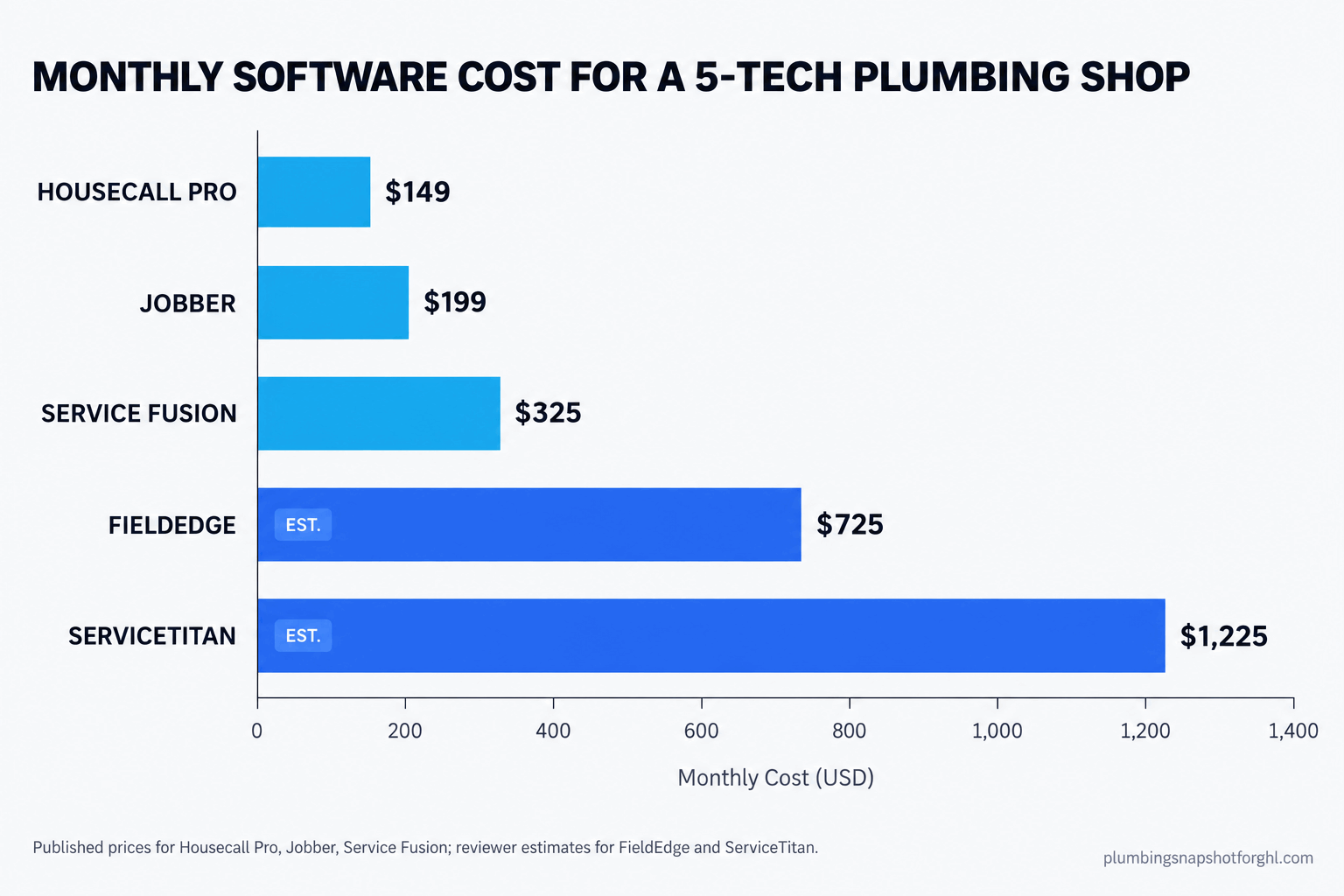
Estimated monthly cost for a 5-technician plumbing shop, closest comparable plan per vendor. Housecall Pro, Jobber, and Service Fusion are published prices; FieldEdge and ServiceTitan are reviewer estimates. Sources: Housecall Pro, Jobber, Service Fusion, Toricent Labs, G2.
For a five-tech shop the transparent tools are two to five times cheaper than the demo-wall platforms, and you can confirm it before anyone calls you.
How a software switch actually goes wrong
Most of the pain of changing software is not the subscription. It is the switch, and these are where it breaks.
The data migration stalls. Your customer list, job history, and open invoices have to move. FieldEdge’s five-week onboarding exists because this is hard, and a migration done wrong means missing equipment records your techs need on the truck. Ask who does it, how long it takes, and what happens to records that do not map cleanly.
You get locked into a term you cannot test. With no free trial, you commit to a year on the strength of a demo, and reviewers report early cancellation is not refunded. Negotiate a shorter initial term or a documented exit first.
The phone still is not answered. FieldEdge schedules and dispatches, but it does not answer the 11 PM burst-pipe call that rings while you are asleep. That gap is why missed after-hours calls quietly cost plumbing shops real money, and it is a separate problem from dispatch software.
Staying legal when you automate the phone and the texts
The moment you automate dispatch texts, “tech is on the way” messages, and review requests, you take on compliance. Three things trip plumbing shops up in 2026, none optional.
Your license number has to be in your advertising. In California, the contractor license number must appear in every advertisement (website, social, business cards, vehicles), and C-36 plumbing contractors must display the company name and license number in letters at least 1.5 inches tall on both sides of every registered truck, with civil penalties from $100 to $5,000 (CSLB). Nevada requires it in all advertising too (Nevada State Contractors Board), and most owners do not know their new website has to carry it.
Texting requires consent (TCPA). You need prior express consent before automated texts, and every message needs a clear opt-out. It is federal, it covers review requests and reminders, and the fines are per message. The consent language is in TCPA compliance for plumbers.
Your texting number has to be registered (A2P 10DLC). Carriers require business texting campaigns to be registered, and as of June 30, 2026 that registration must include a live PrivacyPolicyUrl and TermsAndConditionsUrl (The Campaign Registry). An unregistered number gets its messages filtered or blocked, so the automation you paid for silently stops working.
The full checklist, with sample opt-in copy, is in our plumbing marketing compliance guide for 2026.
Steal this: the email that forces a real quote
You should not have to sit through a demo to get a budget. Send this to any demo-only rep, FieldEdge or otherwise, and you usually get a real number back in one reply, because every question is easy to answer in writing.
Subject: Quote request, [Your Shop Name], before we schedule a call
Hi [Rep], we run [X] trucks and [Y] office staff and we are comparing three platforms this week. Before a demo, I need these in writing so I can budget:
- Exact monthly price per office user and per field technician, on the plan you would put us on.
- The one-time setup or implementation fee, as a figure or a range.
- Contract length, plus cancellation and auto-renewal terms.
- Which of these are extra and what each costs: GPS, review tools, SMS or call credits, and card-processing rates.
- Whether there is a free trial or pilot.
Send those five and I will book the demo the same day. Thanks, [Your Name]
If a vendor will not put those five answers in writing, you have learned something about how the rest of the relationship will go.
Objections
“I already pay for FieldEdge, is switching worth it?” Maybe not, if you are a growing HVAC-heavy shop that lives on service agreements. But if you are a small residential plumbing shop paying per seat for features you do not touch, run the all-in number against a published-price tool for your headcount. The gap in the chart above is the size of the raise you are leaving on the table.
“Do I need to be technical to run any of this?” No, and that is the real question hiding behind the demo. The heavier the platform, the longer the onboarding, which is why FieldEdge runs five weeks. A tool your techs will actually use beats a more powerful one they route around.
“What about my data if I leave?” Ask before you sign, in writing: can you export your customer list, job history, and invoices, and in what format. Demo-wall vendors rarely volunteer this, and it decides whether you are ever free to switch again.
Frequently asked questions
How much does FieldEdge cost per month?
FieldEdge does not publish prices, so figures come from reviewer research: about $100 per office user and $125 per field technician per month, with an overall range near $100 to $200 per user. A one-dispatcher, three-tech shop runs about $475 a month in seats before setup fees and add-ons (source: Toricent Labs FieldEdge pricing research).
Does FieldEdge have a free trial?
No. Reviewers confirm there is no free trial, so you commit based on a demo rather than testing it with your own data first. Ask for a short initial term or a documented pilot if you want a way out.
Why doesn't FieldEdge show its pricing online?
Like ServiceTitan, FieldEdge routes every plan to a demo request instead of a published price. Vendors hide the number when seeing it cold would send a buyer shopping. Housecall Pro, Jobber, and Service Fusion publish theirs in full.
What are the hidden costs of FieldEdge?
Beyond the per-seat subscription: a one-time setup fee of $500 to $2,000 (ITQlick estimates up to $10,000), a mandatory five-week onboarding, GPS at about $25 per vehicle per month, and a review tool like Podium at $249 a month and up. A five-tech shop clears $11,000 in Year 1.
What is a good FieldEdge alternative for a small plumbing shop?
For one to five trucks, Housecall Pro ($59 to $299) and Jobber ($49 to $499) are far cheaper and publish every number. Service Fusion ($208 to $533) is better if you plan to grow, because every tier includes unlimited users with no contract.
Does FieldEdge answer my phone after hours?
No. FieldEdge handles scheduling, dispatch, and invoicing, but it does not answer the after-hours emergency call that rings while you are asleep. That is a separate system, and missed after-hours calls are one of the biggest quiet revenue leaks for a plumbing shop.
The trucks are back and the invoices are nearly done. You opened FieldEdge to get a price and got a calendar invite instead. Now you have the number anyway, the all-in math for your headcount, and a short email that pulls a real quote out of any rep without the 45-minute call. Price every tool the same way, all-in for your exact shop, and the demo wall stops being a wall. It becomes a tell.
Every one of these platforms, ours included, runs on a CRM. To see the one our system is built on, you can start a GoHighLevel account here. That is an affiliate link, so we may earn a commission at no extra cost to you.