You tried to take your kid to a Saturday game. By the second inning your phone had three missed calls, a text from a tech who couldn’t find the shutoff, and a customer asking why nobody had sent the quote you promised Thursday. You left at the fifth inning. You always leave at the fifth inning. If every call, booking, price, and invoice has to pass through you before it happens, you don’t own a plumbing business. You own a job that pages you on weekends, and it will keep paging you until you build the systems that do your job when you’re not there. The good news: there are only six, and each can be handed off. This is how.
In this guide
- What owner-dependence is actually costing you
- The six jobs that keep you in the truck
- Job 1. Answering the phone
- Job 2. Booking the job
- Job 3. Dispatching the tech
- Job 4. Pricing the work
- Job 5. Collecting the money
- Job 6. Following up
- Your real job now: the scoreboard
- Solo, 5-truck, and 15-truck
- Steal this: the SOPs that replace you
- Objections, answered straight
- Frequently asked questions
What owner-dependence is actually costing you
The money you can see: every hour you spend answering the phone, typing a quote, or chasing an invoice is an hour you’re not billing. Do $25-an-hour admin and you’re paying a master-plumber salary for it.
Then there’s the money you can’t see. The call that rings out while you’re under a sink. The 9 PM emergency that hits voicemail because you were asleep. Those aren’t small jobs: water damage and freezing is the second most common home insurance claim behind wind and hail, averaging $15,400 across 2019 to 2023 (Insurance Information Institute), and the person whose basement is filling calls the next number on the list the second you don’t pick up. The demand is not your problem: plumbing pay sits at $63,800 and employment is projected up 7% through 2035 (BLS). Being the only one who can answer is.
And there’s the money at the end. A shop that only works when you’re standing in it is worth far less the day you try to sell, because a buyer is buying your judgment, not a company.
Typical valuation discount business brokers apply to an owner-dependent small business, percent off enterprise value (Viking Mergers).
The fix for all three is the same: get the jobs out of your head and into a system.
The six jobs that keep you in the truck
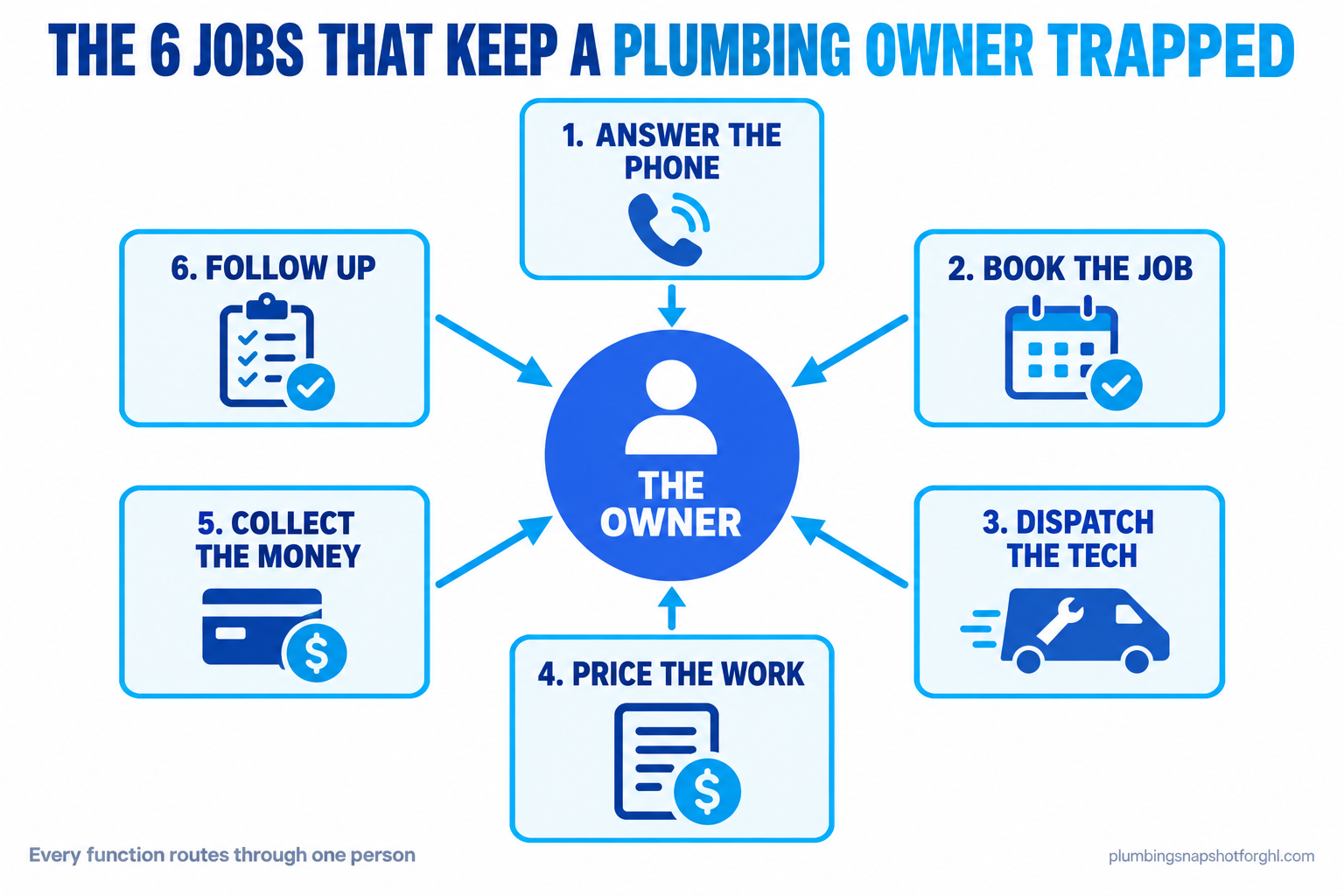
You don’t have a hundred things keeping you trapped. You have six. Everything that pulls you off a job or wakes you at night is one of these:
- Answering the phone when a customer calls.
- Booking the job onto the schedule.
- Dispatching the tech to the right address with the right info.
- Pricing the work so the number is right and consistent.
- Collecting the money and closing the job out.
- Following up for the review, the next job, and the ones that didn’t book.
Hand each to a system, a person, or both, in order, because the early ones feed the later ones. Do one, prove it runs without you, then start the next.
Job 1. Answering the phone
This one owns your life, so fix it first. Right now you are the answering service, the voicemail, the 2 AM line. That stops now.
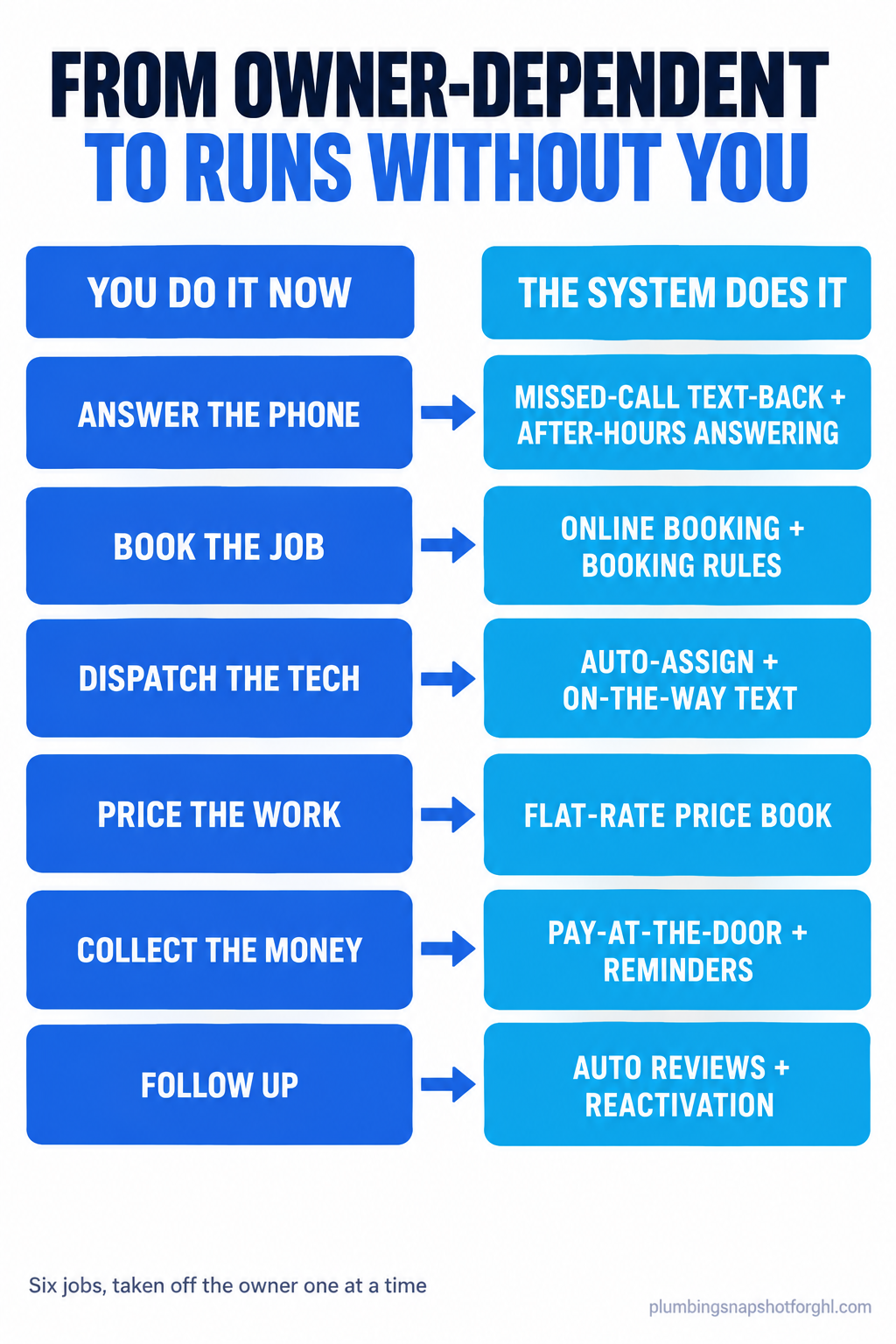
The system that replaces you. Every call gets answered or captured within seconds, whether you’re asleep, on a roof, or at the game. During the day, an answering setup or a trained person picks up. The moment a call is missed, an automatic text fires back. After hours, an after-hours answering setup or an AI receptionist takes the details and books or escalates true emergencies. No call hits a dead voicemail, because that’s a customer dialing your competitor. The missed-call text-back is the highest-ROI message in the shop, and the first to reply wins the job.
How it breaks. You set up the text-back but route the reply to a line nobody watches, so the customer gets silence, which is worse than voicemail. Build the catch and the follow-through together, or don’t bother.
Job 2. Booking the job
The next trap: only you know how to say yes, which Tuesday is open, which jobs you’ll take, what to tell the customer. So every booking waits for you.
The system that replaces you. Put the calendar where the customer and your team can both see it, with rules that make the decision for them. Online booking lets a customer grab a real slot without a call. For calls, a simple booking card tells whoever answers what to ask and offer: the service area, the job types you take, the after-hours deposit, the arrival windows. The rules decide, not you.
How it breaks. You let people book anything, anywhere, anytime, so the schedule fills with low-value jobs an hour apart and your techs drive all day. Set the geography and job-type limits, or the open calendar eats your margin in windshield time.
Job 3. Dispatching the tech
The jobs are booked, but you’re still deciding who goes where, texting addresses, and fielding the “where do I park” call. You’re a human router, a full-time job on top of your real one.
The system that replaces you. A real dispatching and scheduling system assigns jobs by location and skill, sends the tech the address and notes automatically, and texts the customer an “on the way” message without you touching it. The tech sees their day on their phone, the customer knows who’s coming, and you watch one board and step in only for the exception.
How it breaks. You buy dispatch software but keep making every assignment by gut because “the system doesn’t know the customers like I do.” Now you’re still the bottleneck, just with a monthly bill. Teach the rule once, let it route the easy 90%, and save your judgment for the rest.
Job 4. Pricing the work
This is the one owners guard hardest. You believe only you can price a job right, and that’s true today because the pricing lives in your head, which is exactly the problem.
The system that replaces you. A flat-rate price book puts a set, tested price on every common job, so any tech quotes the same number you would. It makes the price consistent and kills the awkward on-the-spot math that makes customers nervous. You set the prices once, in a book, instead of one call at a time forever.
How it breaks. You build the book and then undercut it yourself on the phone, so techs learn the book is fake and go back to calling you. If the book is the price, it’s the price for you too. For why the person at the door matters as much as the number, see why your plumbers don’t sell.
Job 5. Collecting the money
The job’s done, the customer’s happy, and the invoice sits unsent for a week because you were the only one who could send it. Now you’re a bank, lending labor and parts interest-free while you chase payment on your nights off.
The system that replaces you. Collect at the job, not from the office. The tech takes payment on their phone before they leave. The invoice, card reader, and receipt all live in the tech’s hand. For jobs that go to invoice, an automatic reminder sequence chases the balance so you never personally text “just following up” again. The full playbook is in how to get paid faster.
How it breaks. You roll out pay-at-the-door but stay the only one who can send a receipt or take a card by phone, so half the collections still route back to you. Give every tech the ability to close out a job, money included.
Job 6. Following up
This job never gets done, because it’s always what you’ll do “when things slow down,” and things never slow down. So reviews don’t get asked for, past customers never hear from you, and unsold estimates just vanish, every week.
The system that replaces you. Three automatic sequences. First, a review request that fires the same day a job closes, while the customer is still glad you came, and doubling your review pipeline is mostly a timing problem a system solves perfectly. Second, a database reactivation sequence that reaches back to past customers for maintenance and seasonal work. Third, a follow-up on unsold estimates, because a quote the homeowner sat on often closes with one nudge.
How it breaks. You blast review requests at everyone, including the one unhappy customer, and invite a public one-star. Route the ask by outcome: happy customers to the public review, anyone who hints at a problem to a private “how did we do” first. A system should protect your reputation, not gamble with it.
Your real job now: the scoreboard
When the six jobs run on their own, you’ll feel useless for about a week. That feeling is the goal. Your job was never answering phones and sending invoices. It’s to own the business: watch the numbers, fix the one that’s off.
Pick five and read them weekly: calls answered versus missed, jobs booked, average ticket, collections outstanding, and reviews added. Missed calls spike, you fix Job 1. Collections balloon, you tighten Job 5. You run the shop from five numbers instead of the passenger seat of a van, starting with these plumbing business KPIs.
Solo, 5-truck, and 15-truck
The six jobs are identical at every size. What changes is who or what you hand each one to.
Solo owner-operator. Your first hire is software, not a person. Automate Jobs 1, 5, and 6 first: the missed-call catch, pay-at-the-door, and the review and reactivation sequences. Those buy back the most hours for the least money and need no second human. Booking and dispatch stay simple because it’s just your calendar. The win isn’t a day off yet, it’s your evenings back and no more lost after-hours emergencies.
Five-truck shop. Now you’re the bottleneck at dispatch and pricing, and it’s costing payroll. Put in a real dispatch system so you’re not routing by text, and get the flat-rate book live so any tech can quote. This is where your first office hire pays for itself, but only if they have systems to run. Build the SOP first, then hire to it, or you move the bottleneck into their chair (how to hire plumbers).
Ten-to-fifteen trucks. The trap here isn’t doing the six jobs, it’s that everything still escalates to you. You need a layer between you and the work: a dispatcher who owns the board, a lead tech who owns pricing, and an office manager who owns collections. Your job collapses to the scoreboard and the exceptions. An owner still answering phones at this size is leaving six figures of their own time on the floor.
Steal this: the SOPs that replace you
Copy these, change the names, and put them in front of whoever answers the phone.
The missed-call text-back (fires within 60 seconds):
“Hi, this is [Shop Name]. Sorry we missed your call. We’re likely on a job. Reply here with your address and what’s going on and we’ll get you scheduled today. For an active emergency like a burst pipe or no water, reply URGENT and we’ll call you right back.”
The booking rules card (tape it by the phone):
- We serve [these zip codes]. Outside that, take the number for a callback.
- We book: service calls, water heaters, drain and sewer, repipes. We don’t book: [new construction, commercial].
- Offer the first open two-hour window. Never promise an exact time.
- After-hours and weekend calls take a [$X] dispatch fee at booking.
- Always get: name, address, phone, and one line on the problem.
The dispatch rule (one sentence, so nobody waits on you):
“Next available tech closest to the job takes it, unless it’s a [water heater / sewer / gas] job, which goes to [name], and anything after 6 PM goes to whoever’s on call this week.”
The pricing guardrails (so the book holds):
- The flat-rate book is the price. Techs quote from it, owner included.
- Present three options: a fix, a better fix, and the full replacement. Let the customer choose.
- Say the price plainly, then stop talking: “The repair is $X, the replacement is $Y.” Silence after the number is the tech’s job.
The payment-at-the-door line (every tech, every job):
“All done and tested. Your total is $X. I can take a card, tap, or check right here on my phone and text you the receipt. Which works?”
The three-step invoice reminder (for jobs that go to invoice):
- Day of: “Thanks, here’s your invoice and a pay link.”
- Day 3: “Reminder: your invoice for [job] is open, here’s the link.”
- Day 7: “Your balance for [job] is still open. Reply here if there’s an issue, otherwise here’s the link to close it out.”
The same-day review request (happy customers only):
“Thanks for choosing [Shop Name] today. If [tech] took good care of you, a quick review really helps a small local shop. Here’s the link, takes 30 seconds: [link].”
The reactivation opener (to past customers, seasonally):
“Hi [name], it’s [Shop Name]. Your water heater’s getting up there in age and winter’s coming. Want us to swing by for a quick check before it fails on a cold morning? Reply YES and we’ll find a time.”
Note on texting: automated customer messages have consent rules under the TCPA, so collect permission to text at booking and keep the automated messages about the job (FCC telemarketing rules).
Objections, answered straight
“Nobody can price a job the way I can.” True today, and that’s the trap, not the proof. Only you can price it because the pricing is in your head, not written down. Build the flat-rate book once and any trained tech quotes like you. Your judgment then goes to the weird jobs the book doesn’t cover.
“My customers want to deal with me, not a system.” They want their problem solved fast by someone they trust. A missed call at 8 PM doesn’t feel personal, it feels like you don’t care. A text back in 60 seconds and a tech who shows up on time feels like a shop with its act together. The system isn’t a wall, it’s how you keep the promise you can’t personally keep 24 hours a day.
“I can’t afford to hire right now.” Then don’t hire first. Your first hire is software, and it’s cheaper than a part-time employee. Automate the phone catch, pay-at-the-door, and the follow-up before you add a person, so they step into running a system instead of inventing one.
“My shop’s too small for all this.” Small is when owner-dependence hurts most, because there’s no one to cover you. A ten-truck shop survives the owner taking a week off. A solo operator’s whole business goes dark. Right now you are the only point of failure.
Frequently asked questions
How do I make my plumbing business run without me?
Take the six owner-trapping jobs off yourself one at a time: answering the phone, booking, dispatch, pricing, collections, and follow-up. Replace each with automation, a trained person, or both, and write the rules down so the decision no longer lives only in your head. Start with the phone, then work down the list as each one proves it runs on its own.
What's the first thing I should automate as a solo plumber?
The phone. A missed-call text-back that fires within 60 seconds plus an after-hours answering setup, so no emergency ever hits a dead voicemail. For a solo operator this one change recovers the most money and the most evenings and requires no hiring. After that, automate pay-at-the-door collections and review requests.
Won't I lose control if the business runs on systems?
You trade control over every tiny decision for control over the whole business. Instead of approving each booking and quote, you set the rules once and read five numbers a week, then step in when one is off. That's more control, not less, because you can finally see the whole shop at once.
How much does owner-dependence lower what my plumbing business is worth?
Business brokers commonly discount an owner-dependent small business by 20% to 40%, and some buyers pass entirely, because they'd be buying your judgment rather than a company that runs on its own. The systems that let you take a week off are the same ones that make the business sellable, so the work pays off whether you sell or not.
Do I need software to do this, or can I just hire people?
Both, in the right order. Hiring a person to do a job that only exists in your head just moves the bottleneck into their chair. Document the rule first, even a five-line card by the phone, then automate it or hire someone to run it. For a small shop, software is usually the cheaper first hire, and it takes a few months to get the owner out of the day-to-day, one function at a time.
Yvonne builds the retention, review, and reactivation systems inside the Plumbing Snapshot and helps owner-operators get out of the day-to-day without the shop skipping a beat. Related reading: online booking for plumbers, the plumbing dispatching and scheduling system, and how to get paid faster as a plumber.